How Can Web Scraping Technology Help the Finance Industry?
Web scraping automates the extraction and aggregation of financial data, makes it easier to find stocks, and allows you to predict the market based on the information.

Yahoo Finance publishes quotes, price history, statistics and company profiles for symbols across dozens of exchanges. We collect what is public, on your schedule, and hand it over clean.
Plans from €169/month · Free project assessment · Reply within 1 business day
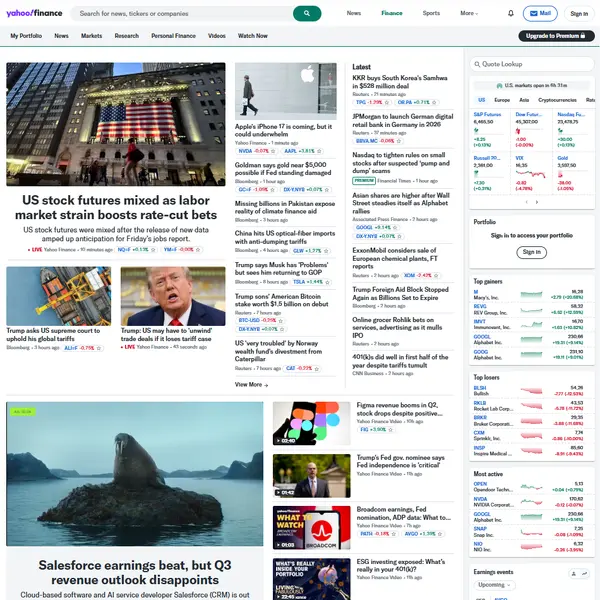
You send a symbol list and the tabs you want. ScrapeIt configures a dedicated crawler with parsing logic written for Yahoo Finance specifically, with no third-party API in the middle, and returns a sample for review before the full run.
Scheduling follows the cadence of the data rather than a default. Quote fields move intraday and can be pulled several times a day. Financials only change on the reporting calendar, so a quarterly sweep is usually enough. Profiles change rarely. We watch the layout, and when Yahoo moves a field we repair the parser instead of sending you a column of nulls.
The quote page for a symbol carries a fixed block of summary fields. We parse them as labelled, without renaming or deriving anything:
Output is CSV, Excel, JSON, or another format that works best for your systems and workflow. Every row carries the symbol, the source URL and the capture timestamp, because a market data table with no capture time cannot be reconciled later against anything.
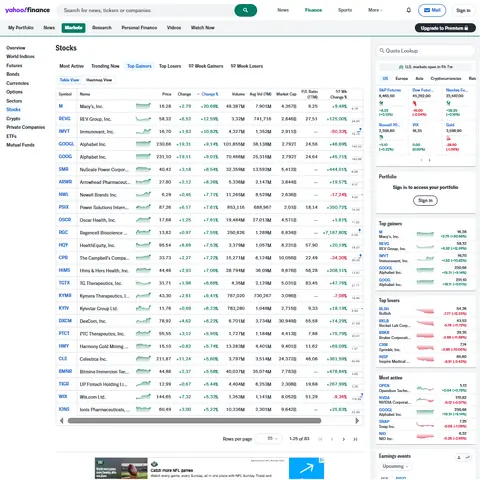
Three things break financial datasets quietly, and all three apply here.
Symbology. A ticker is only unique inside an exchange. Yahoo disambiguates with a suffix on the symbol: .L for the London Stock Exchange, .TO for Toronto, .DE for XETRA, .PA for Euronext Paris, .AX for the ASX, .HK for Hong Kong, .MI for Milan, .F for Frankfurt. Joining a Yahoo pull to any other source means mapping those suffixes onto whatever identifier that source uses. We deliver the symbol exactly as Yahoo publishes it and never guess at the mapping silently.
Corporate actions. The history tab publishes a close and an adjusted close, and emits split and dividend rows of its own. Build a series on the unadjusted close, let a split land mid-window, and the chart shows a collapse that never happened. We take the adjustment rows alongside the prices so the break is visible rather than inferred.
Delay. Yahoo's own tables put London and the ASX at 20 minutes, XETRA, Paris and Hong Kong at 15, Buenos Aires and the Swiss exchange at 30, while Toronto and the main US venues are listed as real time. Pages carry a Delayed Quote label and an as-of stamp. Anything we capture is a snapshot of a page at a moment, and it inherits that page's delay.
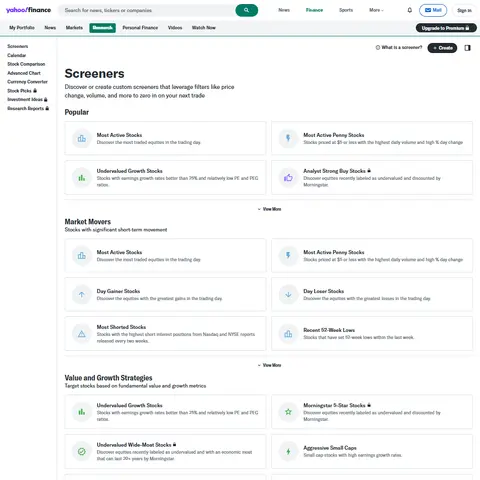
Yahoo Finance launched in 1997 and runs on a single global domain, finance.yahoo.com, in English, with most of its audience in the United States. It covers equities, funds, indices, currencies, commodities and crypto behind one URL pattern, /quote/{SYMBOL}/, with tabs for history, profile, key-statistics, financials, analysis, holders, options, earnings and news hanging off it.
The thing to understand before planning any collection is that Yahoo Finance is a publisher, not a primary source. Its own help pages credit Morningstar for financial statements and valuation data, S&P Global Market Intelligence for company profiles and analyst data, LSEG Data and Analytics for economic events and insider transactions, Commodity Systems, Inc. for US equities and global index data, and Wall Street Horizon for global corporate events. Institutional holder data is credited to Vickers, corporate governance scores to Institutional Shareholder Services, upgrades and downgrades to Benzinga. Yahoo aggregates and presents it. It does not originate most of what it shows.
What a collection project gets is that presentation layer for all of those sources at once: one symbol, one set of tabs, and every row delivered with the symbol, the source URL and the capture timestamp.
Get a Quote
Developers

Customers worldwide

Pages extracted

Hours saved for our clients
€199 / one-time
setup fee - included
€169 / mo
setup fee €499
€229 / mo
setup fee €499
€349 / mo
setup fee €499
€549 / mo
setup fee €799
Delivery: CSV, JSON or XLSX files, our API or a JSON feed. MCP server on request.
Full plan details →The honest reason to scrape Yahoo Finance is breadth for low effort. One page template covers equities, funds, indices, currencies and commodities across dozens of venues, and the same parser handles all of them. For a screening list, a research sample, a coverage check or an internal dashboard, one crawler covers the whole symbol list.
Prices need context. Pages carry a Delayed Quote label and an as-of stamp, tickers carry exchange suffixes, and the history tab emits split and dividend rows of its own, so we deliver the symbol exactly as Yahoo publishes it, the adjustment rows alongside the prices and a capture timestamp on every row. We collect only publicly available data - everything a visitor can see on Yahoo Finance - and we collect it legally.
Learn how to use web scraping to solve data problems for your organization

Web scraping automates the extraction and aggregation of financial data, makes it easier to find stocks, and allows you to predict the market based on the information.

Data and analytics are opening the door to uncovering ways to combat financial crime based on smart data. And advanced AI analytics and cognitive techniques, machine learning, and automation will improve the inefficiency of existing investigative processes.

Leveraging advances in technology, the AI-powered web scraper has skyrocketed in demand and is helping to expand capabilities by automating tedious daily tasks and speeding up data collection from thousands of websites several times over.
ScrapeIt runs the Yahoo Finance scraper as a managed service. We build, run and maintain the crawlers and you receive the data. Nothing to install, no infrastructure on your side.
You name the symbols and tabs; we deliver quote fields, price history, key statistics, financials, profiles and any other tab you need as CSV, JSON or XLSX, a database load or an API endpoint we host.
Yes. The ScrapeIt Yahoo Finance API returns quote fields, price history with adjusted close, key statistics, financials and company profiles as JSON from an endpoint we host, refreshed on the schedule you set. The same data also comes as CSV or XLSX files or straight into your database.
Yes. We collect quote fields, price history, key statistics, financials and profiles from pages any visitor can open, without logging in. We collect only publicly available data - everything a visitor can see on Yahoo Finance - and we collect it legally.
CSV, Excel, JSON, or another format that works best for your systems and workflow. Delivery can be a file drop on a schedule, a bucket we write to, or an API we host and keep current for you.
A dedicated crawler with custom parsing logic, built specifically for Yahoo Finance. No third-party API sits in between. A page parser fails visibly when a layout moves rather than returning quietly wrong values, and we repair it instead of sending you a column of nulls.
Yes, on whatever schedule you set. What no scraper can change is the delay Yahoo applies to the page itself. A symbol listed with a 20 minute delay stays 20 minutes behind however often it is polled, and every row carries the capture timestamp.
Step 1 - Make a Request
You share your needs, expectations, and desired timeframe. We’ll suggest the best solution based on your request and budget.
Step 2 - Configuring Custom Web Crawlers
Our specialists configure the crawlers and extract a sample dataset for your review before proceeding with the full-scale extraction.
Step 3 - Collect and Deliver
Once you approve the sample, we launch the project and start full data collection. We gather, filter, and structure the data for easy use, delivering it on time in your preferred format.
Step 4 - Maintain and Support
Our team manages ongoing processes, monitors website changes, and supports all data extraction cycles. We can also help integrate data into your systems or create dashboards to simplify analysis.
Yahoo Finance data from €169/month. Free project assessment, reply within 1 business day.

Scrapeit Sp. z o.o.
10/208 Legionowa str., 15-099, Bialystok, Poland
NIP: 5423457175
REGON: 523384582