How Can Web Scraping Technology Help the Finance Industry?
Web scraping automates the extraction and aggregation of financial data, makes it easier to find stocks, and allows you to predict the market based on the information.

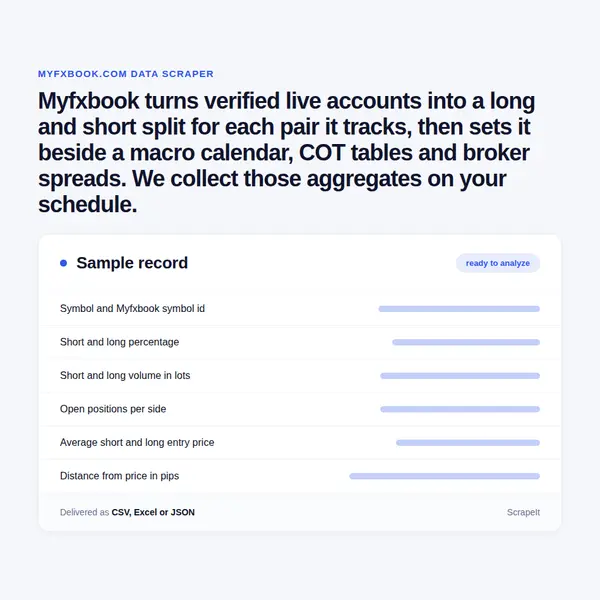
Myfxbook turns verified live accounts into a long and short split for each pair it tracks, then sets it beside a macro calendar, COT tables and broker spreads. We collect those aggregates on your schedule.
A Myfxbook scraping project is planned dataset by dataset, because every one ticks at its own speed. Sentiment is snapshotted at whatever spacing you set and stamped in UTC; calendar rows are polled around scheduled release times so the first Actual is caught; COT is pulled every Friday once the CFTC release is out; historical bars are appended forward to outgrow the site's window of roughly 1,000 points; broker tables are read with the region filter reset to all brokers.
Myfxbook screens traffic through Cloudflare and rejects automated clients before a page loads, which is why anti-bot handling, proxy rotation and CAPTCHA solving come built into every Myfxbook run. Every page we touch is one Myfxbook serves to anonymous visitors: no member logins, no exports behind sign-in, no account API. Files leave as Parquet, CSV, JSON or Excel workbooks, pushed to a bucket or database, or exposed through an endpoint ScrapeIt hosts.
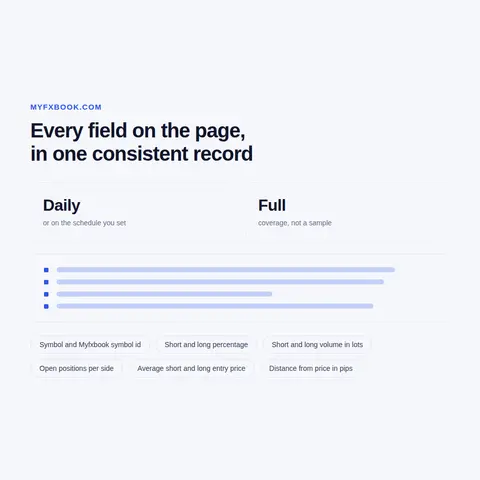
Community sentiment. We extract Myfxbook sentiment data symbol by symbol from a table built on verified real accounts only. Every row holds the short and long split in percent, volume per side in lots, open positions per side, the average short and average long entry price, each with its distance from the current price in pips, the current price, and symbol popularity - the share of the community holding that pair right now. The distance is signed from the side's point of view: a minus means the average short or long is under water. Rows carry the Myfxbook numeric symbol id (EURUSD is 1), and the list runs past currency pairs into gold, silver, platinum and palladium crosses and a long tail of crypto. A thin symbol can read 100 percent long off a single open position, so every percentage we deliver travels with its position count.
Per-pair depth. Each pair page adds a country split of long and short volume and positions, Market Depth in lots and Order Book in positions charts, and sentiment history charts from M1 to D1. Under the main table sits a community block: share of real accounts, profitable versus losing accounts, funds won and lost, average deposit, average account profit and loss, and total funds, all in USD.
Economic calendar. A calendar row gives date and time, time left, country and currency, the event name with its reference period in brackets - (Jul), (Q2) - the impact level, then Previous, Consensus and Actual with their units. Under the labels sit machine-friendly values: a numeric row id, an epoch timestamp, importance from 3 for High down to 0 for holidays, and a verdict on each print - better or worse than expected, with the gap to consensus. Holidays and early closes appear as rows with no impact, and Myfxbook publishes its own sentiment readings for pairs such as AUDUSD into the same calendar as events. Each event links to a page naming the source agency, category, units and next release date.
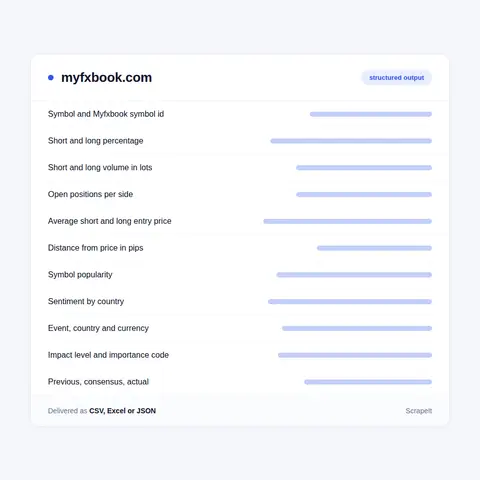
Historical quotes. Myfxbook historical data is served per symbol in nine timeframes, from 1 minute to 1 month, as Date, Open, High, Low, Close, Change in pips and Change in percent, with a start and end filter. The page itself warns that each timeframe reaches back roughly 1,000 data points: years of daily bars, but under a day of minutes. The Myfxbook EURUSD historical data page works like every other pair, so a deep intraday Myfxbook price history must be accumulated forward, run after run.
COT reports. Myfxbook COT data follows the CFTC weekly cycle for ten currencies, the ruble, peso and real among them, and seven commodities from gold to crude oil. Dates are the Tuesday report dates, not the Friday release. Each report gives open interest and long and short positions for non-commercial, commercial and non-reportable traders, plus dealer, asset manager and leveraged funds for financial futures, or producer, swap dealer and managed money for commodities.
Broker tables. Spreads, quotes and volume are compared live per broker server, such as OANDA-v20 Live-2, with commission notes; swaps come as long and short values refreshed every 24 hours with a swap type code. By default the broker list matches the visitor's region.
Market gauges. Correlation runs from -100 to +100 percent across timeframes from 5 minutes to 1 month, volatility is shown in pips or percent from 1 minute to monthly, and liquidity is a per-minute index measured against the average of the past day.
Myfxbook is two sites on one domain. One is a community where traders connect live brokerage accounts, publish systems and argue in forums. The other is a set of free market tools, partly built on top of that community: an economic calendar, a world interest rate table, an economic indicator heatmap, CFTC Commitments of Traders tables, historical quotes, correlation, volatility and liquidity readings, and live spread, quote, swap and volume comparisons across brokers. Myfxbook Ltd is registered in Israel, and its footer says every figure comes as is, for information only, not for trading or advice.
The market side is addressed by symbol, which makes coverage easy to plan. A pair sits at /forex-market/currencies/EURUSD, with siblings for -historical-data, /forex-market/volatility/EURUSD and /forex-market/correlation/EURJPY-USDJPY for one pair against another. Sentiment lives at /community/outlook/EURUSD, calendar events at /forex-economic-calendar/germany/factory-orders-mom and the like, and COT tables at /commitments-of-traders/EUR, with dated weekly reports under /historical-view/. Language folders such as /de/, /ru/, /ja/ and /kr/ mirror the same pages, and Indonesian runs on a separate myfxbook.id domain.
robots.txt closes only account areas - settings, dashboard, login, inbox and redirects - and the sitemap index splits into typed maps, with separate ones for forex market pages and COT reports. Trader accounts and profiles stay out of our scope - no individual returns, portfolios or top-trader rankings - and we work only with market-wide aggregates.
Get a Quote
Developers

Customers worldwide

Pages extracted

Hours saved for our clients
€199 / one-time
setup fee - included
€169 / mo
setup fee €499
€229 / mo
setup fee €499
€349 / mo
setup fee €499
€549 / mo
setup fee €799
The Myfxbook API is real, documented and free, but it was built for account holders. You log in with your email and password to open a session, and since version 1.38 that session is bound to the login IP and lives for a month unless you log out. The methods return your own accounts, watched accounts, open trades and orders, the last 50 closed transactions, daily gain, daily balance and equity data, and a chart widget image, in XML or JSON. The documentation puts it in one line: the API allows access to personal information only.
One method family touches the market: community outlook, which returns the same sentiment fields as the site, plus a by-country variant that needs a symbol. That is the whole Myfxbook sentiment API, capped at 100 requests per 24 hours on the free tier. There is no Myfxbook economic calendar API, and nothing for COT, quotes, correlation, volatility or spreads: the calendar exists as a page, an RSS feed licensed for individual non-commercial use and an embeddable widget.
Site-side exports will not fill that hole either: the Myfxbook export history button on a quotes page, and the CSV and XML buttons on the calendar, first ask the visitor to sign in. Teams that need market tables on a fixed timetable, detached from anyone's trading account, scrape Myfxbook pages instead.
Learn how to use web scraping to solve data problems for your organization

Web scraping automates the extraction and aggregation of financial data, makes it easier to find stocks, and allows you to predict the market based on the information.

Data and analytics are opening the door to uncovering ways to combat financial crime based on smart data. And advanced AI analytics and cognitive techniques, machine learning, and automation will improve the inefficiency of existing investigative processes.

Leveraging advances in technology, the AI-powered web scraper has skyrocketed in demand and is helping to expand capabilities by automating tedious daily tasks and speeding up data collection from thousands of websites several times over.
ScrapeIt is the agency that writes, runs and repairs the Myfxbook crawler for you, adjusting it whenever a page template shifts; your side receives tables and holds no scraping code. ScrapeIt and Myfxbook Ltd are unrelated companies.
Buyers shopping for a Myfxbook alternative in retail positioning should keep the samples apart: Myfxbook pools verified live accounts held at many brokers, while a broker's own client ratio reflects one book. And if the goal is your own trading accounts, the official API already covers that with your login.
Yes, a free one, but it serves account holders rather than market data buyers. The documentation lists login and logout, your accounts and watched accounts, open trades and orders, history limited to the last 50 transactions, daily gain, gain between two dates, daily balance data, a custom chart widget, and two sentiment calls: community outlook and outlook by country. Responses come in XML or JSON, with debug=1 for readable JSON during development. Sessions are tied to the login IP and expire after a month, and the docs ask that software built on the API stay free. A Myfxbook API Python wrapper exists on PyPI, but it calls the same methods.
The account methods cost nothing. Pricing only enters with sentiment: the free community outlook call is capped at 100 requests per 24 hours, and the paid version, sold inside the Sentiment Indicator subscription on monthly or cheaper yearly billing, lifts the cap to 2,880 requests per 24 hours, one call every 30 seconds. The same plan feeds MT4 and MT5 with updates every 15 seconds and up to 10,000 points per timeframe, against 1,000 on the website. None of it adds calendar, COT or quote data, which is where a scraper takes over.
Every dataset runs to a different beat. The sentiment page says it refreshes every 60 seconds, while pair pages carry a notice that the public figures run 60 minutes behind, with live data kept for subscribers. Calendar values land as each release prints, broker volume refreshes every 60 seconds, swaps every 24 hours, the interest rate table daily, and COT weekly after the CFTC Friday release. History is the real constraint: quote tables and sentiment charts keep about 1,000 points per timeframe, and the liquidity index covers only the last 48 hours. Anything older has to be recorded as it happens.
What the page shows, typed and keyed. Sentiment: symbol and symbol id, short and long percent, lots, positions, average entry prices with distance in pips, popularity and the country split. Calendar: row id, UTC timestamp, country, currency, event, reference period, impact, previous, consensus, actual and the better or worse verdict, filterable by currency or by region group - G20, Asia, Middle East, Europe, Americas, Africa. Quotes: OHLC with change in pips and percent. COT: open interest plus long and short by trader category. Formats: JSON, CSV, Parquet or XLSX.
The terms reserve the site's material to Myfxbook and its licensors and say reproduction is prohibited; the RSS feeds are licensed for individual, non-commercial use, and the API asks for free software. robots.txt closes account areas and leaves the market sections open. Collection is limited to what Myfxbook shows anonymous visitors: no logins, and no workarounds for a sign-in prompt. An internal research dataset and a product that republishes Myfxbook sentiment are different questions, and the second needs a license conversation with Myfxbook and sign-off from your legal team before a crawl starts.
Step 1 - Make a Request
You share your needs, expectations, and desired timeframe. We’ll suggest the best solution based on your request and budget.
Step 2 - Configuring Custom Web Crawlers
Our specialists configure the crawlers and extract a sample dataset for your review before proceeding with the full-scale extraction.
Step 3 - Collect and Deliver
Once you approve the sample, we launch the project and start full data collection. We gather, filter, and structure the data for easy use, delivering it on time in your preferred format.
Step 4 - Maintain and Support
Our team manages ongoing processes, monitors website changes, and supports all data extraction cycles. We can also help integrate data into your systems or create dashboards to simplify analysis.

Scrapeit Sp. z o.o.
10/208 Legionowa str., 15-099, Bialystok, Poland
NIP: 5423457175
REGON: 523384582