How Can Web Scraping Technology Help the Finance Industry?
Web scraping automates the extraction and aggregation of financial data, makes it easier to find stocks, and allows you to predict the market based on the information.

MarketBeat folds broker notes, Form 4 filings, 13F holdings and FINRA short interest into one row per ticker. We collect the tables it publishes, on the schedule you set.
Plans from €169/month · Free project assessment · Reply within 1 business day
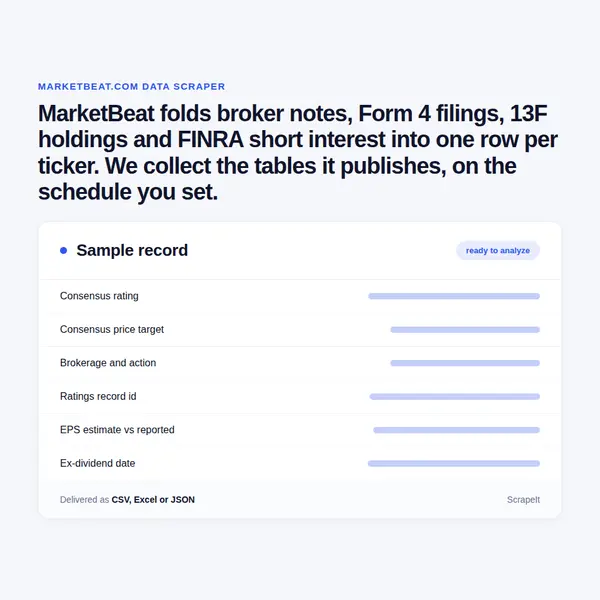
You send a ticker list and the tabs you want; we return a sample before the full run. Parsing is written against this site's own markup - the arrow inside a price target cell, the record id behind each Details link, the currency prefix on Canadian and London rows - so the output arrives typed rather than as scraped strings.
Anti-bot handling, proxy rotation and CAPTCHA solving are part of the service. We stay on the public side: no accounts, no All Access pages, no paywalled accuracy figures. Scheduling follows the data - ratings and calendars daily, short interest twice a month on the publication dates, holdings once a quarter, profiles rarely. When a column moves we repair the parser instead of shipping you a field of nulls. Delivery is CSV, JSON or XLSX, or straight into your bucket or warehouse.
The unit of the ratings feed is a single broker action. On /ratings/ each row carries Company, Action, Brokerage, Analyst, Current Price, Price Target, Rating and a Details link, and that link resolves to /all-access/ratings-screener/details/ with a numeric record id - the closest thing here to a stable primary key. Action is a controlled vocabulary: Upgrades, Downgrades, Initiates Coverage, Raises Target, Lowers Target, Reiterates Rating and Price Target Change. When a target moves, the cell holds both figures, old then new, joined by an arrow glyph. Canadian rows carry C$ targets and London rows GBX, so the currency has to travel with the number.
The site then normalizes what the firms actually wrote. Neutral, Market Perform, Overweight and Underperform collapse to a score of 1 for sell, 2 for hold, 3 for buy and 4 for strong buy, and the mean of the last twelve months of scores sets the consensus band: Hold from 1.5 to 2.5, Moderate Buy from 2.5 to 3.0, Buy from 3.0 to 3.5, Strong Buy above that. MarketBeat publishes a consensus price target alongside it, with the high and low target, the implied upside, the ratings count, and the whole set again as it stood one month, three months and a year ago.
What a MarketBeat scraper extracts from the other tabs is just as regular. Earnings history rows are Date, Quarter, Consensus Estimate, Reported EPS, Beat/Miss, GAAP EPS, Revenue Estimate and Actual Revenue, with a forward table of Quarter, Number of Estimates, Low Estimate, High Estimate, Average Estimate, Revenue Estimate and Company Revenue Guidance. Dividend rows are Announced, Period, Payment, Payment Change, Yield, Ex-Dividend Date, Record Date and Payable Date. Insider rows are Transaction Date, Insider, Buy/Sell, Number of Shares, Average Share Price, Total Transaction and Shares Held After Transaction. Institutional rows are Reporting Date, Major Shareholder Name, Shares Held, Market Value, Percent of Portfolio, Quarterly Change in Shares and Ownership in Company. Short interest rows are Report Date, Total Shares Sold Short, Dollar Volume Sold Short, Change from Previous Report, Percentage of Float Shorted, Days to Cover and Price on Report Date.
Insider and congressional rows name individuals. We take the transaction figures and leave the person out: no named roster of analysts, executives or lawmakers.
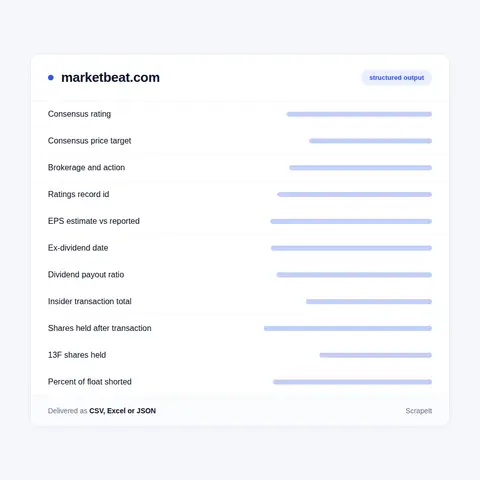
Coverage is North America plus the United Kingdom, unevenly. A US symbol gets the full tab set. A London line such as LON:BARC quotes in GBX with a sterling market cap and drops Financials, Ownership, SEC Filings, Short Interest and the options chain entirely; a Toronto line prices in C$ and keeps the dividend tab but not the ownership tables. Calendar facets follow the same split: USA (NYSE and NASDAQ), USA (All Exchanges), Canada and United Kingdom, with Europe only on the stock screener.
Cadence differs per dataset, and a MarketBeat scraping schedule that ignores that just burns requests. MarketRank recalculates through the trading day. Analyst rankings refresh daily. Short interest lands twice a month on the FINRA cycle, with a settlement date, a due date and then a publication date about a week later. Holdings move once a quarter, with reporting-period-end and filing-date columns weeks apart. Congressional trades surface under the STOCK Act 45-day disclosure window, which is why Date Traded and Date Filed are separate columns.
The paywall is narrow but sharp. Open to anyone are the ratings rows, the calendars, the congress tracker, eleven years of annual income statements, the top twenty-five holdings of an ETF and the whole company profile. Behind MarketBeat All Access sit the star accuracy ratings on every brokerage and analyst, the ranking tables with their 7-day, 30-day and 12-month ROI columns, the MarketRank, Media Sentiment and Analyst Consensus screener filters and saved screeners.
MarketBeat Media publishes MarketBeat.com out of Sioux Falls, South Dakota, and the site is laid out as one page per listed company plus a set of market-wide calendars. Every symbol lives at /stocks/EXCHANGE/TICKER/ and the same tabs hang off it: forecast, earnings, dividend, insider-trades, institutional-ownership, short-interest, sec-filings, financials, options, competitors-and-alternatives, chart and news. In September 2026 the company-profile sitemaps list about 21,300 of those profile pages.
The exchange segment is a MarketBeat code rather than a MIC: NASDAQ, NYSE, NYSEARCA, OTCMKTS, BATS and NYSEAMERICAN for the United States, TSE and CVE for Toronto and the TSX Venture, LON for London, with a thin tail of ETR, EPA, FRA and CNSX rows. That segment is part of the identifier, so a MarketBeat scraper keyed on the ticker alone will collide the moment a symbol trades in two places.
Around the profiles sit the calendars that make the site worth harvesting: /ratings/ for broker actions, /earnings/ with today, tomorrow, next-week, yesterday, beats-and-misses, guidance and transcript views, /dividends/ with an ex-dividend calendar and the achievers, kings, champions, contenders and challengers lists, then /insider-trades/, /13f-filings/, /short-interest/, /ipos/ with lockup and quiet-period expirations, /stock-splits/, /stock-buybacks/, /fda-calendar/, /congress-stock-trades/ and roughly 570 coin pages under /cryptocurrencies/.
Quotes are two-tier. The headline number on a US profile is a fair market value price refreshed every minute by Massive; everything else on the page is at least ten minutes delayed and hosted by Barchart Solutions. MarketBeat data is a research shop window, not a tape.
Get a Quote
Developers

Customers worldwide

Pages extracted

Hours saved for our clients
€199 / one-time
setup fee - included
€169 / mo
setup fee €499
€229 / mo
setup fee €499
€349 / mo
setup fee €499
€549 / mo
setup fee €799
Delivery: CSV, JSON or XLSX files, our API or a JSON feed. MCP server on request.
Full plan details →Analyst ratings are not filed with anyone. A broker note goes to that firm's clients, no regulator collects it, and there is no equivalent of EDGAR to fall back on. The site says it assembles ratings from more than a dozen channels - firms that send their calls in directly, private research feeds, regulatory filings and public media mentions - and that it tracks over a hundred thousand ratings changes a year. That sourcing is the product, and it is why buyers scrape MarketBeat instead of chasing the same calls firm by firm.
The rest of the site is a join rather than an original source. Form 4 insider transactions, 13F-HR holdings, quarterly financials and the semi-monthly short interest report all exist upstream, but they arrive in different shapes, on different calendars, keyed by CIK rather than by ticker. MarketBeat lands them on one page per symbol, converts share counts into dollar totals, computes days to cover against average volume, and stamps a percent-of-float figure onto what the exchanges publish as a bare share count. If you already hold the filings, what you are buying here is the reconciliation.
Where it thins out: the site reports figures as its sources issue them, and depth outside the United States is lighter - London and Toronto lines drop the ownership tables. We collect only publicly available data - everything a visitor can see on MarketBeat - and we collect it legally.
Learn how to use web scraping to solve data problems for your organization

Web scraping automates the extraction and aggregation of financial data, makes it easier to find stocks, and allows you to predict the market based on the information.

Data and analytics are opening the door to uncovering ways to combat financial crime based on smart data. And advanced AI analytics and cognitive techniques, machine learning, and automation will improve the inefficiency of existing investigative processes.

Leveraging advances in technology, the AI-powered web scraper has skyrocketed in demand and is helping to expand capabilities by automating tedious daily tasks and speeding up data collection from thousands of websites several times over.
ScrapeIt runs the MarketBeat scraper as a managed service: we build, run and maintain the crawlers, you receive the files. Nothing to install and no infrastructure on your side.
Ratings rows, consensus targets and the earnings, dividend, insider, institutional and short interest tables arrive typed and keyed by exchange and ticker. For research, coverage checks and internal dashboards, extracting MarketBeat data on a schedule keeps every table current.
Yes. The ScrapeIt MarketBeat API returns broker actions, ratings, old and new price targets, the consensus price target, earnings estimates and insider transaction figures as JSON from an endpoint we host, refreshed on the schedule you set. The same data also comes as CSV or XLSX files or straight into your database.
The site covers the United States, Canada and the United Kingdom. In the URL grammar that means NASDAQ, NYSE, NYSEARCA, OTCMKTS, BATS and NYSEAMERICAN for US listings, TSE and CVE for Toronto and TSX Venture, LON for London, plus a handful of ETR, EPA, FRA and CNSX rows. Depth is not equal: US symbols carry ownership, short interest, SEC filings, financials and options tabs, while London and Toronto symbols carry ratings, earnings, insider trades and, for Toronto, dividends. Prices follow the listing - GBX in London, C$ in Toronto - so we keep the currency with every figure.
Match the pull to the source. Broker actions and the earnings, dividend and insider calendars turn over every trading day, so a daily sweep is right. MarketRank scores recalculate through the session. Analyst and brokerage rankings refresh daily. Short interest updates twice a month on the FINRA settlement cycle, published roughly a week after the settlement date, so two runs a month cover it. Institutional holdings move quarterly. Company profiles and financial statements change on the reporting calendar. Pulling everything nightly is mostly wasted requests.
You get the table columns as published, typed and keyed. Ratings: date, brokerage, analyst slot, action, rating, old and new price target, and the numeric record id from the Details link. Earnings: quarter, consensus estimate, reported EPS, beat or miss, GAAP EPS, revenue estimate and actual revenue. Dividends: announced date, period, payment, payment change, yield, ex-dividend, record and payable dates. Insider and institutional rows keep share counts, average price, transaction totals, shares held after, percent of portfolio and ownership percentage. Output is CSV, JSON or XLSX, or delivered into your storage or warehouse.
Yes. We collect ratings rows, price targets and the earnings, dividend, insider and institutional tables from pages that open without an account, and we do not bypass logins or paywalls. We collect only publicly available data - everything a visitor can see on MarketBeat - and we collect it legally. On personal data: insider and congressional tables name individuals, and we deliver the transaction figures without building a named list of analysts, executives or lawmakers.
Step 1 - Make a Request
You share your needs, expectations, and desired timeframe. We’ll suggest the best solution based on your request and budget.
Step 2 - Configuring Custom Web Crawlers
Our specialists configure the crawlers and extract a sample dataset for your review before proceeding with the full-scale extraction.
Step 3 - Collect and Deliver
Once you approve the sample, we launch the project and start full data collection. We gather, filter, and structure the data for easy use, delivering it on time in your preferred format.
Step 4 - Maintain and Support
Our team manages ongoing processes, monitors website changes, and supports all data extraction cycles. We can also help integrate data into your systems or create dashboards to simplify analysis.
MarketBeat data from €169/month. Free project assessment, reply within 1 business day.

Scrapeit Sp. z o.o.
10/208 Legionowa str., 15-099, Bialystok, Poland
KRS: 0000996672
NIP: 5423457175
REGON: 523384582