Zepto Scraper - Extract Product, Price and Stock Data

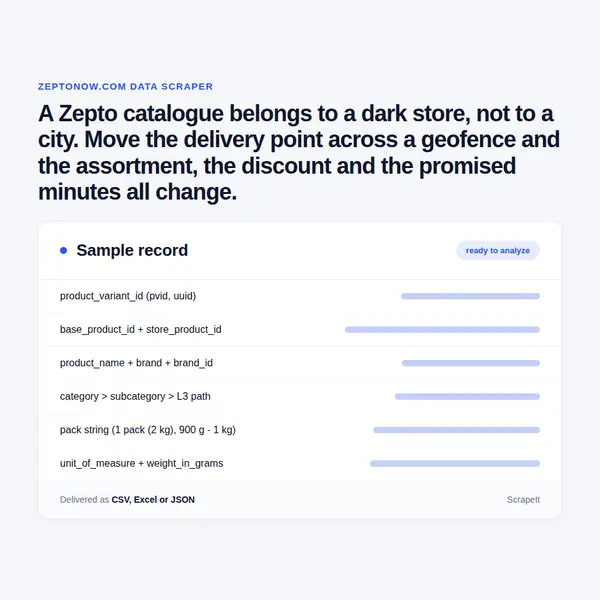
A Zepto catalogue belongs to a dark store, not to a city. Move the delivery point across a geofence and the assortment, the discount and the promised minutes all change.

Zepto Scraper
Solutions

How we run Zepto scraping as a managed job

You give us the delivery points or cities, the categories or brands, the fields you need and a cadence. We design the schema, build the crawler, run it, watch it and repair it when the site moves its markup, so you receive files rather than a codebase. Output is CSV, JSON, XLSX, Parquet, a Google Sheet, a direct database load or a hosted Zepto API endpoint you call, delivered by email, S3, SFTP or webhook.

Anti-bot handling, proxy rotation and CAPTCHA solving are part of the service and never become your problem: the storefront turns away plain automated clients, and getting past that is our job, not yours. We stay on public pages, never touch cart, checkout, payment or account areas, and leave personal data out by default. Every row is stamped with the dark store and the timestamp it came from, so consecutive runs stack into one comparable series instead of a pile of snapshots.

Fields a Zepto product feed can carry, from MRP to seller licence

Every row starts with three separate identifiers, and confusing them is the usual way a Zepto scraper breaks. The pvid in the address is the product variant: one pack size of one product. Behind it sits a base product id that ties the 1 kg, 2 kg and 4 kg packs of the same line together. Wrapping both is a store product id, the pairing of that variant with one dark store, and the row that actually carries stock and money.

What we lift for each variant:

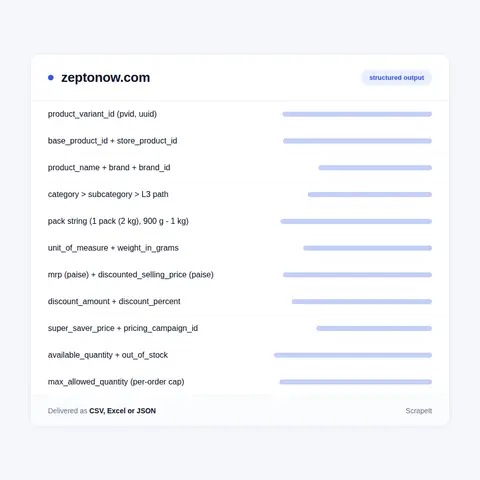
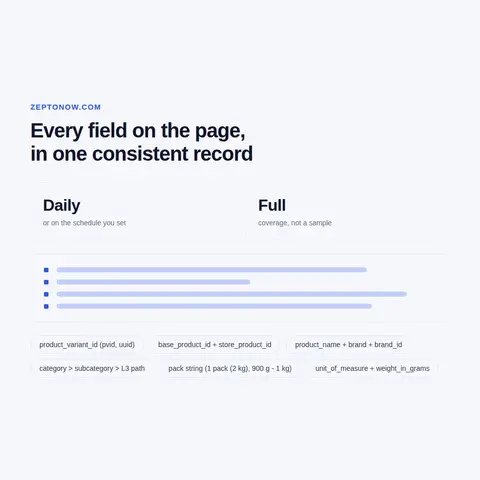
  • Identity: product variant id, base product id, store product id, product name, brand and brand id, primary category, subcategory and L3 category ids, plus the breadcrumb path such as Cleaning Essentials to Detergent Powder and Bars.
  • Pack: the printed pack string like 1 pack (2 kg) or 900 g - 1 kg, numeric pack size, unit of measure (KILOGRAM, PIECE, LITRE), weight in grams, shelf life and storage instructions.
  • Money: MRP and discounted selling price, discount amount and discount percent, the Super Saver selling price where that tier applies, a store product discount id and a pricing campaign id. Both arrive as integers in paise, so every value needs dividing by a hundred before it matches a printed shelf price.
  • Availability: available quantity, out of stock flag, stockout threshold, allocated quantity and the per-order cap, often two or three units.
  • Trust: average rating and total rating count, the discount and attribute badges on the tile, and new, primary and best offer flags.
  • Compliance: seller name, seller address and seller licence code, FSSAI licence number, country of origin, manufacturer or marketer name and address, minimum required age for the Paan Corner shelves, and the returnable, replaceable and return window flags.
  • Content: the description paragraphs, the highlight table as key and value pairs (product type, key features, fragrance, usage instruction, unit), ingredients where present, and the media list marked image or video.

One gap matters for anyone matching across retailers: no barcode is published. There is no GTIN or EAN on the item page, so matching runs on brand, name and pack size, and we hand back the raw pack string beside our parsed grams so you can audit the join.

Fields a Zepto product feed can carry, from MRP to seller licence
Why a Zepto crawl is planned by dark store and delivery point

Why a Zepto crawl is planned by dark store and delivery point

This is the part that decides whether a Zepto data project works. Serviceability is not a list of pin codes: each dark store carries a geofence, and the app resolves a delivery point to a primary store, sometimes a secondary store behind it, sometimes a night store. Every price and stock row is stamped with the store it came from. Two flats on opposite sides of a road can sit in different geofences and see different catalogues.

The city landing pages look like the answer and are not. The Mumbai page and the Delhi page return an identical feed, because with no address set both fall back to the same default store, a Bengaluru dark store the payload names outright. City pages are search landings; only a resolved delivery point moves the catalogue. So coverage is planned as a grid of points, one per store geofence, and every delivered row carries its store id, store name and capture time.

Each resolved point also returns operational fields worth keeping: store open and close times, live and online flags, whether the store is taking orders, a stand still mode, a raining flag, and an ETA in minutes per store, five on a nearby primary store and twenty one on the backup behind it.

Two more habits of the site shape the crawl. Category feeds have no page numbers: paging runs on a continuous widget cursor, so the crawler follows the feed to an end of page flag instead of incrementing a number. And a variant id that no longer exists does not return a clean error page, it renders a friendly fallback pointing back to the home page, so delisted lines must be detected rather than trusted.

How the Zepto storefront is built, from vertical down to dark store

Zepto is an Indian quick commerce app that sells from its own dark stores: small neighbourhood warehouses holding a few thousand fast-moving lines and promising delivery in minutes. The storefront answers on zeptonow.com and on zepto.com, both named as the same platform in the terms of use, and both operated by Zepto Marketplace Private Limited from Bengaluru.

It is a marketplace rather than a single retailer. Each line is sold by a registered seller entity, and the seller name, full address and licence code sit on the item page beside the manufacturer or marketer details. Anyone who wants to scrape Zepto for supply-side work keeps that block, because it is the only place the legal supplier behind a pack is named.

The shop splits into verticals the header calls All, Cafe, Home, Toys, Fresh, Electronics, Mobiles, Beauty and Fashion. Under them sit the grocery categories: Fruits and Vegetables, Dairy Bread and Eggs, Atta Rice Oil and Dals, Meats Fish and Eggs, Masala and Dry Fruits, Breakfast and Sauces, Packaged Food, Tea Coffee and More, Ice Creams, Frozen Food, Sweet Cravings, Cold Drinks and Juices, Munchies and Biscuits, plus Paan Corner with cigarettes and hookah needs, Skincare, Makeup and Beauty, Bath and Body, Cleaning Essentials, Home Needs, Hygiene and Grooming, Toys and Sports, Electronics and Appliances, Homegrown Brands and Zepto Cafe for hot food. The footer alone links twenty two category entries and sixty seven city pages.

Addresses are stable and easy to plan a crawl around. Items live at /pn/slug/pvid/uuid, subcategories at /cn/category/subcategory/cid/uuid/scid/uuid, brands at /brand/name, short aliases at /category/slug, and editorial rails at /pip/slug/number.

Get a Quote
dev_w
25

Developers

customers
500+

Customers worldwide

pages
1 500 000 000+

Pages extracted

stime
15000+

Hours saved for our clients

Plans

Airplane

€199 / one-time

setup fee - included

Data limits100,000
Frequencyone-time
Run timeup to 5 days
Data storing7 days

Helicopter

€169 / mo

setup fee €499

Data limits250,000
Frequencymonthly
Run timeup to 5 days
Data storing14 days

Glasses

€229 / mo

setup fee €499

Data limits1,000,000
Frequencyweekly
Run timeup to 5 days
Data storing30 days

DNA

€549 / mo

setup fee €799

Data limits3,000,000
Frequency3 times daily
Run timesame day
Data storing90 days

What teams do with Zepto price data once it lands

Quick commerce prices in India move faster than shelf prices, and Zepto shows two numbers on every tile: the MRP struck through and the price actually charged. A daily Zepto price series turns the gap between them into discount depth by brand, category and dark store, which is what category managers argue about when they set trade spend.

  • Price monitoring against Blinkit and Swiggy Instamart, chasing the same ten minute basket. None of the three publishes a barcode, so matching runs on brand plus pack size and we keep the raw strings for audit.
  • Assortment gaps: a line stocked in one store and missing in the next is a distribution problem, not a pricing one. The same category across stores shows where a brand has really landed.
  • Stockouts: available quantity and the out of stock flag become a fill rate curve by hour, the number a supplier needs when arguing for more shelf.
  • New launches: fresh variant ids in a category feed are the earliest public sign a competitor has listed something.
  • Private label pressure: tracking where Zepto value lines sit against national brands shows how much shelf the platform keeps for itself.
  • Promo mechanics: badges, campaign ids and the Super Saver tier show whether a low price is a reposition or a funded burst.

Ratings and rating counts come through as ordinary numbers. We do not collect reviewer or delivery partner names, or anything that identifies a person.

Our Blog

Reads Our Latest News & Blog

Learn how to use web scraping to solve data problems for your organization

How Artificial Intelligence Is Used In Web Scraping

How Artificial Intelligence Is Used In Web Scraping

Leveraging advances in technology, the AI-powered web scraper has skyrocketed in demand and is helping to expand capabilities by automating tedious daily tasks and speeding up data collection from thousands of websites several times over.

What is Web Scraping and What is it Used For?

What is Web Scraping and What is it Used For?

Web scraping is a method of obtaining web data by extracting it from pages of web resources with the help of a program, that is, in automatic mode. It is used to syntactically convert web pages into more usable forms.

Web Scraping for Machine Learning

Web Scraping for Machine Learning

If you specialize in machine learning, you need to feed large amounts of data to the algorithms. Web scraping is the easiest and the most efficient method of collecting the data from all over the Internet.

scrapeit logo

Who builds and runs the feed

ScrapeIt is a managed web scraping agency. We are not a library and not a self-serve tool: we build the crawler, run it on your schedule, monitor it and fix it when a site changes, so you maintain a data feed instead of code. A sample lands before sign-off, which lets you check the paise to rupee conversion, the pack size parsing and the store stamping against live pages yourself. Coverage, cadence and field list are set by you and reviewed as your categories change. We have no affiliation with Zepto.

FAQ

Does Zepto have a public API for product and price data?

No. There is no public developer programme, no documented endpoint and no developer page on the site: the address simply does not exist. The app talks to internal services that are not published, and the partner portal for brands and sellers sits behind a login and serves their own sales data, not the open catalogue. So the practical route to a Zepto API is one we host: we run the crawl, normalise the fields and expose the result as an endpoint you call, or as scheduled files if you prefer.

Which fields can you extract from a Zepto product listing?

Variant id, base product id and store product id, product name, brand, category path, pack string and parsed pack size, unit of measure and weight, MRP, discounted selling price, discount amount and percent, Super Saver price where present, available quantity, out of stock flag, per-order cap, rating and rating count, badges, seller name and licence, FSSAI number, country of origin, manufacturer details, shelf life, return flags, the highlight table and the image and video list. No barcode is published, so cross-retailer matching runs on brand and pack size.

Does the Zepto catalogue really change with the delivery address?

Yes, and it is the main design constraint. Assortment, price and stock are held per dark store, and the app maps a delivery point to a store by geofence rather than by pin code or city name. City landing pages do not switch the catalogue on their own: with no address set they all render the same default store. That is why we plan coverage as a grid of delivery points, one per store area, and stamp every row with the store it came from.

How often can Zepto price and stock data be refreshed?

As often as the decision needs. Daily is the common cadence for price monitoring and share of shelf. Hourly or several times a day suits stockout tracking, promo windows and festival periods, when discounts on a fast-moving pack can change inside a single day. Very high frequency raises cost, because each dark store is a separate pass, so we usually run a wide daily sweep across all stores plus a narrow intraday sweep on a watchlist of packs and stores that matter.

Is it legal to scrape Zepto data, and what do you not collect?

We collect only public pages: catalogue, pack, price, stock and seller information, the same things any shopper sees without logging in. We do not log in, do not touch account, cart or checkout areas, and do not collect personal data such as customer or delivery partner identities. The robots file allows crawling while the terms of use restrict automated access, so the two do not agree, and each buyer takes their own view with their own counsel on the basis we describe. We work to whatever limits you set.

How does it Work?

Step 1 - Make a Request

You share your needs, expectations, and desired timeframe. We’ll suggest the best solution based on your request and budget.

Step 2 - Configuring Custom Web Crawlers

Our specialists configure the crawlers and extract a sample dataset for your review before proceeding with the full-scale extraction.

Step 3 - Collect and Deliver

Once you approve the sample, we launch the project and start full data collection. We gather, filter, and structure the data for easy use, delivering it on time in your preferred format.

Step 4 - Maintain and Support

Our team manages ongoing processes, monitors website changes, and supports all data extraction cycles. We can also help integrate data into your systems or create dashboards to simplify analysis.

Request a Quote

Tell us more about you and your project information.
Which sites, which fields, how often. A couple of lines is enough.

We reply within 1 business day. No obligation.

scrapiet

Scrapeit Sp. z o.o.
10/208 Legionowa str., 15-099, Bialystok, Poland
NIP: 5423457175
REGON: 523384582