ACRA Scraper for Singapore Entities and UEN Identifiers

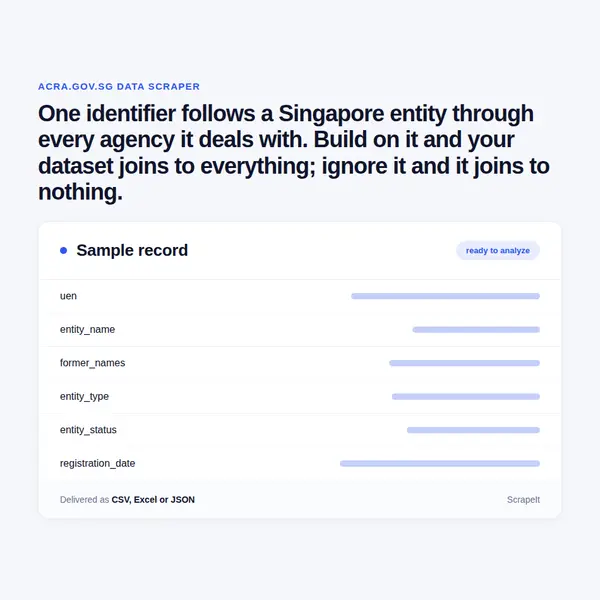
One identifier follows a Singapore entity through every agency it deals with. Build on it and your dataset joins to everything; ignore it and it joins to nothing.

ACRA Scraper
Solutions

Managed Singapore registry data, run end to end by us

ScrapeIt runs the collection as a managed service. You name the entity types, activity classifications or filters; we build the pipeline keyed on the unique entity number in its published form, keep entity types precise, and hand back CSV, JSON, Excel or a push into your warehouse.

Paid document retrieval is quoted separately against a list you approve, with per-item costs shown rather than buried in a pipeline price.

This is a public registry and we collect it politely within the crawl rules it publishes. Officer and shareholder records describe named individuals and you are the controller of whatever you build; your counsel should see the use case before the project starts.

ACRA fields in every export

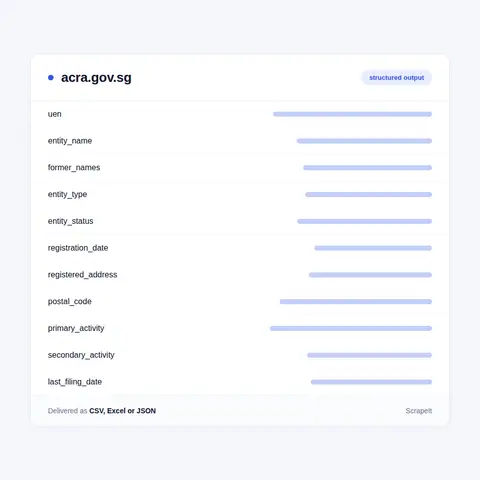
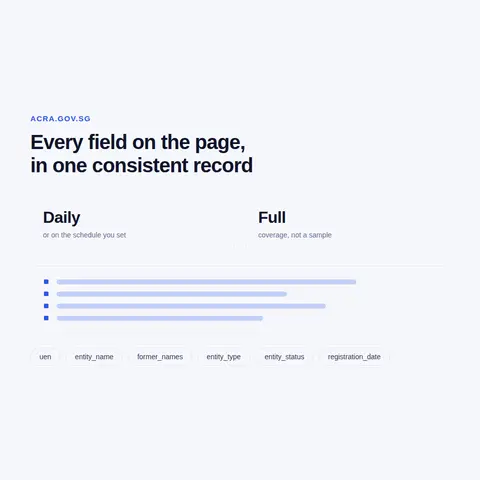
Entity records carry the unique entity number, entity name, former names, entity type, status, registration date, registered address, primary and secondary activity classifications and the date of the last filing where published.

The unique entity number is the primary key and stays in its published form. Reformatting it - stripping letters, padding digits - breaks the join to every other government dataset that uses it, which is the single reason to prefer this register over name-based matching in the first place.

Entity type is kept precisely, because Singapore distinguishes companies, limited liability partnerships, partnerships and sole proprietorships with different filing obligations, and collapsing them into a company field loses that.

Activity classification is collected as published, with both primary and secondary retained, since an entity doing two things is poorly described by one code.

Officer and shareholder detail generally sits behind paid documents, and where a client needs it we scope retrieval explicitly with the per-item cost shown, and mark it as personal data.

ACRA fields in every export
Status monitoring, regional structures and limits

Status monitoring, regional structures and limits

Status and registration monitoring is the lighter product and runs entirely on free entity data: new registrations, status changes, strike-offs and name changes, by activity classification.

Regional structure analysis is the reason many clients come. Holding entities registered in Singapore frequently sit above operating companies elsewhere in Southeast Asia, and the register is the anchor point for mapping those structures - though the layers outside Singapore need their own sources.

Cross-agency joining is the distinctive capability: because the identifier travels, official datasets from other Singapore agencies can be attached without name matching.

Limits: officer and shareholder detail is behind paid documents, we do not attempt to bypass charges, and where such detail is retrieved it is personal data about named individuals with the scoping conversation that always implies.

The registry behind a single business identifier

ACRA is Singapore's Accounting and Corporate Regulatory Authority, the national registrar for companies, partnerships and sole proprietorships, operating the BizFile service through which entities are registered and file their returns.

Its distinguishing feature for data work is the Unique Entity Number. Singapore issues one identifier per registered entity and it is used across government services, which means a dataset keyed on it can be joined to other official datasets cleanly rather than through name matching.

That is rarer than it sounds. Most countries have a company register number that works inside the register and nowhere else. Here the identifier is designed to travel, and a project that builds on it inherits that property.

The registry site responds directly with substantial content and crawl rules are published. As with most registries, entity search is free and detailed documents are purchased per item.

Get a Quote
dev_w
25

Developers

customers
500+

Customers worldwide

pages
1 500 000 000+

Pages extracted

stime
15000+

Hours saved for our clients

Plans

Airplane

€199 / one-time

setup fee - included

Data limits100,000
Frequencyone-time
Run timeup to 5 days
Data storing7 days

Helicopter

€169 / mo

setup fee €499

Data limits250,000
Frequencymonthly
Run timeup to 5 days
Data storing14 days

Glasses

€229 / mo

setup fee €499

Data limits1,000,000
Frequencyweekly
Run timeup to 5 days
Data storing30 days

DNA

€549 / mo

setup fee €799

Data limits3,000,000
Frequency3 times daily
Run timesame day
Data storing90 days

Why building on the identifier changes what is possible

Most company datasets spend a large part of their budget on matching. Names are written differently across sources, suffixes vary, and the resulting joins are probabilistic and need constant maintenance.

A register with a government-wide identifier removes that problem where the identifier is present. A dataset built on it joins to other official Singapore datasets directly, which means a client can assemble a picture across agencies without an entity resolution layer in the middle.

The corollary is a rule we hold firmly: never reformat the identifier. Stripping its letters or normalising its length to look tidy destroys exactly the property that made the source worth using, and it is the kind of well-intentioned cleaning that happens silently in a transformation step.

The second reason to use this source is regional. Singapore is the holding company base for a large amount of Southeast Asian business activity, so its register is a useful window onto ownership structures that operate across the region.

The third is the free and paid split, familiar from any registry: entity-level data supports most briefs, while officer and shareholding detail sits behind paid documents and should be scoped as a separate, approved line.

Our Blog

Reads Our Latest News & Blog

Learn how to use web scraping to solve data problems for your organization

How Artificial Intelligence Is Used In Web Scraping

How Artificial Intelligence Is Used In Web Scraping

Leveraging advances in technology, the AI-powered web scraper has skyrocketed in demand and is helping to expand capabilities by automating tedious daily tasks and speeding up data collection from thousands of websites several times over.

What is Web Scraping and What is it Used For?

What is Web Scraping and What is it Used For?

Web scraping is a method of obtaining web data by extracting it from pages of web resources with the help of a program, that is, in automatic mode. It is used to syntactically convert web pages into more usable forms.

Web Scraping for Machine Learning

Web Scraping for Machine Learning

If you specialize in machine learning, you need to feed large amounts of data to the algorithms. Web scraping is the easiest and the most efficient method of collecting the data from all over the Internet.

scrapeit logo

Who builds and keeps your Singapore registry feed

ScrapeIt is a managed extraction company, not a tool you have to learn. Our team builds the pipeline, keeps the identifier intact through every transformation, and repairs the collector before a status monitoring series misses a strike-off.

You see a sample first, in your format, over the entity types you actually track, with identifiers unmodified so you can test a join against another official dataset immediately.

FAQ

Why does the identifier matter so much?

Because it travels across government services, so a dataset keyed on it joins to other official datasets directly instead of through name matching. That removes the entity resolution layer that eats most of the budget on company data projects elsewhere.

Can you clean up the identifier format?

We will not, and it matters. Stripping letters or padding digits to make it look tidy breaks the join to every other dataset that uses it - destroying the one property that made this source worth choosing. It is a common silent error in transformation steps.

What is free and what costs money?

Entity-level data - name, type, status, registration, address, activity codes - is free and meets most briefs. Officer and shareholding detail sits behind paid documents, which we scope as a separate line against a list you approve.

Why keep entity types separate?

Because Singapore distinguishes companies, limited liability partnerships, partnerships and sole proprietorships with different filing obligations. Collapsing them into a company field loses a distinction that matters to anyone doing diligence.

Can I map Southeast Asian ownership structures from here?

You can anchor them here - Singapore is a common holding base for the region - but the layers outside Singapore need their own sources. We scope those separately rather than implying one register shows the whole structure.

How does it Work?

Step 1 - Make a Request

You share your needs, expectations, and desired timeframe. We’ll suggest the best solution based on your request and budget.

Step 2 - Configuring Custom Web Crawlers

Our specialists configure the crawlers and extract a sample dataset for your review before proceeding with the full-scale extraction.

Step 3 - Collect and Deliver

Once you approve the sample, we launch the project and start full data collection. We gather, filter, and structure the data for easy use, delivering it on time in your preferred format.

Step 4 - Maintain and Support

Our team manages ongoing processes, monitors website changes, and supports all data extraction cycles. We can also help integrate data into your systems or create dashboards to simplify analysis.

Request a Quote

Tell us more about you and your project information.
Which sites, which fields, how often. A couple of lines is enough.

We reply within 1 business day. No obligation.

scrapiet

Scrapeit Sp. z o.o.
10/208 Legionowa str., 15-099, Bialystok, Poland
NIP: 5423457175
REGON: 523384582