Handelsregister Scraper for German Commercial Register Data

Search is free, documents are not. On a register that charges per retrieval, the budget conversation comes before the pipeline conversation.

Handelsregister Scraper
Solutions

Managed German register data, run end to end by us

ScrapeIt runs the collection as a managed service. You name the companies, regions or filters; we collect the free register data broadly, keep court and number as a compound key, preserve legal forms as recorded, and hand back CSV, JSON, Excel or a push into your warehouse.

Document retrieval is quoted separately with the per-item charges shown, against a list you approve. We do not put a document budget inside a pipeline price where you cannot see it.

This is a public register maintained by the courts and we collect it politely. Representatives are named individuals and you are the controller of whatever you build; your counsel should see the use case before the project starts.

Handelsregister fields in every export

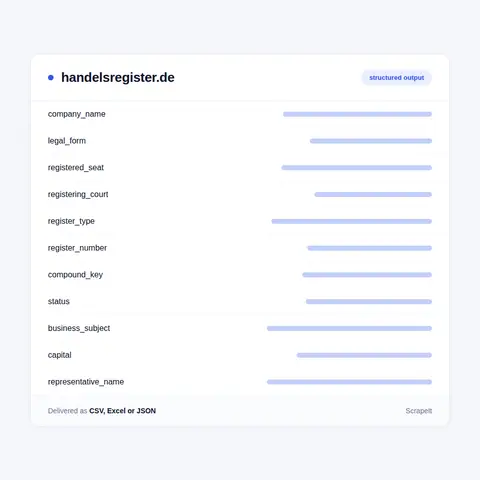
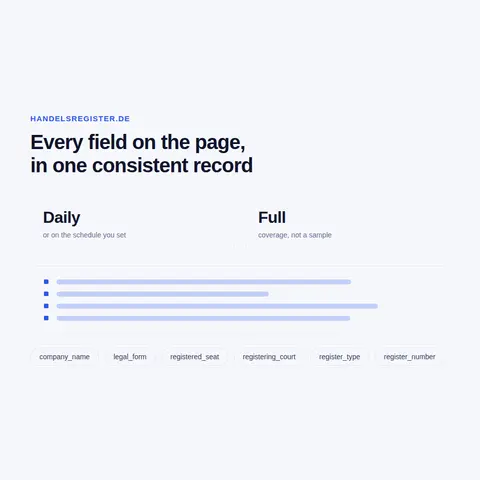
Company records carry the company name, legal form, registered seat, the registering court, the register type and number, status, and the subject matter of the business as recorded.

Court and register number travel together as a compound identifier, because the number alone is not unique across Germany. A dataset that drops the court will collide companies from different regions, and the collision is silent.

Legal form is kept as recorded rather than translated, since German legal forms do not map cleanly onto English equivalents and a translated field loses distinctions that matter legally.

Representatives are recorded where published, with the same personal data marking we apply on any register: these are named individuals and the schema should say so.

Document availability is recorded rather than document content by default, so a client can decide what to retrieve knowing what each retrieval costs.
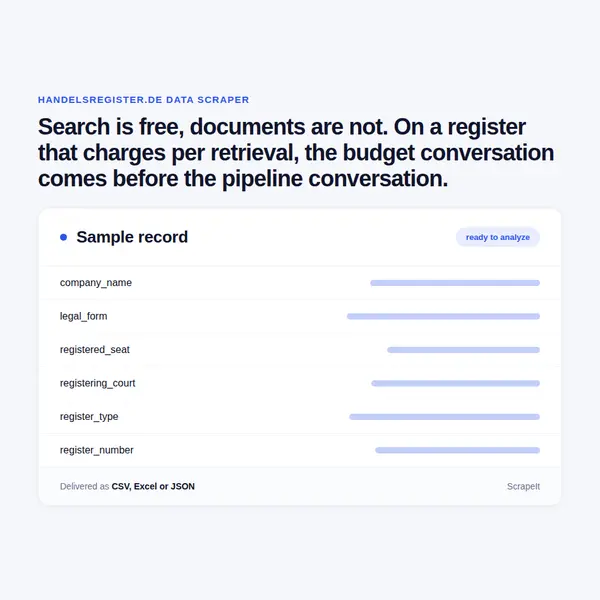
Handelsregister fields in every export
Change monitoring, cross-border matching and limits

Change monitoring, cross-border matching and limits

Change monitoring on register entries - new registrations, changes of representative, capital changes, insolvency entries - is the highest value output and it runs on the free register data rather than on paid documents.

Cross-border company matching is the common wider brief, and Germany is where it usually breaks. Matching a German entry to a UK or French company requires handling the compound identifier, the legal form differences and name conventions including the legal form suffix. We treat it as an entity resolution problem with confidence values rather than a join.

Document retrieval is scoped explicitly as a separate line with its own cost, approved per batch.

Limits: we do not attempt to bypass charges, we pace politely on a public register, and representatives are marked as personal data with the same scoping conversation we have on any register that names individuals.

A federal portal over local court registers

The Handelsregister is the German commercial register, recording companies, their legal form, registered seat, share capital, representatives and the filings they are required to make.

Its structure surprises people who expect a single national database. The register is maintained by local courts, and the national portal is a shared front end over those court registers. Register numbers are issued per court, so a number is only unique in combination with the court that issued it - a detail that breaks any dataset keyed on the number alone.

The second structural fact is commercial. Searching the register is free; retrieving documents generally is not, with charges applied per retrieval. That turns a bulk document project into a budgeting exercise before it is an engineering one, and it is better raised in the first conversation than in an invoice.

The portal responds directly and crawl rules are published.

Get a Quote
dev_w
25

Developers

customers
500+

Customers worldwide

pages
1 500 000 000+

Pages extracted

stime
15000+

Hours saved for our clients

Plans

Airplane

€199 / one-time

setup fee - included

Data limits100,000
Frequencyone-time
Run timeup to 5 days
Data storing7 days

Helicopter

€169 / mo

setup fee €499

Data limits250,000
Frequencymonthly
Run timeup to 5 days
Data storing14 days

Glasses

€229 / mo

setup fee €499

Data limits1,000,000
Frequencyweekly
Run timeup to 5 days
Data storing30 days

DNA

€549 / mo

setup fee €799

Data limits3,000,000
Frequency3 times daily
Run timesame day
Data storing90 days

Why the cost model shapes the project

On most sources the engineering decides the price. Here the register does.

Because document retrieval carries a per-item charge, a project covering thousands of companies has a document budget that dwarfs the pipeline cost. The sensible design is therefore to collect the free register data broadly and retrieve documents narrowly, against a list the client has approved. We build it that way and put the arithmetic in front of the client rather than discovering it in delivery.

The second point is the federated structure. Anyone building a German company dataset needs the court as part of the key, and anyone comparing German data against another country needs to understand that a register number here is not the same kind of identifier as a company number in a centralised register.

The third is legal form. German company law distinguishes forms with different liability and disclosure obligations, and a pipeline that translates them into approximate English equivalents destroys exactly the distinction a client doing due diligence needs.

The fourth is that representatives are named individuals. The register publishes them for transparency about who can act for a company, and building profiles of those people is a different activity from recording who represents a company, with different obligations attached.

Our Blog

Reads Our Latest News & Blog

Learn how to use web scraping to solve data problems for your organization

How Artificial Intelligence Is Used In Web Scraping

How Artificial Intelligence Is Used In Web Scraping

Leveraging advances in technology, the AI-powered web scraper has skyrocketed in demand and is helping to expand capabilities by automating tedious daily tasks and speeding up data collection from thousands of websites several times over.

What is Web Scraping and What is it Used For?

What is Web Scraping and What is it Used For?

Web scraping is a method of obtaining web data by extracting it from pages of web resources with the help of a program, that is, in automatic mode. It is used to syntactically convert web pages into more usable forms.

Web Scraping for Machine Learning

Web Scraping for Machine Learning

If you specialize in machine learning, you need to feed large amounts of data to the algorithms. Web scraping is the easiest and the most efficient method of collecting the data from all over the Internet.

scrapeit logo

Who builds and keeps your German register feed

ScrapeIt is a managed extraction company, not a tool you have to learn. Our team builds the pipeline, maintains the compound key handling and legal form vocabulary, and repairs the collector before a change monitoring series misses a registration.

You see a sample first, in your format, over the regions you actually cover, with court and number kept together so you can test a cross-border match on real entries.

FAQ

Why is the register number not enough?

Because numbers are issued per local court, so a number is only unique together with the court that issued it. A dataset keyed on the number alone collides companies from different regions, and the collision leaves no trace.

Why do documents cost extra?

Because the register charges per retrieval. That is the register's model, not ours, and on a project covering thousands of companies the document budget dwarfs the pipeline cost - which is why we put the arithmetic in front of you first.

Can you translate the legal forms?

We keep them as recorded and can add a translation alongside, never instead. German legal forms carry liability and disclosure differences that English approximations lose, and due diligence work needs the original.

What can I get without paying for documents?

A great deal: names, legal form, seat, court, register number, status, business subject matter and representatives, plus change monitoring over all of it. Most briefs are met here, with documents retrieved narrowly against a list you approve.

Can you match German companies to other countries?

Yes, as entity resolution with confidence values rather than a join. Germany is where cross-border matching usually breaks - compound identifiers, legal form suffixes in names, and no central number to match on.

How does it Work?

Step 1 - Make a Request

You share your needs, expectations, and desired timeframe. We’ll suggest the best solution based on your request and budget.

Step 2 - Configuring Custom Web Crawlers

Our specialists configure the crawlers and extract a sample dataset for your review before proceeding with the full-scale extraction.

Step 3 - Collect and Deliver

Once you approve the sample, we launch the project and start full data collection. We gather, filter, and structure the data for easy use, delivering it on time in your preferred format.

Step 4 - Maintain and Support

Our team manages ongoing processes, monitors website changes, and supports all data extraction cycles. We can also help integrate data into your systems or create dashboards to simplify analysis.

Request a Quote

Tell us more about you and your project information.
Which sites, which fields, how often. A couple of lines is enough.

We reply within 1 business day. No obligation.

scrapiet

Scrapeit Sp. z o.o.
10/208 Legionowa str., 15-099, Bialystok, Poland
NIP: 5423457175
REGON: 523384582