Federal Register Scraper for Rules, Notices and Comments

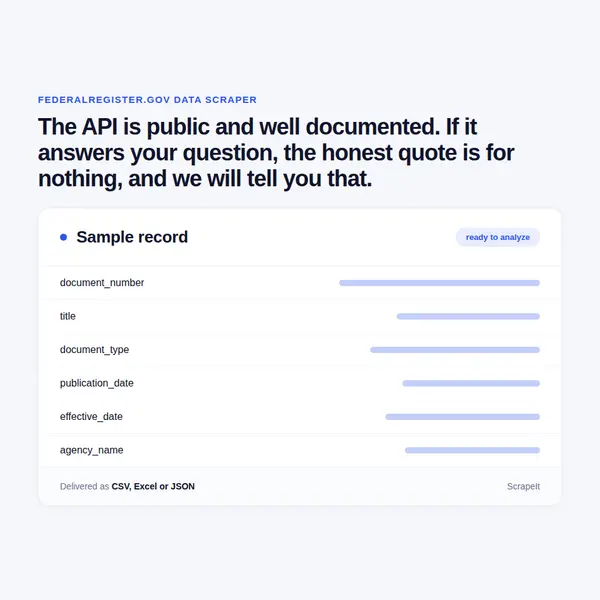
The API is public and well documented. If it answers your question, the honest quote is for nothing, and we will tell you that.

Federal Register Scraper
Solutions

Managed regulatory data, run end to end by us

ScrapeIt runs the collection as a managed service. You name the agencies, topics or regulation identifiers; we use the published interface where it covers the need, build the lifecycle chains it does not, and hand back CSV, JSON, Excel or a push into your warehouse.

Where your question is entirely answered by the published interface, we will tell you and help you use it rather than quoting for a pipeline you do not need.

This is public government information and we collect it politely and at a sensible rate. If it feeds compliance decisions, your own regulatory team should see the output before it is relied upon, since the tolerance for error there differs from ordinary analytics.

Federal Register fields in every export

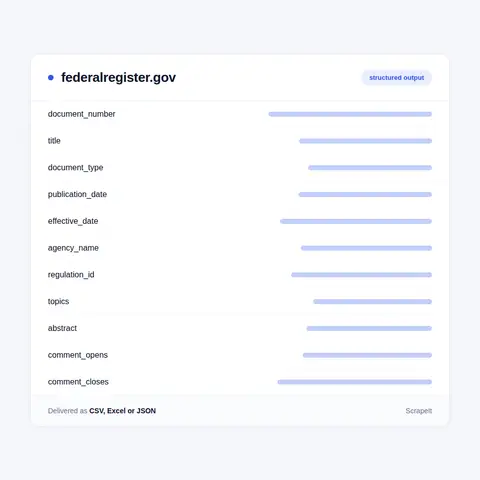
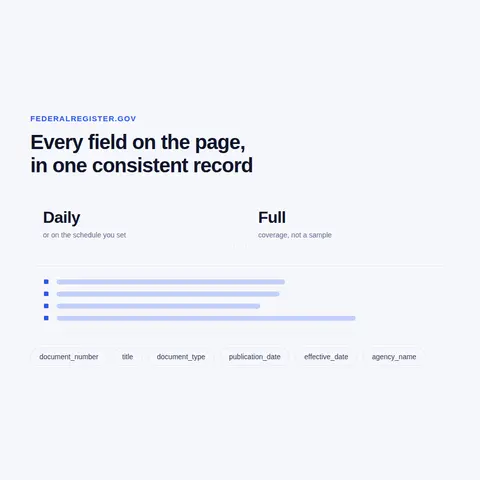
Document records carry the document number, title, type, publication date, effective date where stated, the issuing agencies, the regulation identifier where assigned, topics, abstract and the full text where needed.

The regulation identifier is what makes lifecycle reconstruction possible. Documents belonging to one rulemaking share it, and without it a client is left matching on title text, which fails exactly when an agency rewords a title between stages.

Agency is delivered as rows rather than a single field, because documents are frequently issued jointly and flattening a joint issuance to one agency quietly reassigns regulatory activity from one body to another.

Comment period fields are collected where published: opening date, closing date and where comments are submitted. Those are the operationally useful dates for anyone who needs to respond rather than just observe.

Every row carries the collection timestamp and whether it came from the published interface or from page collection.

Federal Register fields in every export
Comment deadlines, agency activity and open licensing

Comment deadlines, agency activity and open licensing

Comment deadline monitoring is the most operationally valuable output. A feed of what is open for comment, closing when, by agency and topic, is directly actionable for anyone with a regulatory affairs function.

Agency activity analysis - volume and type of documents by agency over time - is a straightforward read on where regulatory attention is going, and it is robust because the underlying classification is the government's own.

Lifecycle reconstruction, once built, supports the harder questions: how long rulemakings take by agency, how often proposals change materially between stages, and which ones quietly never finish.

On rights this source is unusually simple. US federal government works are generally not subject to copyright, which makes this one of the few sources in this catalogue where reuse is broadly unproblematic. We still say generally rather than always, because incorporated third party material can carry its own terms, and we flag those rather than assuming.

The daily journal of the US government

The Federal Register publishes the daily record of US federal agency activity: proposed rules, final rules, notices and presidential documents. It is where regulation is formally announced and where the public comment process begins.

It is also one of the better-run public data sources anywhere. There is a documented programmatic interface, and it covers a great deal of what people arrive wanting: search, document metadata, full text, agency and topic classification.

That shapes how we scope work here. The first step is checking whether the published interface answers the question, because where it does, building a collector is work nobody should pay for. We say that in the quote rather than after.

What the interface does not hand over neatly is the lifecycle. A regulation exists as a sequence of documents over months or years - proposed, commented on, finalised, sometimes corrected or withdrawn - and reconstructing that chain is a modelling problem rather than a retrieval one.

Get a Quote
dev_w
25

Developers

customers
500+

Customers worldwide

pages
1 500 000 000+

Pages extracted

stime
15000+

Hours saved for our clients

Plans

Airplane

€199 / one-time

setup fee - included

Data limits100,000
Frequencyone-time
Run timeup to 5 days
Data storing7 days

Helicopter

€169 / mo

setup fee €499

Data limits250,000
Frequencymonthly
Run timeup to 5 days
Data storing14 days

Glasses

€229 / mo

setup fee €499

Data limits1,000,000
Frequencyweekly
Run timeup to 5 days
Data storing30 days

DNA

€549 / mo

setup fee €799

Data limits3,000,000
Frequency3 times daily
Run timesame day
Data storing90 days

Why the lifecycle is the part worth building

Almost every brief that arrives here can be split into two halves, and the halves need completely different answers.

The first half - find documents matching these criteria, give me their metadata and text - is already solved by the published interface. Quoting a scraping project for it would be charging for a wrapper around something free, and we do not do that.

The second half is the lifecycle, and it is genuinely unsolved. A rule that was proposed in one year, drew comments, was finalised in another and amended after that is one regulatory story told across several documents. Assembling that chain, with dates, stages and the relationships between documents, is what turns a document archive into something a compliance or policy team can act on.

The third piece is cross-source joining. Rulemaking connects to the comment dockets, to the codified regulations and to agency guidance published elsewhere, and the value in a regulatory dataset usually sits in those joins rather than in any single source.

The fourth is timing. Effective dates, comment deadlines and publication dates are three different dates, and a dataset that carries one of them and calls it the date will eventually cause somebody to miss a deadline.

Our Blog

Reads Our Latest News & Blog

Learn how to use web scraping to solve data problems for your organization

How Artificial Intelligence Is Used In Web Scraping

How Artificial Intelligence Is Used In Web Scraping

Leveraging advances in technology, the AI-powered web scraper has skyrocketed in demand and is helping to expand capabilities by automating tedious daily tasks and speeding up data collection from thousands of websites several times over.

What is Web Scraping and What is it Used For?

What is Web Scraping and What is it Used For?

Web scraping is a method of obtaining web data by extracting it from pages of web resources with the help of a program, that is, in automatic mode. It is used to syntactically convert web pages into more usable forms.

Web Scraping for Machine Learning

Web Scraping for Machine Learning

If you specialize in machine learning, you need to feed large amounts of data to the algorithms. Web scraping is the easiest and the most efficient method of collecting the data from all over the Internet.

scrapeit logo

Who builds and keeps your regulatory feed

ScrapeIt is a managed extraction company, not a tool you have to learn. Our team builds the pipeline, maintains the lifecycle logic as document conventions change, and repairs it before a comment deadline goes unnoticed.

You see a sample first, in your format, over the agencies you actually track, with lifecycle chains assembled so you can judge the modelling on a real rulemaking.

FAQ

Why would you tell me not to buy a pipeline?

Because a large share of what people ask for here is already answered by the published interface, and charging for a wrapper around something free is not a business we want. We check first and say so in the quote.

What is the lifecycle and why build it?

A regulation is a sequence of documents over months or years - proposed, commented on, finalised, sometimes corrected. Assembling that chain with its stages and dates is what turns a document archive into something a compliance team can act on, and it is not handed to you ready made.

Why are agencies delivered as rows?

Because documents are frequently issued jointly, and flattening a joint issuance to a single agency quietly reassigns regulatory activity from one body to another - an error that is invisible in the output and wrong in every aggregate.

Which date should I use?

Depends what you are asking, which is why we carry publication, effective and comment closing dates separately. A dataset that keeps one of them and calls it the date eventually causes somebody to miss a deadline.

Can I reuse this content?

Generally yes - US federal government works are typically not subject to copyright, which makes this one of the least restricted sources in our catalogue. We say generally rather than always, because incorporated third party material can carry its own terms and we flag those.

How does it Work?

Step 1 - Make a Request

You share your needs, expectations, and desired timeframe. We’ll suggest the best solution based on your request and budget.

Step 2 - Configuring Custom Web Crawlers

Our specialists configure the crawlers and extract a sample dataset for your review before proceeding with the full-scale extraction.

Step 3 - Collect and Deliver

Once you approve the sample, we launch the project and start full data collection. We gather, filter, and structure the data for easy use, delivering it on time in your preferred format.

Step 4 - Maintain and Support

Our team manages ongoing processes, monitors website changes, and supports all data extraction cycles. We can also help integrate data into your systems or create dashboards to simplify analysis.

Request a Quote

Tell us more about you and your project information.
Which sites, which fields, how often. A couple of lines is enough.

We reply within 1 business day. No obligation.

scrapiet

Scrapeit Sp. z o.o.
10/208 Legionowa str., 15-099, Bialystok, Poland
NIP: 5423457175
REGON: 523384582