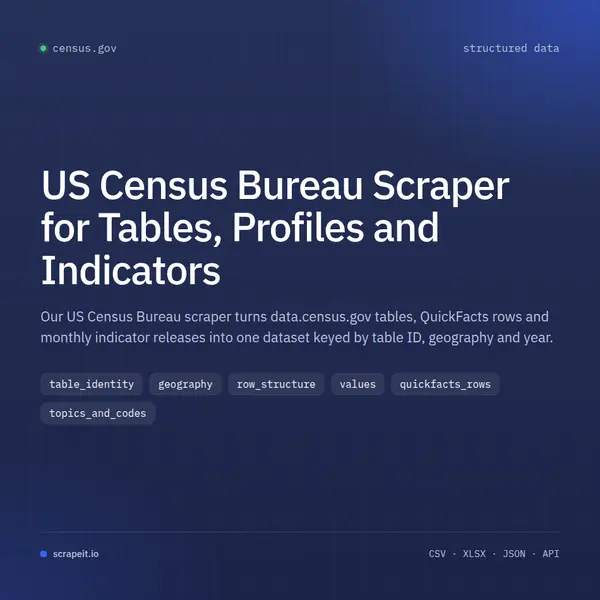
US Census Bureau Scraper for Tables, Profiles and Indicators

Our US Census Bureau scraper turns data.census.gov tables, QuickFacts rows and monthly indicator releases into one dataset keyed by table ID, geography and year.

Plans from €169 a month · Free project assessment · Reply within 1 business day

CSV · Excel · JSON · XML · FTP · SFTP · Amazon S3 · Google Cloud

census.gov
US Census Bureau Scraper for Tables, Profiles and Indicators
census.govwhat you get
Typical fields for public registers
record_identity_namestatusregistered_ataddressdocument_url
Delivery

API, JSON feed or CSV, XLSX and JSON files

Schedule

One-time, monthly, weekly, daily or 3 times a day

How a managed census data scraper works

  1. You send

    U.S. Census Bureau pages, filters, fields and a schedule

  2. We run the scrapers

    Built, monitored and repaired by our team

  3. You receive the data

    API, JSON feed or CSV, XLSX and JSON files

You name the tables, the geographies and the years; we build the crawlers, run them and repair them when census.gov changes a page. A request can be as narrow as DP05 for every county in one state or as wide as every QuickFacts fact for all places above its size cut-off. data.census.gov builds its tables by script, so rendering, pacing, proxy rotation and CAPTCHA handling are part of the service.

Each run is one-off or on the schedule you set, and the output arrives as CSV, Excel or JSON, through our API, or as a load into your database. Field documentation ships with the first delivery, and a free project assessment comes before any quote.

US Census Bureau datasets: fields we extract

A census figure only makes sense with its coordinates attached: which table, which vintage, which geography and how reliable the estimate is. We keep all four on every row.

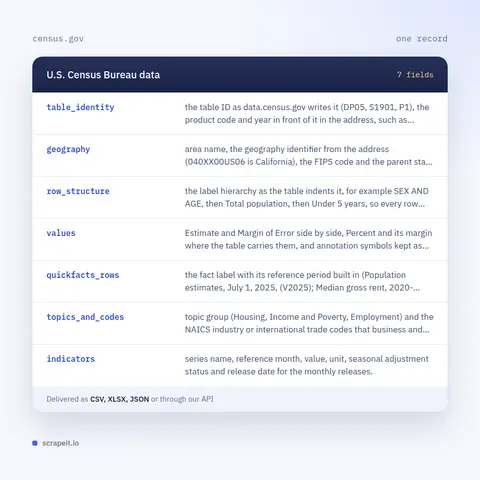
  • Table identitythe table ID as data.census.gov writes it (DP05, S1901, P1), the product code and year in front of it in the address, such as ACSDP5Y2023, the table title and the survey or program it belongs to: American Community Survey, Decennial Census, Population Estimates, Economic Census, Economic Surveys or Public Sector.
  • Geographyarea name, the geography identifier from the address (040XX00US06 is California), the FIPS code and the parent state or county. Levels run from Nation and State through County, County Subdivision, Place, ZIP Code Tabulation Area and Metropolitan/Micropolitan Statistical Area down to Census Tract, Block Group and Block.
  • Row structurethe label hierarchy as the table indents it, for example SEX AND AGE, then Total population, then Under 5 years, so every row keeps its parent group.
  • ValuesEstimate and Margin of Error side by side, Percent and its margin where the table carries them, and annotation symbols kept as text instead of being turned into zeros.
  • QuickFacts rowsthe fact label with its reference period built in (Population estimates, July 1, 2025, (V2025); Median gross rent, 2020-2024), the value, fact note letters and value flags such as D, S, X and Z.
  • Topics and codestopic group (Housing, Income and Poverty, Employment) and the NAICS industry or international trade codes that business and trade tables are cut by.
  • Indicatorsseries name, reference month, value, unit, seasonal adjustment status and release date for the monthly releases.

The margin of error matters most at tract and block group level, where samples are small and a gap between two neighbourhoods can sit inside the error band. Median household income for a tract without its margin is a number you cannot rank on.

US Census Bureau datasets: fields we extract
Scrape Census Bureau releases: vintages, indicators and trade balance

Scrape Census Bureau releases: vintages, indicators and trade balance

One table is one vintage of one product. Most projects need the series around it, and the US Census Bureau data release schedule decides when each piece appears.

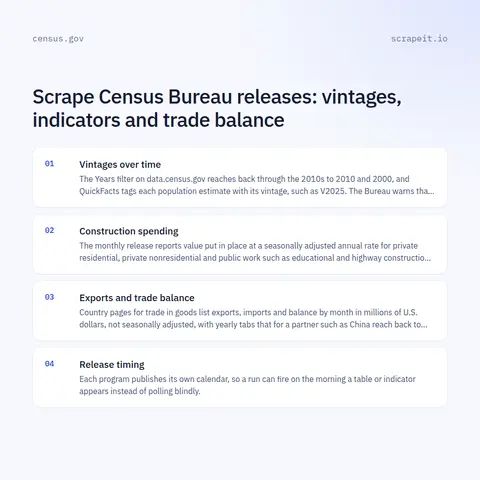
  • Vintages over timeThe Years filter on data.census.gov reaches back through the 2010s to 2010 and 2000, and QuickFacts tags each population estimate with its vintage, such as V2025. The Bureau warns that different vintages are not comparable, so repeated runs keep each one as its own row and a revision never overwrites the figure you already modelled on.
  • Construction spendingThe monthly release reports value put in place at a seasonally adjusted annual rate for private residential, private nonresidential and public work such as educational and highway construction. Data center construction is reported as a separate line inside private office, and we capture each release with the revisions to earlier months.
  • Exports and trade balanceCountry pages for trade in goods list exports, imports and balance by month in millions of U.S. dollars, not seasonally adjusted, with yearly tabs that for a partner such as China reach back to 1985.
  • Release timingEach program publishes its own calendar, so a run can fire on the morning a table or indicator appears instead of polling blindly.

About the U.S. Census Bureau and data.census.gov

Source
census.gov
Category
public registers
Delivery
API, JSON feed, CSV, XLSX
Plans
From €169 a month
Get a quote

The U.S. Census Bureau, part of the U.S. Department of Commerce, publishes statistics on people, housing, businesses, governments and trade. For anyone collecting its numbers, census.gov is less one website than several publishing systems under one domain.

data.census.gov is the main table platform. Its search splits results into Tables, Maps, Charts, Profiles and Pages, and its filter panel works on Geographies, Topics, Surveys, Years and Codes - NAICS industries, commodities and international trade among them. Each table result names its program and links to the same table in its other products and years, which is why one table ID can stand for many distinct data tables.

QuickFacts condenses the most requested figures for all states and counties, and for cities and towns with a population of 5,000 or more, into one view that mixes sources: Population Estimates, the American Community Survey, County Business Patterns, Nonemployer Statistics, the Economic Census, the Annual Business Survey and Building Permits.

Economic indicators and foreign trade statistics sit in their own sections of census.gov, published as press releases and HTML tables on a fixed calendar.

25Developers
500+Customers
1.5BPages extracted
15,000+Hours saved for our clients

U.S. Census Bureau scraping plans and pricing

Airplane

€199one-time

Setup fee included

100,000
One-time
Up to 5 days
7 days

Helicopter

€169/ mo

Setup fee €499

250,000
Monthly
Up to 5 days
14 days

Glasses

€229/ mo

Setup fee €499

1,000,000
Weekly
Up to 5 days
30 days

Microscope popular

€349/ mo

Setup fee €499

2,000,000
Daily
Same day
60 days

DNA

€549/ mo

Setup fee €799

3,000,000
3 times daily
Same day
90 days

Delivery: CSV, JSON or XLSX files, our API or a JSON feed. MCP server on request.

Full plan details

Why teams collect US Census Bureau data at scale

Census tables are the denominator behind most location decisions in the United States, and the work is rarely about one table.

  • Site selection and retail planningpopulation, age bands, households and median household income by census tract or ZIP Code Tabulation Area, joined to your store or branch list on the geography identifier.
  • Housing researchowner-occupied rate, median value of owner-occupied homes, median gross rent and building permits by county or place, compared across vintages.
  • Market sizing by industryCounty Business Patterns establishments, employment and annual payroll by NAICS code, set against nonemployer counts for the same county.
  • Macro and sector trackingconstruction spending, including the data center line, and monthly exports by partner country, captured on release day with the revisions that follow.
  • Modelling teamsone long table with estimate and margin of error in separate columns, so a model can weight small areas by reliability instead of dropping them.

About ScrapeIt

ScrapeIt is a managed web scraping service: we build, run and maintain the crawlers, and you receive the dataset. Statistical sites are a different job from shops and marketplaces - less about reaching a page, more about keeping table IDs, vintages, geographies and footnotes straight across thousands of combinations. Every column is described in the field documentation, and suppressed or unavailable cells are flagged, never filled. Plans start from EUR 169 a month, or EUR 199 for a one-time extract.

FAQ

Still unsure? Write to info@scrapeit.io

Do you offer a US Census Bureau API for table data?

Yes. The ScrapeIt US Census Bureau API returns table ID, geography identifier, row label, estimate, margin of error and vintage as JSON from an endpoint we host, refreshed on the schedule you set. The same data also comes as CSV or XLSX files, a JSON feed or a load into your database.

Is it legal to scrape the US Census Bureau website?

Yes. Tables, QuickFacts and indicator releases are published for every visitor, with no account needed to read them. We collect only publicly available data - everything a visitor can see on census.gov - and we collect it legally. The figures are aggregates, and cells the Bureau suppresses to avoid disclosure keep their D flag in our files.

How often does the Census Bureau collect data, and how often should a run repeat?

It depends on the program: the decennial census counts the population every ten years, the American Community Survey is ongoing and publishes yearly estimates, the Economic Census covers years ending in 2 and 7, and indicators such as construction spending come monthly. We match runs to that calendar - monthly for indicators, yearly for ACS tables, once for a historical pull.

Can you cover every geography level, down to census tract and block group?

Yes, wherever the table is published at that level. ACS five-year estimates reach census tract for all tables and block group for selected detailed tables, while QuickFacts stops at cities and towns. We enumerate the geographies first - every tract in a county, every place in a state - then collect each table for each one, keeping the identifier so rows join to your own maps.

Do you also track construction spending and exports by country?

Yes. We collect every monthly construction spending release, including the data center line under private office, and the trade-in-goods tables that list exports, imports and balance by partner country and month. Each row carries the release date, so a revised month shows up as a new version rather than a silent change.

How it works

  1. 1

    Make a request

    You share your needs, expectations, and desired timeframe. We'll suggest the best solution based on your request and budget.

  2. 2

    We configure the crawlers

    Our specialists configure the crawlers and extract a sample dataset for your review before proceeding with the full-scale extraction.

  3. 3

    Collect and deliver

    Once you approve the sample, we launch the project and start full data collection. We gather, filter, and structure the data for easy use, delivering it on time in your preferred format.

  4. 4

    Maintain and support

    Our team manages ongoing processes, monitors website changes, and supports all data extraction cycles. We can also help integrate data into your systems or create dashboards to simplify analysis.

Request a quote

Tell us which sites, which fields and how often. A couple of lines is enough to start.

  • We reply within 1 business day
  • A sample dataset before the full run
  • We sign an NDA on request
  • Delivery by API, JSON feed or files
Which sites, which fields, how often. A couple of lines is enough.

This form is protected by Google reCAPTCHA, which loads when you start filling it in; the Google Privacy Policy and Terms of Service apply. If you prefer not to use it, email us at info@scrapeit.io. Privacy & Cookie Policy

We reply within 1 business day. No obligation.

U.S. Census Bureau data from €169/month. Free project assessment, reply within 1 business day.