EPA ECHO Scraper for Facility Compliance and Enforcement Data

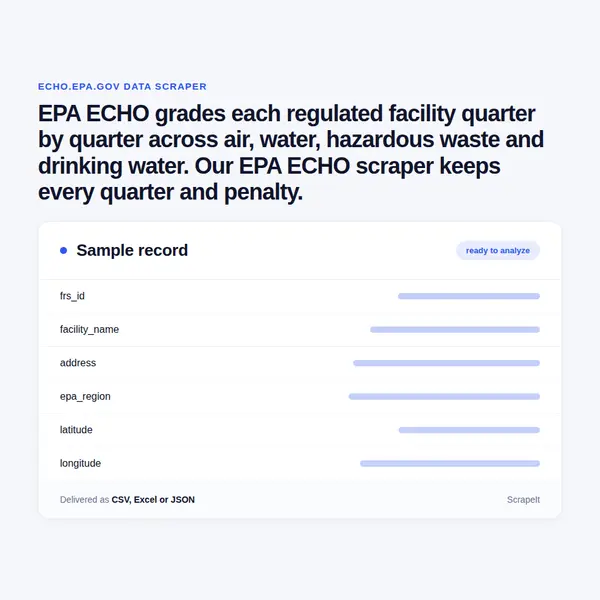
EPA ECHO grades each regulated facility quarter by quarter across air, water, hazardous waste and drinking water. Our EPA ECHO scraper keeps every quarter and penalty.

Plans from €169 a month · Free project assessment · Reply within 1 business day

CSV · Excel · JSON · XML · FTP · SFTP · Amazon S3 · Google Cloud

echo.epa.gov
EPA ECHO Scraper for Facility Compliance and Enforcement Data
echo.epa.govwhat you get
Typical fields for public registers
record_identity_namestatusregistered_ataddressdocument_url
Delivery

API, JSON feed or CSV, XLSX and JSON files

Schedule

One-time, monthly, weekly, daily or 3 times a day

How to Scrape EPA ECHO Facility Records

  1. You send

    EPA ECHO pages, filters, fields and a schedule

  2. We run the scrapers

    Built, monitored and repaired by our team

  3. You receive the data

    API, JSON feed or CSV, XLSX and JSON files

You set the scope: a state, county or ZIP code, an EPA Region, NAICS or SIC codes, a programme such as the Clean Air Act or RCRA, a compliance status, or simply a list of FRS IDs or company names. We build the crawlers for the facility search, the Detailed Facility Report and the enforcement case search, keep them running and fix them when ECHO changes. Search results are paged and capped, so a large scope is split into smaller searches and merged on the FRS ID; rendering, pacing and proxy rotation are part of the service.

Runs are one-off or scheduled, weekly for a supplier list or monthly for a whole industry. Field documentation comes with the dataset, and a free project assessment tells you what the run will return before you order it.

EPA ECHO Data: Detailed Facility Report Fields

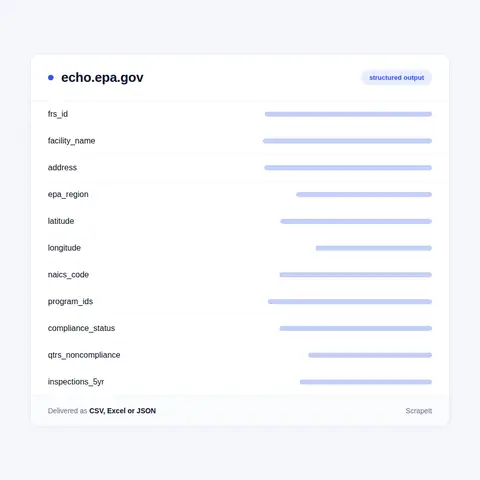
The core record is the Detailed Facility Report, one per facility, opened by its FRS ID - the Facility Registry Service number that ties together every programme ID a site holds. The report has six sections: Facility Summary, Facility/System Characteristics, Enforcement and Compliance, Environmental Conditions, Pollutants and Community. We read them all into one row per facility plus child tables.

  • Facilityname, address, FRS ID, EPA Region, latitude and longitude with the locational data source, industry codes (NAICS and SIC) and the Indian Country flag.
  • Programme systemseach statute's system with its source ID (NPDES, ICIS-Air, RCRA, SDWA), universe, status and, for the Clean Water Act, the permit expiration date.
  • Compliance statusper statute, from No Violation Identified to High Priority Violation under the Clean Air Act, Significant/Category I Noncompliance under the Clean Water Act, Significant Noncomplier under RCRA and Enforcement Priority under the Safe Drinking Water Act, with quarters with noncompliance out of 12 and quarters with significant violation.
  • Inspectionscompliance monitoring activities over five years, the date of the last one and its type.
  • Violationsviolation type, violation determined date, return to compliance date for RCRA and violation end date for the Clean Air Act.
  • Enforcementinformal enforcement actions with type of action, lead agency and date; formal enforcement actions with action type, law and section, case number, case name, issued or filed date, settlement date, federal and state or local penalty assessed, penalty amount collected, SEP value and compliance action cost.
  • PollutantsToxics Release Inventory (TRI) releases by year to air, surface water, land and underground injection, CWA discharge monitoring report loadings, SDWA lead and copper 90th percentile results against the action level, and hazardous waste shipped by year.
  • Surroundingsthe 12-digit watershed, assessed water conditions, air quality nonattainment areas and the demographic profile of the surrounding area.

Facilities are businesses and public bodies, collected as ECHO names them, with the source's own data last refreshed stamp on each row.

EPA ECHO Data: Detailed Facility Report Fields
Building an EPA ECHO Dataset Beyond One Facility

Building an EPA ECHO Dataset Beyond One Facility

The facility search is where coverage is planned. Its results table carries counts the report only implies - compliance monitoring activity over five years, significant violations, quarters with noncompliance over three years, formal enforcement actions over five years, total penalties, the date and amount of the last penalty, GHG and TRI releases - and the programme ID columns for ICIS-Air, NPDES, RCRA, RMP, SEMS, SDWA, TRI, GHG and TSCA that show which programmes touch a site.

The enforcement case search adds the case view: case identifier, case name, case category, civil or criminal indicator, case status, primary law and section, filed or issued date, settlement date, federal penalty assessed or agreed to, SEP value, value of complying actions and enforcement outcome. We join cases to facilities by name and address so a penalty sits beside the site that paid it.

Time is the reason to run it more than once. The compliance grid shows a rolling twelve quarters, so the oldest quarter drops off as each new one is added. Snapshots kept on a schedule build a compliance history longer than any single report shows, and a facility's slide from violation identified to significant violation is caught when it happens.

About the EPA ECHO Database

Source
echo.epa.gov
Category
public registers
Delivery
API, JSON feed, CSV, XLSX
Plans
From €169 a month
Get a quote

ECHO - Enforcement and Compliance History Online - is run by the US Environmental Protection Agency at echo.epa.gov. It brings together the inspection, violation and enforcement records of four programmes: the Clean Air Act for stationary sources of air pollution, the Clean Water Act's NPDES permits for wastewater, biosolids and industrial stormwater, RCRA Subtitle C for hazardous waste, and the Safe Drinking Water Act for public water systems.

Federal and state records sit side by side. A formal action may be led by EPA or by a state or local agency, which is why the lead agency field matters, and civil cases come from a different source system than criminal ones. Search tools are split the same way: an All Media Programs facility search, one search per programme, a drinking water system search, the Corporate Compliance Screener and the EPA enforcement case search.

Around them sit analysis tools - EPA/State dashboards, the Water Pollutant Loading Tool, the ECHO Clean Air Tracking Tool, the Data Visualization Gallery and PFAS Analytic Tools. ECHO also publishes a Known Data Problems page and a refresh date for each source, a reminder that each programme reports on its own timetable.

25Developers
500+Customers
1.5BPages extracted
15,000+Hours saved for our clients

EPA ECHO scraping plans and pricing

Airplane

€199one-time

Setup fee included

100,000
One-time
Up to 5 days
7 days

Helicopter

€169/ mo

Setup fee €499

250,000
Monthly
Up to 5 days
14 days

Glasses

€229/ mo

Setup fee €499

1,000,000
Weekly
Up to 5 days
30 days

Microscope popular

€349/ mo

Setup fee €499

2,000,000
Daily
Same day
60 days

DNA

€549/ mo

Setup fee €799

3,000,000
3 times daily
Same day
90 days

Delivery: CSV, JSON or XLSX files, our API or a JSON feed. MCP server on request.

Full plan details

Why Collect EPA ECHO Compliance Records

A facility's record in ECHO is a running account of how it treats air, water and waste, and several kinds of buyer read it for different reasons.

  • Supplier and ESG screeningSignificant violations, quarters in noncompliance and penalties across every facility of a parent company give a procurement or ESG team a factual score per site.
  • Lending, insurance and due diligenceFormal actions, settlements, SEP values and TRI releases are the environmental history of a plant before it is financed, insured or acquired.
  • Environmental consulting and salesNPDES permit expiration dates and open violations point to the facilities that need permit renewals, monitoring or remediation work next.
  • Water quality and utilitiesSDWA lead and copper results against the action level, and DMR loadings by permit, show where drinking water and discharge risks concentrate.
  • Research and reportingFacility coordinates joined to the demographic profile, nonattainment areas and impaired waters support environmental justice studies, PFAS investigations and local journalism.

About ScrapeIt

We are ScrapeIt, a managed data collection service: we design the crawl, run it, fix it and deliver the rows as CSV, XLSX or JSON files, through a JSON feed, SFTP or Google Cloud Storage, or as a load into your database. Compliance registers such as ECHO are about joins as much as pages - facility to programme, programme to case, case to penalty - and we keep those keys intact. Facilities are organisations, so the data is collected as published. Plans start from EUR 169 a month, or EUR 199 for a one-time extract.

FAQ

Still unsure? Write to info@scrapeit.io

Do you offer an EPA ECHO API for facility compliance data?

Yes. The ScrapeIt EPA ECHO API returns FRS ID, facility name, compliance status by statute, quarters with noncompliance, formal enforcement actions and penalties as JSON from an endpoint we host, refreshed on the schedule you choose. You can also take the same rows as CSV or Excel files, a JSON feed or a load into your database.

Is it legal to scrape EPA ECHO?

Yes. ECHO publishes facility reports, compliance status, inspections and enforcement cases for public review. We collect only publicly available data - everything a visitor can see on EPA ECHO - and we collect it legally. The records describe facilities run by companies and public bodies rather than private persons.

How often is EPA ECHO data updated in your deliveries?

Each programme refreshes on its own timetable, and ECHO shows the date each source was last refreshed. We run on the cadence you pick, weekly or monthly in most projects, and stamp every row with both our collection date and ECHO's own refresh date, so you always know how current a status is.

Can you track EPA ECHO violations by facility over time?

Yes. The report shows a rolling twelve-quarter compliance grid, so we store every quarter from every run and the history keeps growing after quarters leave the live report. New violations, violation determined dates and return to compliance dates are kept per facility and per statute.

Can you pull EPA ECHO DMR data for wastewater permits?

Yes. For Clean Water Act facilities the report lists discharge monitoring report pollutant loadings by NPDES ID and year, next to the permit status and expiration date. We deliver them per permit, loading category and year, with the load over limit, ready to compare plants within a watershed or an industry.

How it works

  1. 1

    Make a request

    You share your needs, expectations, and desired timeframe. We'll suggest the best solution based on your request and budget.

  2. 2

    We configure the crawlers

    Our specialists configure the crawlers and extract a sample dataset for your review before proceeding with the full-scale extraction.

  3. 3

    Collect and deliver

    Once you approve the sample, we launch the project and start full data collection. We gather, filter, and structure the data for easy use, delivering it on time in your preferred format.

  4. 4

    Maintain and support

    Our team manages ongoing processes, monitors website changes, and supports all data extraction cycles. We can also help integrate data into your systems or create dashboards to simplify analysis.

Request a quote

Tell us which sites, which fields and how often. A couple of lines is enough to start.

  • We reply within 1 business day
  • A sample dataset before the full run
  • We sign an NDA on request
  • Delivery by API, JSON feed or files
Which sites, which fields, how often. A couple of lines is enough.

This form is protected by Google reCAPTCHA, which loads when you start filling it in. If you prefer not to use it, email us at info@scrapeit.io. Privacy & Cookie Policy

We reply within 1 business day. No obligation.

EPA ECHO data from €169/month. Free project assessment, reply within 1 business day.