Congress.gov Scraper for Bills, Actions and Members

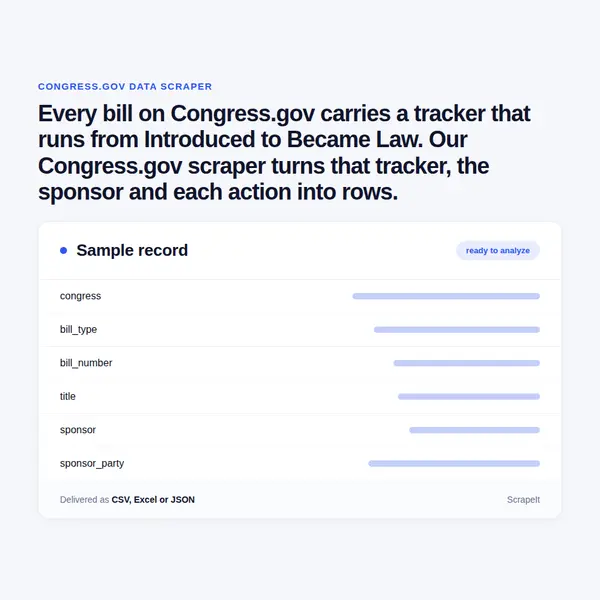
Every bill on Congress.gov carries a tracker that runs from Introduced to Became Law. Our Congress.gov scraper turns that tracker, the sponsor and each action into rows.

Plans from €169 a month · Free project assessment · Reply within 1 business day

CSV · Excel · JSON · XML · FTP · SFTP · Amazon S3 · Google Cloud

congress.gov
Congress.gov Scraper for Bills, Actions and Members
congress.govwhat you get
Typical fields for public registers
record_identity_namestatusregistered_ataddressdocument_url
Delivery

API, JSON feed or CSV, XLSX and JSON files

Schedule

One-time, monthly, weekly, daily or 3 times a day

Scrape Congress.gov as a Managed Service

  1. You send

    Congress.gov pages, filters, fields and a schedule

  2. We run the scrapers

    Built, monitored and repaired by our team

  3. You receive the data

    API, JSON feed or CSV, XLSX and JSON files

You tell us which slice of Congress.gov matters - one Congress or several, a bill type such as H.R., S. or H.J.Res., a policy area, a committee, a list of sponsors or a fixed watchlist of bill numbers - and how often the run should repeat. We build the crawlers, schedule them and repair them when Congress.gov changes its pages. Anti-bot handling - pacing, proxy rotation, CAPTCHA handling and rendering - is part of the service.

Each project opens with a free assessment of the scope, followed by a sample file you can check against the bills you already know. Field documentation comes with the dataset. Analysts usually take CSV or Excel; engineering teams take JSON or JSONLines on SFTP or Amazon S3, or a load straight into their database.

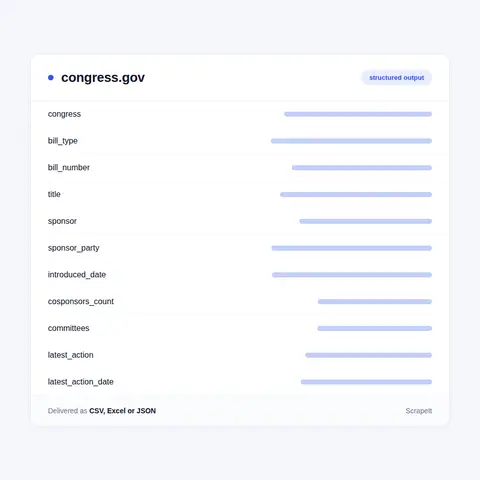
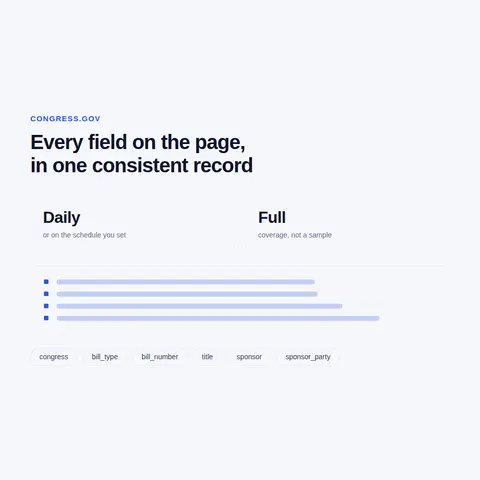
Congress.gov Data: Fields We Collect per Bill

A measure on Congress.gov is named by three parts: the Congress, the type and the number. The page address spells them out, as in /bill/118th-congress/house-bill/ followed by the number, and we keep the same three parts as the row key, so H.R. 1 of one Congress never merges with H.R. 1 of the next.

  • IdentityCongress, bill or resolution type (H.R., S., H.Res., S.Res., H.J.Res., S.J.Res., H.Con.Res., S.Con.Res.), number, the official and short titles listed on the Titles tab, and the page URL.
  • Sponsor and cosponsorsthe sponsor with party and state as the overview prints them, the introduction date, and every cosponsor with the date they signed on. Members of Congress act in public office, so their names stay in the data.
  • Statusthe tracker stage (Introduced, Passed House, Passed Senate, To President, Became Law), the latest action with its date, and the public law number once a bill is enacted.
  • Actionsthe full action history with date, chamber and action text, including the Congressional Record page references, roll call votes and committee reports the Actions tab links to.
  • Committeescommittees and subcommittees of referral with the activity recorded against each, plus committee reports and CBO cost estimates where the overview lists them.
  • Subjectsthe one policy area assigned to every public bill and the legislative subject terms that Congressional Research Service analysts add.
  • Summary and textthe CRS summary written for each version, the list of text versions with their dates, and the full text when the project needs it.
  • Linksamendments with their own numbers and sponsors, and related bills with the relationship Congress.gov states, such as an identical bill in the other chamber.

Search results already show the title, sponsor, committees, latest action and tracker for each bill, so a crawl can start from a query and then open the tabs only for the bills that need the full record.

Congress.gov Data: Fields We Collect per Bill
Congress.gov Bill Tracker: Actions Over Time

Congress.gov Bill Tracker: Actions Over Time

A single snapshot tells you where a bill stands today. Repeated runs tell you how it got there: the day it was reported out of committee, the week its cosponsor count doubled, the vote that moved the tracker from Passed House to Passed Senate. Keyed on Congress, type and number, those runs become a bill tracker for your own watchlist, with dated rows for every new action, cosponsor and text version.

Coverage can be cut the way Congress.gov cuts it: by Congress, bill type, status of legislation, policy area, chamber of origin, committee, sponsor, cosponsor or the sponsor's party. Beyond legislation, the same project can take member pages - each with its own identifier in the address, the member's party, state, years of service and lists of sponsored and cosponsored legislation - and the other collections: committee reports, nominations, treaty documents, House and Senate communications and the daily Congressional Record. We deliver them as linked tables, so a committee report row points back to the bill it reports on.

Inside the Congress.gov Legislative Database

Source
congress.gov
Category
public registers
Delivery
API, JSON feed, CSV, XLSX
Plans
From €169 a month
Get a quote

Congress.gov is the Library of Congress site for the work of the US Congress, and the successor to the older THOMAS system. Its core is legislation: every bill and resolution introduced in the House and the Senate, for the current Congress and the earlier ones the site holds. Each record is built by more than one office: the actions record what each chamber did, while the summaries, the policy area and the legislative subject terms come from the Congressional Research Service.

The site is organised around the two-year Congress. Bill numbers restart with each one, which is why the Congress number belongs in every row. A bill record has a collapsible overview with the sponsor, committees, latest action and tracker, and a row of tabs below it: Summary, Text, Actions, Titles, Amendments, Cosponsors, Committees, Related Bills and Subjects.

Around legislation sit the other collections - members, committees, the Congressional Record, committee reports, nominations, treaty documents and communications to each chamber. For anyone who needs data, that makes Congress.gov the legislative half of US lawmaking; the rules agencies write afterwards are published elsewhere, in the Federal Register.

25Developers
500+Customers
1.5BPages extracted
15,000+Hours saved for our clients

Congress.gov scraping plans and pricing

Airplane

€199one-time

Setup fee included

100,000
One-time
Up to 5 days
7 days

Helicopter

€169/ mo

Setup fee €499

250,000
Monthly
Up to 5 days
14 days

Glasses

€229/ mo

Setup fee €499

1,000,000
Weekly
Up to 5 days
30 days

Microscope popular

€349/ mo

Setup fee €499

2,000,000
Daily
Same day
60 days

DNA

€549/ mo

Setup fee €799

3,000,000
3 times daily
Same day
90 days

Delivery: CSV, JSON or XLSX files, our API or a JSON feed. MCP server on request.

Full plan details

Why Teams Need a Congress.gov Dataset

Government affairs and lobbying teams run the most common project: a watchlist of bills by policy area or keyword, refreshed daily while Congress is in session, with an alert when the latest action changes or a bill is referred to a committee they follow. The committees and actions columns carry that signal directly.

Cosponsor lists are the second use. The number of cosponsors, their party split and the dates they joined show whether a bill is gathering support across the aisle or stalling inside one caucus, long before any vote. Matched to member pages, the same rows build a profile of each member's sponsored and cosponsored legislation by policy area.

Researchers and newsrooms take whole Congresses at once: how many bills each committee received, how many reached the floor and how many became public law, compared across Congresses. Compliance and legal teams follow the narrow end - the handful of bills in their sector that reach To President - and read the CRS summary and the enrolled text version before the law takes effect.

About ScrapeIt

ScrapeIt is a managed web scraping service: we build, run and maintain the crawlers, and you receive the data on the schedule you set, one-off or daily, weekly or on demand. Government portals such as Congress.gov ask for exactly that kind of upkeep - records with long histories, identifiers that must stay stable across years, and many linked collections that only make sense once they are joined.

FAQ

Still unsure? Write to info@scrapeit.io

Do you offer a Congress.gov API for bill status and actions?

Yes. The ScrapeIt Congress.gov API returns the bill number, sponsor, cosponsors, latest action, tracker stage and policy area as JSON from an endpoint we host, refreshed on the schedule you set. The same rows also come as CSV or XLSX files, a JSON feed or a load into your database.

Is it legal to scrape Congress.gov?

Yes. Bills, actions, member pages, committee reports and the Congressional Record are published on Congress.gov for anyone to read. We collect only publicly available data - everything a visitor can see on Congress.gov - and we collect it legally.

Which Congresses and bill types can you cover?

Any Congress that Congress.gov holds bill records for, from the current one back through its archive, though older rows may carry status and actions without full text. A project can take all eight bill and resolution types or only H.R. and S. bills, and narrow further by chamber of origin, committee or policy area.

How often are bill actions updated, and how often should you collect them?

New actions, cosponsors and text versions appear on Congress.gov as the chambers process them, so during a session a daily run keeps a watchlist current. Weekly runs suit research archives. On request, each run can be compared with the previous one and the delivery limited to bills whose status changed.

Can you collect nominations and the Congressional Record as well as bills?

Yes. Nominations, the Congressional Record, committee reports and treaty documents are separate collections on Congress.gov, each with its own numbering, and we deliver them as linked tables. A nominations database can sit next to the bill table and share the committee names, so one query covers both.

How it works

  1. 1

    Make a request

    You share your needs, expectations, and desired timeframe. We'll suggest the best solution based on your request and budget.

  2. 2

    We configure the crawlers

    Our specialists configure the crawlers and extract a sample dataset for your review before proceeding with the full-scale extraction.

  3. 3

    Collect and deliver

    Once you approve the sample, we launch the project and start full data collection. We gather, filter, and structure the data for easy use, delivering it on time in your preferred format.

  4. 4

    Maintain and support

    Our team manages ongoing processes, monitors website changes, and supports all data extraction cycles. We can also help integrate data into your systems or create dashboards to simplify analysis.

Request a quote

Tell us which sites, which fields and how often. A couple of lines is enough to start.

  • We reply within 1 business day
  • A sample dataset before the full run
  • We sign an NDA on request
  • Delivery by API, JSON feed or files
Which sites, which fields, how often. A couple of lines is enough.

This form is protected by Google reCAPTCHA, which loads when you start filling it in; the Google Privacy Policy and Terms of Service apply. If you prefer not to use it, email us at info@scrapeit.io. Privacy & Cookie Policy

We reply within 1 business day. No obligation.

Congress.gov data from €169/month. Free project assessment, reply within 1 business day.