NHTSA Scraper for Recalls, Complaints and Safety Ratings

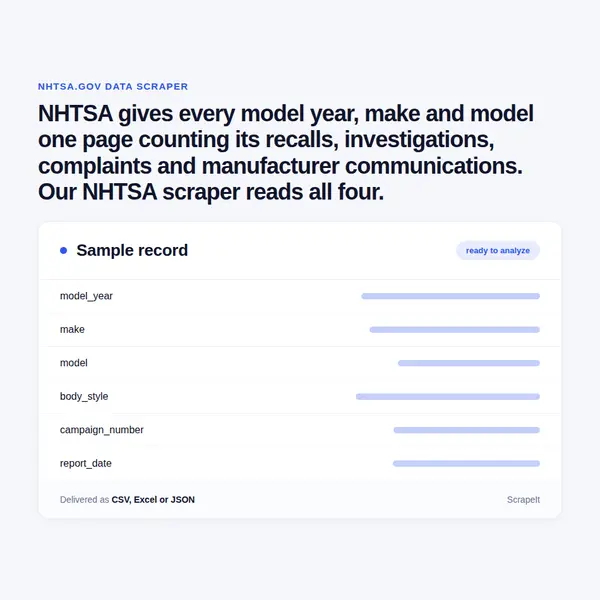
NHTSA gives every model year, make and model one page counting its recalls, investigations, complaints and manufacturer communications. Our NHTSA scraper reads all four.

Plans from €169 a month · Free project assessment · Reply within 1 business day

CSV · Excel · JSON · XML · FTP · SFTP · Amazon S3 · Google Cloud

nhtsa.gov
NHTSA Scraper for Recalls, Complaints and Safety Ratings
nhtsa.govwhat you get
Typical fields for public registers
record_identity_namestatusregistered_ataddressdocument_url
Delivery

API, JSON feed or CSV, XLSX and JSON files

Schedule

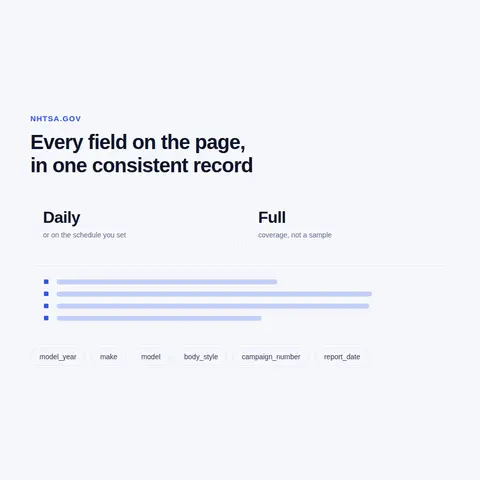
One-time, monthly, weekly, daily or 3 times a day

How to Scrape NHTSA Vehicle Records, Done for You

  1. You send

    NHTSA pages, filters, fields and a schedule

  2. We run the scrapers

    Built, monitored and repaired by our team

  3. You receive the data

    API, JSON feed or CSV, XLSX and JSON files

Tell us the scope - model years, makes and models, a whole make's lineup, a list of campaign numbers, or the VINs of a fleet - and we build the crawler, run it and keep it working when NHTSA changes its pages. The recall, complaint, investigation and manufacturer communication panels only load when opened, and the VIN and license plate lookup is guarded by a CAPTCHA, so rendering, CAPTCHA handling, pacing and proxy rotation come with the service.

If you were weighing how to scrape NHTSA in-house, this is what you skip: the panel logic, the paging inside each panel and the repair work. Runs are one-off or scheduled, daily for a recall watch and weekly for complaint monitoring. You get field documentation with the first file, and a free project assessment before anything runs.

NHTSA Data We Extract per Vehicle

Every vehicle page is addressed by model year, make, model, body style and drive, as in /vehicle/2021/TOYOTA/CAMRY/4 DR/FWD, and carries four counters: recalls, investigations, complaints and manufacturer communications. Each counter expands into records with their own NHTSA identifiers, and we keep them as separate tables joined on the vehicle.

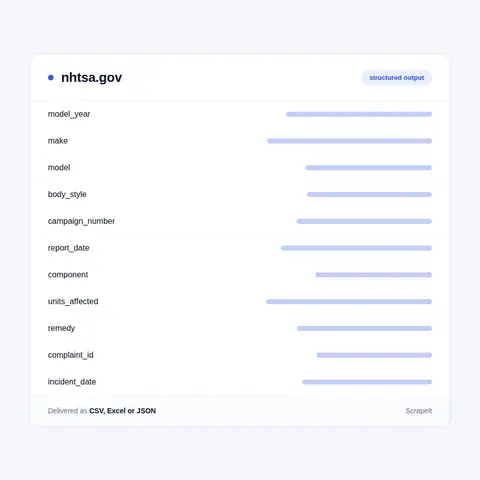
  • Vehiclemodel year, make, model, body style, drive type and the four counters.
  • Recallsdate, NHTSA campaign number such as 23V865000, headline, consequence statement, manufacturer, components, potential number of units affected, summary, remedy, notes, and the counts of associated products and documents.
  • ComplaintsNHTSA ID number, date, incident date, consumer location at city and state, the VIN with its last six characters masked, crash and fire flags, injuries and deaths, component and the complaint narrative.
  • InvestigationsNHTSA action number with its prefix (PE for a preliminary evaluation, EA for an engineering analysis, AQ for an audit query), open or closed status, subject, components, the Opened From period and the Office of Defects Investigation summary.
  • Manufacturer communicationsNHTSA ID number, the manufacturer communication number, components and summary: the service bulletins, warranty extensions and notices a maker files with the agency.
  • 5-Star Safety Ratingsoverall rating, frontal crash (driver and front passenger combined), side crash (side barrier and side pole combined) and rollover resistance, with the rating breakdown.
  • Recommended safety technologyForward Collision Warning, Lane Departure Warning, Crash Imminent Braking and Dynamic Brake Support, each with its availability, such as Standard.
  • Safety featuresfrontal, curtain, torso and knee air bags by seat, seat belt and head restraint features, LATCH locations and anti-pinch power windows.

Rows keep the component names exactly as NHTSA writes them - AIR BAGS, POWER TRAIN, ENGINE - so counts by component line up across makes.

NHTSA Data We Extract per Vehicle
An NHTSA Recall Dataset Across Model Years

An NHTSA Recall Dataset Across Model Years

A recall is filed once but lands on many pages. Campaign 23V865000 appears on the 2021 Camry, yet its summary names Avalon, Corolla, Highlander, RAV4, Sienna Hybrid and several Lexus models across three model years. We key every recall on its campaign number and keep the list of affected vehicles beside it, so a make's recall history is counted once, not once per page.

Coverage runs the same way for the other record types: every model year of a nameplate, every nameplate of a make, then complaints, investigations and manufacturer communications deduplicated on their NHTSA ID numbers. Car seats add their own layer - Ease-of-Use Ratings by brand, model and mode, scored from one to five stars in four categories: Evaluation of Instructions, Vehicle Installation Features, Evaluation of Labels and Securing the Child.

History comes from repeated runs. Complaint counts climb, an investigation moves from open to closed or escalates from a preliminary evaluation to an engineering analysis, and a remedy text gains the dates when owner letters went out. For a fleet we check each VIN against unrepaired recalls, which is exactly what the VIN search reports; repaired recalls and recalls older than fifteen years are not part of that answer.

How the NHTSA Database Is Built, from Complaint to Recall

Source
nhtsa.gov
Category
public registers
Delivery
API, JSON feed, CSV, XLSX
Plans
From €169 a month
Get a quote

The National Highway Traffic Safety Administration is an agency of the US Department of Transportation. It sets vehicle safety standards, rates new cars and requires manufacturers to recall vehicles and equipment with safety defects. Its site is organised under Ratings, Recalls, Risky Driving, Road Safety and Vehicle Safety, and the recall search covers four kinds of product: vehicles, car seats, tires and equipment.

The recall pipeline explains the data. Owners file complaints, which join a public NHTSA database once personally identifying information is removed. The Office of Defects Investigation screens them, analyses petitions and opens investigations; an investigation closes with a recall recommendation or with no defect found. Most recalls are started by manufacturers themselves, and the remedy is a repair, a replacement, a refund or, rarely, a repurchase.

Ratings come from the New Car Assessment Program and its 5-Star Safety Ratings: frontal, side barrier, side pole and rollover tests. They are not all comparable in the same way. Frontal ratings compare only within one weight class, while side ratings compare across all vehicles, and some vehicles show Not Rated. The field documentation carries that rule, so a crash test column is not read across classes by mistake.

25Developers
500+Customers
1.5BPages extracted
15,000+Hours saved for our clients

NHTSA scraping plans and pricing

Airplane

€199one-time

Setup fee included

100,000
One-time
Up to 5 days
7 days

Helicopter

€169/ mo

Setup fee €499

250,000
Monthly
Up to 5 days
14 days

Glasses

€229/ mo

Setup fee €499

1,000,000
Weekly
Up to 5 days
30 days

Microscope popular

€349/ mo

Setup fee €499

2,000,000
Daily
Same day
60 days

DNA

€549/ mo

Setup fee €799

3,000,000
3 times daily
Same day
90 days

Delivery: CSV, JSON or XLSX files, our API or a JSON feed. MCP server on request.

Full plan details

What an NHTSA Dataset Is Used For

The value sits in the joins: a campaign to its components, a complaint to its model year, a rating to its body style.

  • Fleet and dealer recall workA VIN list checked against unrepaired recalls, with the remedy text and campaign number, tells a fleet manager or a used-car dealer which vehicles need a workshop visit before they go back on the road or onto the lot.
  • Parts and aftermarket planningComponents and the potential number of units affected show how many sensors, inflators or modules a remedy will pull through the supply chain, and when.
  • Insurance and risk modelsComplaints with crash, fire, injury and death fields, star ratings and the availability of crash avoidance technology give per-model signals beyond claims history.
  • Product safety and engineeringComplaint narratives grouped by component show a pattern before an investigation opens; investigation summaries often cite the complaint counts that triggered them.
  • Litigation and journalismInvestigation subjects, action numbers and associated documents let researchers follow a defect from first complaint to recall.

Vehicle history for a single car - owners, accidents, title records - is a different product and not what NHTSA publishes; this data describes models, campaigns and components.

About ScrapeIt

ScrapeIt runs web data collection as a managed service. We write the crawlers, keep them working and hand over the rows, from a one-off extract to a daily feed. Safety records like NHTSA's reward patience more than speed: panels that load on demand, identifiers that repeat across pages and narratives that need to stay intact. We handle personal data under GDPR, and nothing is added to the complaints beyond what NHTSA publishes. Plans start from EUR 169 a month, or EUR 199 for a one-time extract.

FAQ

Still unsure? Write to info@scrapeit.io

Do you offer an NHTSA API for recall and complaint data?

Yes. The ScrapeIt NHTSA API serves campaign number, components, potential number of units affected, remedy, complaint crash and injury fields and star ratings as JSON from an endpoint we host, refreshed on your schedule. The same data arrives as CSV or XLSX files, a JSON feed, or a load into your database.

Is it legal to scrape NHTSA?

Yes. Recalls, complaints, investigations, manufacturer communications and 5-Star Safety Ratings are published on nhtsa.gov for any visitor. We collect only publicly available data - everything a visitor can see on NHTSA - and we collect it legally. Complaints are published without the filer's identity, and we deliver them that way.

Can you track NHTSA recalls by VIN for a fleet?

Yes. You send the VIN list and we check each one on a schedule, returning the unrepaired recalls the VIN search reports with campaign number, components and remedy. The answer covers recalls from the manufacturers NHTSA's VIN search supports, and a repaired recall drops out once the repair is recorded.

How often are NHTSA recalls updated in your feed?

As often as you set it. New campaigns and complaints appear on vehicle pages continuously, and remedy texts change as owner letters go out, so recall watches usually run daily and complaint monitoring weekly. Each run keeps the campaign number and NHTSA ID as keys, so new records and changed ones are easy to separate.

Does the NHTSA complaints database show who filed a complaint?

No. NHTSA removes personally identifying information before a complaint is published. What remains is the NHTSA ID number, dates, city and state, a masked VIN, the crash, fire, injury and death fields, the component and the narrative, and that is the full complaint record we deliver.

How it works

  1. 1

    Make a request

    You share your needs, expectations, and desired timeframe. We'll suggest the best solution based on your request and budget.

  2. 2

    We configure the crawlers

    Our specialists configure the crawlers and extract a sample dataset for your review before proceeding with the full-scale extraction.

  3. 3

    Collect and deliver

    Once you approve the sample, we launch the project and start full data collection. We gather, filter, and structure the data for easy use, delivering it on time in your preferred format.

  4. 4

    Maintain and support

    Our team manages ongoing processes, monitors website changes, and supports all data extraction cycles. We can also help integrate data into your systems or create dashboards to simplify analysis.

Request a quote

Tell us which sites, which fields and how often. A couple of lines is enough to start.

  • We reply within 1 business day
  • A sample dataset before the full run
  • We sign an NDA on request
  • Delivery by API, JSON feed or files
Which sites, which fields, how often. A couple of lines is enough.

This form is protected by Google reCAPTCHA, which loads when you start filling it in. If you prefer not to use it, email us at info@scrapeit.io. Privacy & Cookie Policy

We reply within 1 business day. No obligation.

NHTSA data from €169/month. Free project assessment, reply within 1 business day.