Grants.gov Scraper for Federal Funding Opportunities

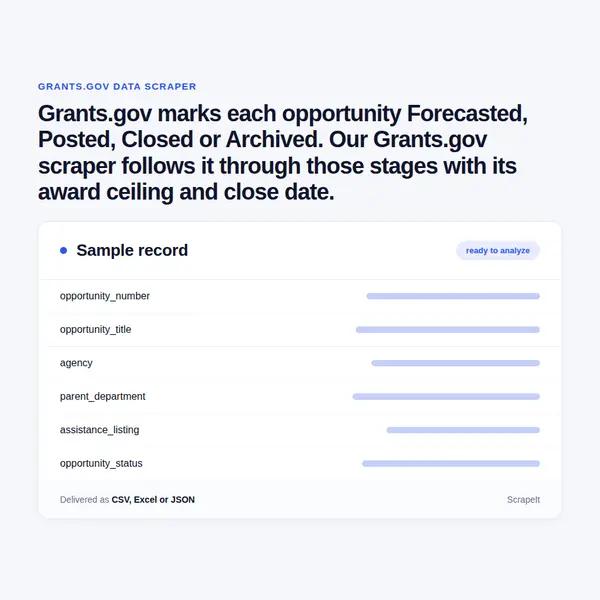
Grants.gov marks each opportunity Forecasted, Posted, Closed or Archived. Our Grants.gov scraper follows it through those stages with its award ceiling and close date.

Plans from €169 a month · Free project assessment · Reply within 1 business day

CSV · Excel · JSON · XML · FTP · SFTP · Amazon S3 · Google Cloud

grants.gov
Grants.gov Scraper for Federal Funding Opportunities
grants.govwhat you get
Typical fields for public registers
record_identity_namestatusregistered_ataddressdocument_url
Delivery

API, JSON feed or CSV, XLSX and JSON files

Schedule

One-time, monthly, weekly, daily or 3 times a day

Scrape Grants.gov Without Building the Crawler

  1. You send

    Grants.gov pages, filters, fields and a schedule

  2. We run the scrapers

    Built, monitored and repaired by our team

  3. You receive the data

    API, JSON feed or CSV, XLSX and JSON files

Tell us what to watch: a set of agencies, categories of funding activity, eligibility types such as small businesses or nonprofits with 501(c)(3) status, keywords, Assistance Listings numbers, or simply everything posted. We build and run the crawlers, repair them when Grants.gov changes its pages, and handle the anti-bot side - pacing, proxy rotation, CAPTCHA handling and rendering - as part of the service.

A free assessment of the scope comes first, then a sample of current opportunities in your field. Each delivery includes field documentation. Files arrive as CSV, Excel or JSON on SFTP, Dropbox, Google Drive or Amazon S3; teams with a grants pipeline take a JSON feed or a load into their database.

Grants.gov Data: Opportunity Fields We Extract

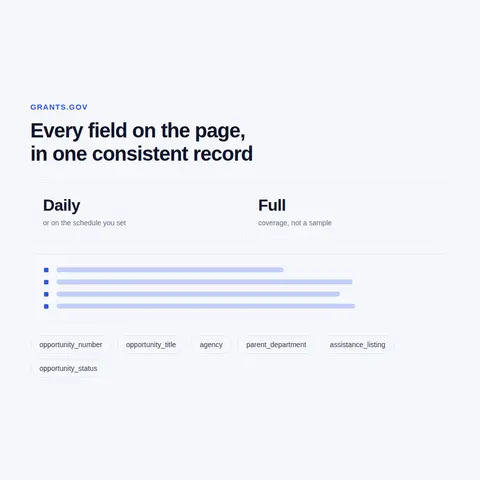
Every listing on Grants.gov is anchored by its funding opportunity number, an agency-coded identifier that stays the same while the synopsis is revised. We key rows on it and keep the version number beside it, so an extended deadline shows up as a new version of the same opportunity, not a second row.

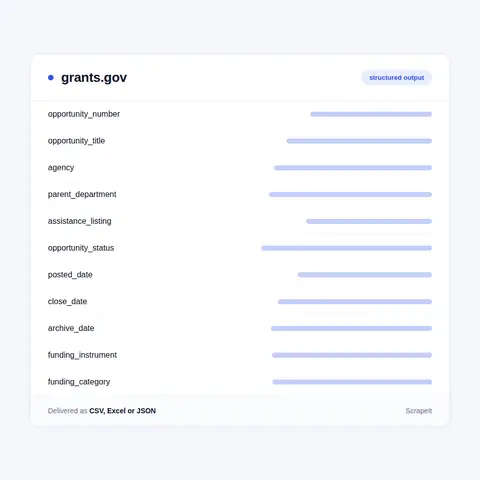
  • Identityfunding opportunity number, opportunity title, version, the agency and its parent department, and the Assistance Listings number and program title.
  • Status and datesopportunity status (Forecasted, Posted, Closed, Archived), posted date, last updated date, original and current close date with the agency's note on submission time, and archive date.
  • Moneyestimated total program funding, award ceiling, award floor and expected number of awards, as numbers in US dollars.
  • Classificationopportunity category (Discretionary and the other categories), funding instrument type (Grant, Cooperative Agreement, Procurement Contract, Other) and category of funding activity, from Agriculture and Education to Science and Technology and other Research and Development.
  • Eligibilityeach eligible applicant type as Grants.gov lists it, from state and county governments to Native American tribal governments, public and private institutions of higher education, small businesses and individuals, plus the additional information on eligibility.
  • Conditionscost sharing or matching requirement, the description of the program, and the link to additional information.
  • Forecastfor forecasted opportunities, the estimated post date, estimated application due date, estimated award date, estimated project start date and fiscal year.
  • Files and contactthe related documents attached to the announcement, with file names and update dates, and the grantor contact block.

The grantor contact is often a named grants officer with an e-mail and phone. It is left out by default, handled under GDPR and delivered only when the project needs it.

Grants.gov Data: Opportunity Fields We Extract
Building a Government Grants Database Over Time

Building a Government Grants Database Over Time

Grants.gov shows the current state of an opportunity, and a separate Version History tab lists earlier versions of its forecast and synopsis. Repeated runs turn that into a timeline you can query: when a forecast became a posted synopsis, how often the close date moved, when the award ceiling was raised, and when the opportunity closed and later went to archive.

Coverage follows the search page. Grants.gov filters by opportunity status, funding instrument type, eligibility, category and agency, sorts by opportunity number, title, agency, posted date or close date, and narrows by posting date from the last few days to the last eight weeks. We use those cuts to define a project, then open each opportunity for its synopsis or forecast tab, its related documents and its package tab.

Archived opportunities stay searchable, so a first extract can include years of past funding calls by agency or Assistance Listings number, and scheduled runs keep it current from there.

Grants.gov and How Its Listings Are Structured

Source
grants.gov
Category
public registers
Delivery
API, JSON feed, CSV, XLSX
Plans
From €169 a month
Get a quote

Grants.gov is the US federal government's single place to find and apply for federal funding opportunities, operated under the Department of Health and Human Services. Federal agencies post their notices of funding opportunity there, from cabinet departments down to individual bureaus such as the Geological Survey within the Department of the Interior, and applicants search them in one format.

An opportunity page is split into tabs. Only one of Forecast or Synopsis shows, depending on the stage; next to it sit Version History, Related Documents and Package, the last holding the application package with its opening and closing dates. A forecast is an agency's advance notice with estimated dates; a synopsis is the live call with a firm close date.

Each listing links to an Assistance Listings number, the program the funding belongs to, which is how the same program can be followed across many funding calls. Simpler.Grants.gov, the newer search interface, shows the same opportunities with plainer labels such as Award min., Award max. and Expected awards.

25Developers
500+Customers
1.5BPages extracted
15,000+Hours saved for our clients

Grants.gov scraping plans and pricing

Airplane

€199one-time

Setup fee included

100,000
One-time
Up to 5 days
7 days

Helicopter

€169/ mo

Setup fee €499

250,000
Monthly
Up to 5 days
14 days

Glasses

€229/ mo

Setup fee €499

1,000,000
Weekly
Up to 5 days
30 days

Microscope popular

€349/ mo

Setup fee €499

2,000,000
Daily
Same day
60 days

DNA

€549/ mo

Setup fee €799

3,000,000
3 times daily
Same day
90 days

Delivery: CSV, JSON or XLSX files, our API or a JSON feed. MCP server on request.

Full plan details

Uses of Government Grants Data

Grant consultants and university research offices use a daily feed as a pipeline. Filtered by eligibility type and category of funding activity, sorted by close date, it shows which posted opportunities fit their institutions and how many weeks remain to apply. Forecasts are worth even more: an estimated application due date gives months of notice before a call opens.

Nonprofits and local governments compare award ceilings, award floors and the expected number of awards across agencies, to choose calls where the odds and the amounts make an application worth the effort. Cost sharing columns remove calls they cannot match before anyone reads the full announcement.

Policy analysts, journalists and funders look at the totals: estimated total program funding by agency, by category and by fiscal year, how many calls are discretionary, and which programs under one Assistance Listings number return every year. Grant software vendors use the same records to populate search inside their own products.

About ScrapeIt

ScrapeIt is a managed scraping service: we write, run and repair the crawlers, and you receive the data as files, a feed or rows in your database. Funding portals and public registers like Grants.gov suit this model well - listings that change status on a calendar, deadlines that move, and identifiers that must stay stable while a record is revised.

FAQ

Still unsure? Write to info@scrapeit.io

Do you offer a Grants.gov API for opportunities and deadlines?

Yes. The ScrapeIt Grants.gov API returns the funding opportunity number, agency, opportunity status, award ceiling, eligibility and close date as JSON from an endpoint we host, refreshed on the schedule you set. The same data also comes as CSV or XLSX files, a JSON feed or straight into your database.

Is it legal to scrape Grants.gov?

Yes. Opportunity listings, synopses, forecasts and their attached announcements are public on Grants.gov for any applicant to read. We collect only publicly available data - everything a visitor can see on Grants.gov - and we collect it legally.

Can you build a Grants.gov database filtered by applicant eligibility?

Yes. Each opportunity lists its eligible applicant types, and we deliver them as separate flags, so the dataset can be filtered to small businesses, tribal governments or nonprofits without the 501(c)(3) status. The free-text additional information on eligibility comes as its own column for the cases the flags do not settle.

How often are Grants.gov opportunities updated?

Agencies post new forecasts and synopses and revise existing ones throughout the year, and each revision raises the version number. A daily run catches new calls and moved close dates; a weekly run is enough for funding research. Status changes from Posted to Closed and Archived follow the dates on each listing.

Do you keep the version history of an opportunity?

Yes. Every row carries the version number and last updated date, and repeated runs keep the earlier values, so you can see how the close date, award ceiling or description changed. The versions listed on the Version History tab can be included in the first extract.

How it works

  1. 1

    Make a request

    You share your needs, expectations, and desired timeframe. We'll suggest the best solution based on your request and budget.

  2. 2

    We configure the crawlers

    Our specialists configure the crawlers and extract a sample dataset for your review before proceeding with the full-scale extraction.

  3. 3

    Collect and deliver

    Once you approve the sample, we launch the project and start full data collection. We gather, filter, and structure the data for easy use, delivering it on time in your preferred format.

  4. 4

    Maintain and support

    Our team manages ongoing processes, monitors website changes, and supports all data extraction cycles. We can also help integrate data into your systems or create dashboards to simplify analysis.

Request a quote

Tell us which sites, which fields and how often. A couple of lines is enough to start.

  • We reply within 1 business day
  • A sample dataset before the full run
  • We sign an NDA on request
  • Delivery by API, JSON feed or files
Which sites, which fields, how often. A couple of lines is enough.

This form is protected by Google reCAPTCHA, which loads when you start filling it in; the Google Privacy Policy and Terms of Service apply. If you prefer not to use it, email us at info@scrapeit.io. Privacy & Cookie Policy

We reply within 1 business day. No obligation.

Grants.gov data from €169/month. Free project assessment, reply within 1 business day.