Regulations.gov Scraper for Dockets, Rules and Comments

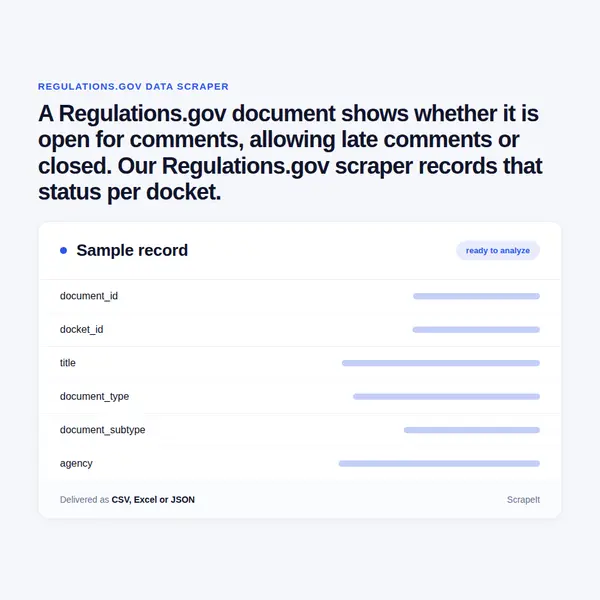
A Regulations.gov document shows whether it is open for comments, allowing late comments or closed. Our Regulations.gov scraper records that status per docket.

Plans from €169 a month · Free project assessment · Reply within 1 business day

CSV · Excel · JSON · XML · FTP · SFTP · Amazon S3 · Google Cloud

regulations.gov
Regulations.gov Scraper for Dockets, Rules and Comments
regulations.govwhat you get
Typical fields for public registers
record_identity_namestatusregistered_ataddressdocument_url
Delivery

API, JSON feed or CSV, XLSX and JSON files

Schedule

One-time, monthly, weekly, daily or 3 times a day

Scrape Regulations.gov Dockets on a Schedule

  1. You send

    Regulations.gov pages, filters, fields and a schedule

  2. We run the scrapers

    Built, monitored and repaired by our team

  3. You receive the data

    API, JSON feed or CSV, XLSX and JSON files

A project starts from your scope: the agencies you follow, a list of docket IDs, a document type such as Proposed Rule, a topic, or every document open for comments this week. We build the crawlers, run them on your schedule and repair them when Regulations.gov changes its pages, with pacing, proxy rotation, CAPTCHA handling and rendering included in that work.

You get a free assessment of the scope and a sample from a docket you choose, so the columns can be checked against a rulemaking you already know. The dataset ships with field documentation. Delivery is CSV, Excel, JSON or XML, sent to SFTP, Google Cloud Storage or e-mail, or loaded into your database.

Regulations.gov Data: Document and Docket Fields

Regulations.gov keeps three kinds of record - documents, comments and dockets - and links them by identifier. A docket ID starts with the agency acronym and names one regulatory action; every document filed in it carries a document ID made of the docket ID plus a sequence number. We keep both, so a comment, the proposed rule it answers and the docket that holds them join without guesswork.

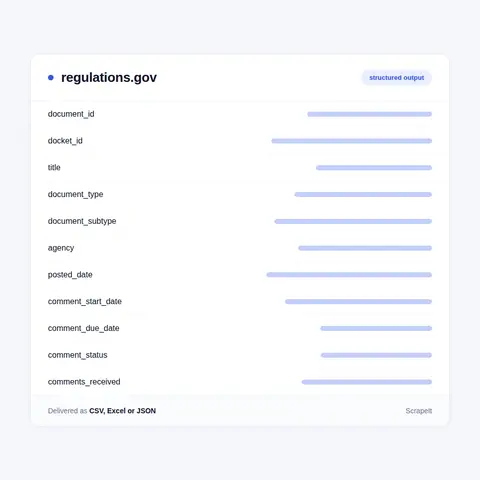
  • Documentdocument ID, title, document type (Notice, Proposed Rule, Rule, Supporting & Related Material, Other), document subtype, the agency in the line Posted by the agency, posted and received dates, page count and the Withdrawn label with its reason when one is shown.
  • Comment periodcomment start date, comment due date, the status label (Open for Comments, Allowing Late Comments, Closed for Comments) and the days left before the comment period ends.
  • Federal Register linksFederal Register number, FR citation, start and end page, CFR part, RIN and related RINs, effective date and topics.
  • Docketdocket ID, title and short title, agency, bureau or office, docket type (Rulemaking or Nonrulemaking), subtype, keywords, abstract and RIN.
  • Unified Agendafor rulemaking dockets, the agenda stage of rulemaking, priority, major rule flag, small entities affected, government levels affected and legal authorities.
  • Comment countscomments received and comments posted, plus the note an agency adds when it received duplicate or significantly similar comments.
  • Commentscomment ID, tracking number, received and posted dates, organization name, government agency and agency type, and the attachment list.

Public comments are often written by private persons. Their names and comment text are left out by default and handled under GDPR; comments filed by organizations and agencies are delivered with the organization name as Regulations.gov shows it.

Regulations.gov Data: Document and Docket Fields
Regulations.gov Comments Scraper and Comment Counts

Regulations.gov Comments Scraper and Comment Counts

Comments are where Regulations.gov differs from a publication index. A single proposed rule can draw a large volume of public submissions, which the agency reviews before posting, so the count of comments received usually runs ahead of the count posted. Repeated runs record both numbers per document, so you can see a campaign building before the comment due date and the posting backlog shrinking afterwards.

Search on Regulations.gov is split into Documents, Comments and Dockets, each with its own filters: document type, agency, posting date, comment due date, documents open for comment, and docket type. We use the same cuts to scope a project, then follow each document to its docket and from the docket to the rest of its file - supporting material, earlier notices and the final rule when it is posted.

For organizations' comments we take the attachment list and, when the project needs it, the text of the submission, so a trade association's position can be read next to the rule it addresses.

How Regulations.gov Is Organised

Source
regulations.gov
Category
public registers
Delivery
API, JSON feed, CSV, XLSX
Plans
From €169 a month
Get a quote

Regulations.gov is the shared portal of the federal eRulemaking initiative: participating agencies post their regulatory dockets there, and the public reads proposed rules and submits comments on them. The site follows the rulemaking process it serves - pre-rule, proposed rule, final rule - and every step of it becomes a document inside one docket.

The docket is the unit that matters for data. It has an agency, a docket type that separates rulemaking from other actions, and a set of details that varies by agency, from bureau or office to keywords and an agency subtype. Rulemaking dockets add a Unified Agenda Details tab with the agenda stage, priority and the impact flags an agency reports. Inside the docket, documents of each type sit next to the public submissions they drew.

Each document page states its comment status at the top in plain words, with a countdown while the comment period runs and a Comment Period Ends line. Documents that also appear in the daily Federal Register carry its document number and citation, which is how a Regulations.gov record links to the published version of the same notice or rule.

25Developers
500+Customers
1.5BPages extracted
15,000+Hours saved for our clients

Regulations.gov scraping plans and pricing

Airplane

€199one-time

Setup fee included

100,000
One-time
Up to 5 days
7 days

Helicopter

€169/ mo

Setup fee €499

250,000
Monthly
Up to 5 days
14 days

Glasses

€229/ mo

Setup fee €499

1,000,000
Weekly
Up to 5 days
30 days

Microscope popular

€349/ mo

Setup fee €499

2,000,000
Daily
Same day
60 days

DNA

€549/ mo

Setup fee €799

3,000,000
3 times daily
Same day
90 days

Delivery: CSV, JSON or XLSX files, our API or a JSON feed. MCP server on request.

Full plan details

What a Regulations.gov Dataset Is Used For

Regulatory affairs teams use it as a deadline calendar. A daily feed of documents that are open for comments, filtered by agency and topic, with the comment due date and the days left, shows what needs a response this week. The Allowing Late Comments status is worth its own column: it marks dockets where a submission is still accepted after the date has passed.

Trade associations and public affairs firms use the comment counts. Comments received per document, tracked daily, show which proposals are drawing a reaction and how fast; the organization names on posted comments show who else has taken a position, from companies to state agencies.

Policy researchers and law firms work at the docket level. Docket type, Unified Agenda stage and RIN let them follow one rulemaking from its first notice to the final rule, count how many proposals in an agency stall at the proposed stage, and read the supporting and related material that an agency filed to justify a rule.

About ScrapeIt

ScrapeIt is a managed data extraction service. Our team builds and runs the crawlers and delivers the records on a schedule you choose, from a one-time extract to daily runs. Government portals like Regulations.gov are part of that work: records linked across dockets, documents and comments, statuses that change with the calendar, and personal data that has to be filtered out of public submissions before the dataset reaches you.

FAQ

Still unsure? Write to info@scrapeit.io

Do you offer a Regulations.gov API for dockets and comment periods?

Yes. The ScrapeIt Regulations.gov API returns the document ID, docket ID, document type, agency, comment due date and comment status as JSON from an endpoint we host, refreshed on your schedule. The same records also arrive as CSV or Excel files, a JSON feed or a load into your database.

Is it legal to scrape Regulations.gov?

Yes. Dockets, proposed and final rules, notices and posted comments are published on Regulations.gov for public reading and participation. We collect only publicly available data - everything a visitor can see on Regulations.gov - and we collect it legally.

Can a Regulations.gov docket tracker warn us about new comment periods?

Yes. We run the search for the agencies and topics you name every day, record each new document with its comment start and due dates, and flag changes in status from Open for Comments to Allowing Late Comments or Closed. The delivery can be a daily file, an e-mail digest or rows in your database.

Do you collect the comments themselves or only the counts?

Both, with a default that protects individuals. Counts of comments received and posted are collected for every document. Comments filed by organizations and agencies come with the organization name, attachments and, when the project needs it, the text; names and text of private commenters are left out.

How do you track comment deadlines on Regulations.gov across agencies?

Every document row carries the comment due date and the status label, and each docket row carries its agency and docket type. Sorting the daily delivery by due date gives one calendar across all the agencies you follow, with withdrawn documents marked rather than silently dropped.

How it works

  1. 1

    Make a request

    You share your needs, expectations, and desired timeframe. We'll suggest the best solution based on your request and budget.

  2. 2

    We configure the crawlers

    Our specialists configure the crawlers and extract a sample dataset for your review before proceeding with the full-scale extraction.

  3. 3

    Collect and deliver

    Once you approve the sample, we launch the project and start full data collection. We gather, filter, and structure the data for easy use, delivering it on time in your preferred format.

  4. 4

    Maintain and support

    Our team manages ongoing processes, monitors website changes, and supports all data extraction cycles. We can also help integrate data into your systems or create dashboards to simplify analysis.

Request a quote

Tell us which sites, which fields and how often. A couple of lines is enough to start.

  • We reply within 1 business day
  • A sample dataset before the full run
  • We sign an NDA on request
  • Delivery by API, JSON feed or files
Which sites, which fields, how often. A couple of lines is enough.

This form is protected by Google reCAPTCHA, which loads when you start filling it in; the Google Privacy Policy and Terms of Service apply. If you prefer not to use it, email us at info@scrapeit.io. Privacy & Cookie Policy

We reply within 1 business day. No obligation.

Regulations.gov data from €169/month. Free project assessment, reply within 1 business day.