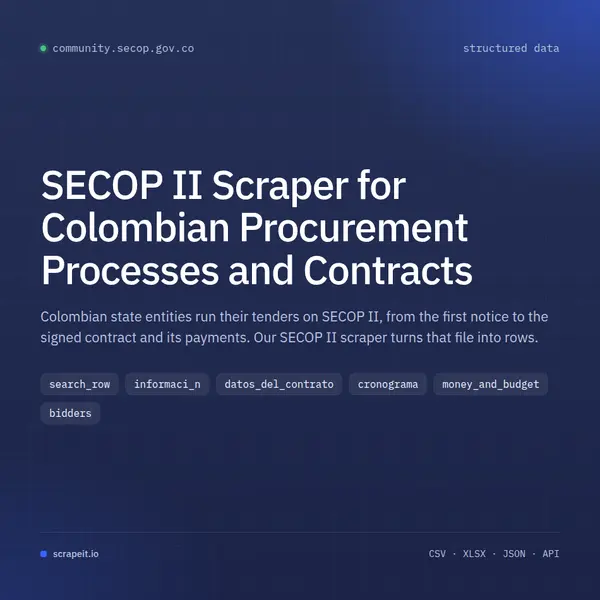
SECOP II Scraper for Colombian Procurement Processes and Contracts

Colombian state entities run their tenders on SECOP II, from the first notice to the signed contract and its payments. Our SECOP II scraper turns that file into rows.

Plans from €169 a month · Free project assessment · Reply within 1 business day

CSV · Excel · JSON · XML · FTP · SFTP · Amazon S3 · Google Cloud

community.secop.gov.co
SECOP II Scraper for Colombian Procurement Processes and Contracts
community.secop.gov.cowhat you get
Typical fields for public registers
record_identity_namestatusregistered_ataddressdocument_url
Delivery

API, JSON feed or CSV, XLSX and JSON files

Schedule

One-time, monthly, weekly, daily or 3 times a day

Scrape SECOP II as a Managed Service

  1. You send

    SECOP II pages, filters, fields and a schedule

  2. We run the scrapers

    Built, monitored and repaired by our team

  3. You receive the data

    API, JSON feed or CSV, XLSX and JSON files

You tell us which contracting entities, UNSPSC codes, modalities or date ranges matter and how often; we build the crawler, run it and fix it when the SECOP II pages change. The public search opens only after a validation step, so CAPTCHA handling, pacing and proxy rotation are part of what we run for you, not something you set up.

Each process is read from its search row down to the Expediente electrónico (the electronic process file) and, where one exists, the contract view. Delivery comes as CSV, XLSX or JSON, through our API or into your database, and field documentation in English comes with the dataset. Runs are one-off or scheduled daily or weekly. Plans start from EUR 169 a month, or EUR 199 for a one-time extract.

SECOP II Data: Fields From Each Process and Contract

SECOP II keeps a whole procurement process in one file, and our scraper follows it section by section. The anchors are the platform's own references: a process notice carries a code of the form CO1.NTC plus a number, a contract carries a CO1.PCCNTR code, and the entity's own process number sits in the Referencia column. These keys hold rows together between runs.

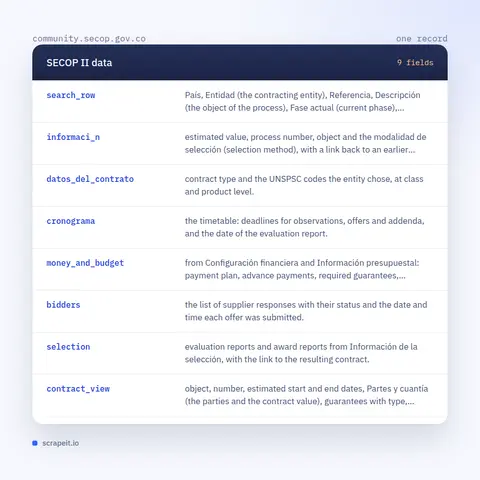
  • Search rowPaís, Entidad (the contracting entity), Referencia, Descripción (the object of the process), Fase actual (current phase), publication date, offer deadline and Estado (status).
  • Informaciónestimated value, process number, object and the modalidad de selección (selection method), with a link back to an earlier phase when there is one.
  • Datos del contratocontract type and the UNSPSC codes the entity chose, at class and product level.
  • Cronogramathe timetable: deadlines for observations, offers and addenda, and the date of the evaluation report.
  • Money and budgetfrom Configuración financiera and Información presupuestal: payment plan, advance payments, required guarantees, spending purpose, funding source and the CDP budget certificate number.
  • Biddersthe list of supplier responses with their status and the date and time each offer was submitted.
  • Selectionevaluation reports and award reports from Información de la selección, with the link to the resulting contract.
  • Contract viewobject, number, estimated start and end dates, Partes y cuantía (the parties and the contract value), guarantees with type, issuer, value and validity, and goods and services with quantities, unit prices and totals.
  • Executionprogress, invoices and payment requests with approval and payment status, Modificaciones (amendments) with type and date, and recorded Incumplimientos (breaches and sanctions).

Titles from the Documentación section - estudios previos, risk matrix, technical annexes, forms - come as a list with links, and the files themselves can be collected when the project needs them. Suppliers that are companies are delivered as SECOP II shows them; natural persons who contract as individuals are left out by default and handled under GDPR when a project needs them.

SECOP II Data: Fields From Each Process and Contract
SECOP II Tenders, Annual Plans and Contract History

SECOP II Tenders, Annual Plans and Contract History

One process page answers one question; most buyers want a whole market. We cover the search side by slicing it the way the platform allows - by UNSPSC code, status, process number, description and publication date range - and merge the results on the notice code. A full history means working through the publication dates period by period, then reading each process file.

The Plan Anual de Adquisiciones (annual procurement plan) is a second source. Each entity publishes its plan by year with total value, version and last modification date, and the planned lines carry UNSPSC code, object, value, estimated dates, duration and modality - a view of tenders before they are announced. Planned lines and later notices can be matched on entity, code and object.

Repeated runs add what a single pass cannot: phase and status changes as a process moves from open offers to award, new addenda, bidder questions and entity answers in Observaciones y mensajes, contract amendments and the payment record during execution. Each change is kept with the date we first saw it.

About SECOP II and Colombia Compra Eficiente

Source
community.secop.gov.co
Category
public registers
Delivery
API, JSON feed, CSV, XLSX
Plans
From €169 a month
Get a quote

SECOP II (Sistema Electrónico de Contratación Pública) is Colombia's transactional procurement platform: state entities create, publish and award their processes on it, and suppliers submit their offers on it. It belongs to the Agencia Nacional de Contratación Pública - Colombia Compra Eficiente, the national procurement agency, and the public site runs on community.secop.gov.co, with VORTAL named as the software provider in its footer.

Because the work happens on the platform rather than being reported to it afterwards, the record is detailed. The same file holds the notice, the questions bidders asked, the offers received, the evaluation and the contract that followed, through to invoices and amendments, and anyone can follow it through the public view without an account.

Processes are grouped by modality, the legal route the entity used: licitación pública (open tender, the general rule), selección abreviada (abbreviated selection, including reverse auctions), concurso de méritos (merit-based selection), contratación directa (direct award) and mínima cuantía (minimum-value purchases), plus special-regime processes with and without offers. The interface switches between English and Español (Colombia), but entity names, objects and documents stay in Spanish and amounts are in Colombian pesos.

25Developers
500+Customers
1.5BPages extracted
15,000+Hours saved for our clients

SECOP II scraping plans and pricing

Airplane

€199one-time

Setup fee included

100,000
One-time
Up to 5 days
7 days

Helicopter

€169/ mo

Setup fee €499

250,000
Monthly
Up to 5 days
14 days

Glasses

€229/ mo

Setup fee €499

1,000,000
Weekly
Up to 5 days
30 days

Microscope popular

€349/ mo

Setup fee €499

2,000,000
Daily
Same day
60 days

DNA

€549/ mo

Setup fee €799

3,000,000
3 times daily
Same day
90 days

Delivery: CSV, JSON or XLSX files, our API or a JSON feed. MCP server on request.

Full plan details

Why Scrape SECOP II Procurement Records

Records from SECOP II serve anyone who sells to the Colombian state or watches how it spends.

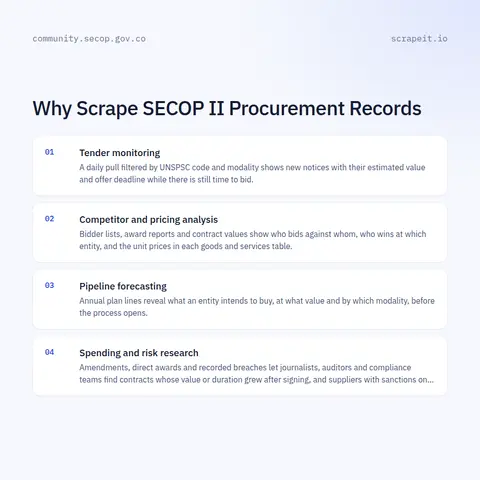
  • Tender monitoringA daily pull filtered by UNSPSC code and modality shows new notices with their estimated value and offer deadline while there is still time to bid.
  • Competitor and pricing analysisBidder lists, award reports and contract values show who bids against whom, who wins at which entity, and the unit prices in each goods and services table.
  • Pipeline forecastingAnnual plan lines reveal what an entity intends to buy, at what value and by which modality, before the process opens.
  • Spending and risk researchAmendments, direct awards and recorded breaches let journalists, auditors and compliance teams find contracts whose value or duration grew after signing, and suppliers with sanctions on record.
  • Market sizingContract value by entity, UNSPSC code and year gives a measured size of the public market for a product line.

About ScrapeIt

ScrapeIt is a managed web scraping company: we build, run and repair the crawlers, and you receive the dataset. Public registers like SECOP II are a regular part of our work - records that grow every day, filed in the source's own language and structure, and useful only once they are joined over time. We deliver Spanish labels as published next to English column names, keep the platform's codes as keys, and start every project with a free assessment and a sample.

FAQ

Still unsure? Write to info@scrapeit.io

Do you offer a SECOP II API for tender and contract data?

Yes. The ScrapeIt SECOP II API returns the notice code, entity, object, modality, estimated value, status and awarded contract value as JSON from an endpoint we host, refreshed on the schedule you set. The same data also comes as CSV or XLSX files, a JSON feed or straight into your database.

Is it legal to scrape SECOP II?

Yes. SECOP II shows its processes, bidder lists, award reports and contracts in a public view that anyone can open without an account. We collect only publicly available data - everything a visitor can see on SECOP II - and we collect it legally.

Can you build a SECOP II dataset going back several years?

Yes. We work through the publication date filter period by period, read each process file and merge everything on the notice code. A historical extract can be delivered once and then kept current by scheduled runs that add new notices and status changes.

How often do SECOP II processes change?

Often while a process is open: addenda, bidder questions, new offers and the move from one phase to the next arrive as the cronograma runs. Contracts keep changing after signing as invoices, payments and amendments are recorded. For tender alerts we usually run daily; for contract and spending analysis, weekly is often enough.

Can you filter SECOP II by entity, modality or UNSPSC code?

Yes. The public search narrows by UNSPSC code, status, process number and publication dates, and every row carries the entity and the modalidad de selección, so a dataset can cover one ministry or one product family across the whole country. Column names come in English, while entity names, objects and document titles stay in Spanish as SECOP II publishes them.

How it works

  1. 1

    Make a request

    You share your needs, expectations, and desired timeframe. We'll suggest the best solution based on your request and budget.

  2. 2

    We configure the crawlers

    Our specialists configure the crawlers and extract a sample dataset for your review before proceeding with the full-scale extraction.

  3. 3

    Collect and deliver

    Once you approve the sample, we launch the project and start full data collection. We gather, filter, and structure the data for easy use, delivering it on time in your preferred format.

  4. 4

    Maintain and support

    Our team manages ongoing processes, monitors website changes, and supports all data extraction cycles. We can also help integrate data into your systems or create dashboards to simplify analysis.

Request a quote

Tell us which sites, which fields and how often. A couple of lines is enough to start.

  • We reply within 1 business day
  • A sample dataset before the full run
  • We sign an NDA on request
  • Delivery by API, JSON feed or files
Which sites, which fields, how often. A couple of lines is enough.

This form is protected by Google reCAPTCHA, which loads when you start filling it in; the Google Privacy Policy and Terms of Service apply. If you prefer not to use it, email us at info@scrapeit.io. Privacy & Cookie Policy

We reply within 1 business day. No obligation.

SECOP II data from €169/month. Free project assessment, reply within 1 business day.