Jameda Scraper for German Practice Listings and Specialties

A practice address is directory data. A patient review about a named doctor is something else entirely, and German courts have had a great deal to say about it.

Jameda Scraper
Solutions

Managed provider directory data, run end to end by us

ScrapeIt runs the collection as a managed service. You name the specialties and regions; we build the pipeline with hours structured, geography parsed and review content excluded by default, and hand back CSV, JSON, Excel or a push into your warehouse.

Directory records are refreshed often because their value is currency, and changes come as their own records so a moved practice is flagged rather than silently overwritten.

We collect published directory data, honour the crawl rules and pace requests. Review text is only in scope where you have a specific purpose and your own legal position, and we ask for both before the project starts rather than after.

Jameda fields in every export

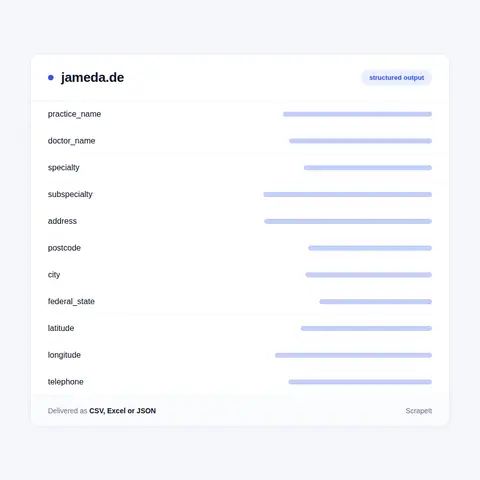
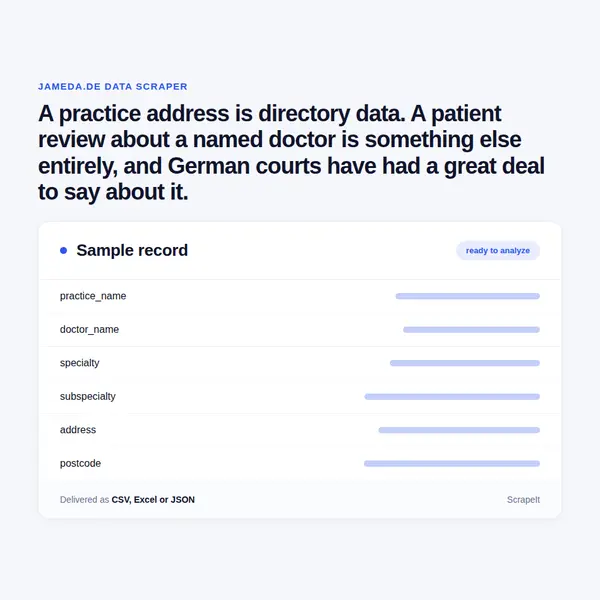
Practice records carry the practice name, doctor name as listed, specialty and subspecialties, full address, postcode, city, federal state, coordinates where published, telephone, website, opening hours by day, languages and insurance types accepted.

Opening hours are structured by day rather than kept as text, because hours as a string cannot drive an application and this is the single most common reason clients arrive having tried the collection themselves.

Geography is delivered ready to join: postcode parsed, state recorded, coordinates where available, so provision can be mapped against population without another cleaning pass.

Review data, where a client has a defensible reason for it, is a separate table with its own access decision - never merged into the practice row. Aggregate rating and review count can sit on the practice record as numbers without the text.

Every row carries the collection timestamp, which on a directory is what tells a downstream application whether an opening time can still be trusted.

Jameda fields in every export
Provision mapping, insurance analysis and scope

Provision mapping, insurance analysis and scope

Provision mapping is the strongest use: practices per specialty per region against population, which for health policy research, insurers and anyone planning a practice is directly actionable and needs no personal data beyond professional listings.

Insurance acceptance analysis is distinctively German and useful. The split between statutory and private insurance shapes access, and which practices accept which is visible in the directory data.

Language coverage - which practices list which languages - answers a real access question for non-German-speaking populations and is rarely assembled anywhere.

Scope limits we hold: reviews are a separate decision with a separate table, never merged in; we collect nothing behind a login; and we do not build profiles of individual doctors' reputations. If a brief is really about ranking named individuals, we would rather decline it than deliver it quietly.

Germany's doctor search, and its contested layer

Jameda is Germany's largest doctor search and booking platform, listing practices with specialties, addresses, opening hours, languages spoken, insurance accepted and appointment availability, alongside patient reviews.

The listing layer and the review layer are different kinds of data and they need to be treated differently from the first line of a project.

A doctor's practice address, specialty and opening hours are professional directory information - the same category as any business listing. Patient reviews about a named, identifiable doctor are something else: they concern an individual professional's reputation, they are written by patients about a care experience, and in Germany they have been the subject of extensive litigation over what a platform may publish and what a doctor may require removed.

We are not in a position to adjudicate that and we do not try. What we do is keep the layers separate so a client can take the directory data, which carries none of that weight, without acquiring the review corpus by accident.

The search responds directly and crawl rules are published, allowing the site generally and disallowing only statistics and AJAX endpoints.

Get a Quote
dev_w
25

Developers

customers
500+

Customers worldwide

pages
1 500 000 000+

Pages extracted

stime
15000+

Hours saved for our clients

Plans

Airplane

€199 / one-time

setup fee - included

Data limits100,000
Frequencyone-time
Run timeup to 5 days
Data storing7 days

Helicopter

€169 / mo

setup fee €499

Data limits250,000
Frequencymonthly
Run timeup to 5 days
Data storing14 days

Glasses

€229 / mo

setup fee €499

Data limits1,000,000
Frequencyweekly
Run timeup to 5 days
Data storing30 days

DNA

€549 / mo

setup fee €799

Data limits3,000,000
Frequency3 times daily
Run timesame day
Data storing90 days

Why the directory and the reviews are different projects

Almost every legitimate brief on this source needs the directory and not the reviews, and separating them early saves the client a problem they had not thought about.

Directory data answers the questions people actually have: where provision is dense and where it is thin, which specialties are underserved in which regions, how far a patient must travel, which practices accept which insurance. All of that is structural and carries no individual reputation dimension.

Review text is a different object. It concerns a named individual's professional reputation, it is written by patients about care they received, and in Germany the question of what may be published about a doctor has been through the courts repeatedly. A client wanting review text should have a specific purpose and their own legal position on it, and we ask for both at scoping rather than delivering the corpus and leaving the question open.

The third point is currency. Practice details change - doctors move, practices merge, hours shift - and a directory that is a year old will send somebody to a door that is not there. Refresh frequency is a design decision rather than a budget line.

The fourth is that the aggregate rating is available as a number without the text, which satisfies a surprising share of briefs that started by asking for reviews.

Our Blog

Reads Our Latest News & Blog

Learn how to use web scraping to solve data problems for your organization

How Artificial Intelligence Is Used In Web Scraping

How Artificial Intelligence Is Used In Web Scraping

Leveraging advances in technology, the AI-powered web scraper has skyrocketed in demand and is helping to expand capabilities by automating tedious daily tasks and speeding up data collection from thousands of websites several times over.

What is Web Scraping and What is it Used For?

What is Web Scraping and What is it Used For?

Web scraping is a method of obtaining web data by extracting it from pages of web resources with the help of a program, that is, in automatic mode. It is used to syntactically convert web pages into more usable forms.

Web Scraping for Machine Learning

Web Scraping for Machine Learning

If you specialize in machine learning, you need to feed large amounts of data to the algorithms. Web scraping is the easiest and the most efficient method of collecting the data from all over the Internet.

scrapeit logo

Who builds and keeps your directory feed

ScrapeIt is a managed extraction company, not a tool you have to learn. Our team builds the pipeline, watches it as listing templates change, and repairs it before your directory starts sending patients to the wrong address.

You see a sample first, in your format, over the specialties and regions you actually cover, with hours structured and reviews excluded so you can confirm the directory answers your question on its own.

FAQ

Can I have the patient reviews?

Only with a specific purpose and your own legal position, and as a separate table. Reviews concern named individuals' professional reputation and in Germany what may be published about a doctor has been through the courts repeatedly. We ask before the project, not after.

What can I do without the reviews?

Most of what people actually want: provision density by specialty and region, travel distance, insurance acceptance, language coverage. Aggregate rating and review count are available as numbers too, which satisfies many briefs that opened by asking for review text.

Do you deliver opening hours as usable data?

Yes, structured by day with open and close times. Hours as a text string cannot drive an application, and this is the most common reason clients arrive having already tried the collection themselves.

How current is the directory?

As current as the refresh you buy, and it matters here. Doctors move, practices merge and hours change, so a year-old directory sends people to doors that are not there. We deliver changes as records rather than silently overwriting.

Would you build a doctor ranking?

No. If a brief is really about ranking named individuals by reputation, we would rather decline than deliver it quietly. Provision and access analysis needs none of that and is what this source is genuinely good for.

How does it Work?

Step 1 - Make a Request

You share your needs, expectations, and desired timeframe. We’ll suggest the best solution based on your request and budget.

Step 2 - Configuring Custom Web Crawlers

Our specialists configure the crawlers and extract a sample dataset for your review before proceeding with the full-scale extraction.

Step 3 - Collect and Deliver

Once you approve the sample, we launch the project and start full data collection. We gather, filter, and structure the data for easy use, delivering it on time in your preferred format.

Step 4 - Maintain and Support

Our team manages ongoing processes, monitors website changes, and supports all data extraction cycles. We can also help integrate data into your systems or create dashboards to simplify analysis.

Request a Quote

Tell us more about you and your project information.
Which sites, which fields, how often. A couple of lines is enough.

We reply within 1 business day. No obligation.

scrapiet

Scrapeit Sp. z o.o.
10/208 Legionowa str., 15-099, Bialystok, Poland
NIP: 5423457175
REGON: 523384582