RxList Scraper for Drug Monographs and Interactions

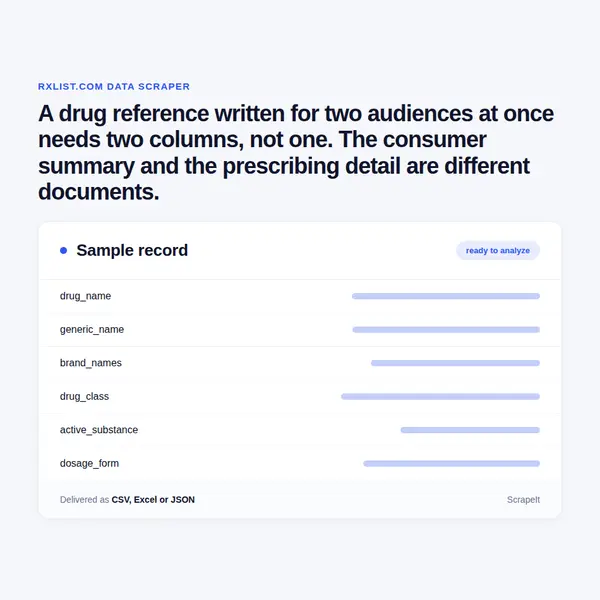
A drug reference written for two audiences at once needs two columns, not one. The consumer summary and the prescribing detail are different documents.

RxList Scraper
Solutions

Managed drug reference collection, run end to end by us

ScrapeIt runs the collector as a managed service. You name the drug list or take the full index; we build the pipeline, keep consumer and professional layers separate, deliver interactions as pairs and hand back CSV, JSON, Excel or a push into your warehouse.

Cadence is slow by design. Reference content moves on review cycles, so monthly or quarterly with change records is what we recommend and what we quote.

We collect what the site renders publicly, honour the crawl rules it publishes and pace requests. Content is copyrighted and the terms restrict reuse, so the dataset is for analysis rather than republication. This is consumer and reference publishing, not clinical guidance: if your use case touches patient care it needs authoritative sources and your own clinical governance. Bring it to your counsel before the project starts.

RxList fields in every export

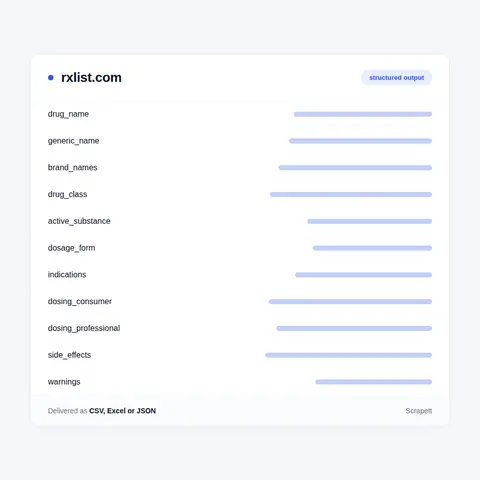
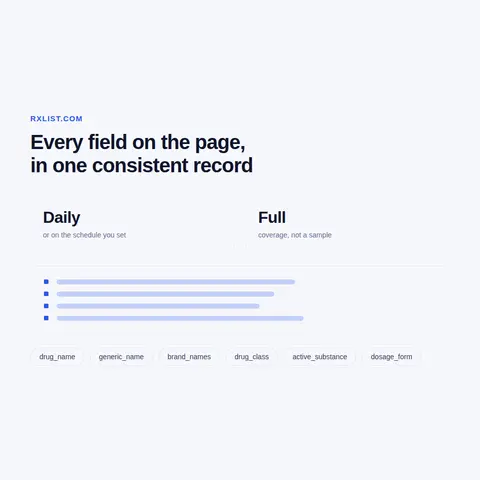
The drug record covers the drug name, generic and brand names, drug class, dosage forms and strengths, the conditions it is indicated for, dosing guidance, side effects, warnings and precautions, contraindications and storage.

Consumer and professional layers are delivered as separate fields rather than concatenated. Merging them is the most common mistake on drug reference sites and it is invisible in the output: the text reads fine and carries two different levels of clinical precision in the same column.

Interaction data comes as rows: this drug, that drug, and the severity as published. Kept as prose it is unusable; kept as pairs it is a graph that can be queried, which is the shape every client actually wants.

Class and ingredient fields are normalised so that a drug appearing under several brand names resolves to one active substance, which is what makes comparison across a catalogue possible.

Every row carries the collection timestamp and the layer it came from, because six months later somebody will need to know whether a sentence came from the consumer summary or the prescribing section.

RxList fields in every export
Interaction graphs, catalogue gaps and joining to labels

Interaction graphs, catalogue gaps and joining to labels

The interaction graph is worth building deliberately. Once pairs and severities are structured, the questions are graph questions: which drugs are most connected, where severity ratings differ between references, and which combinations a client's own content does not cover.

Catalogue gap analysis against a client's own drug library is the most direct commercial use. Which medicines exist here and not there, and where the depth differs, is a set difference once both sides are structured, and it usually redirects a content roadmap immediately.

Joining to regulatory labels is the recommendation we make on every project here. A consumer reference tells you what the public is being told; the label tells you what the authority approved. Both belong in a serious dataset and only one of them is authoritative.

Refresh is slow. Reference content changes on editorial review rather than continuously, so monthly or quarterly collection with change records suits every brief, and the change records are what surface a monograph that was materially revised.

A drug reference with an alphabetical index

RxList is a drug reference publishing monographs per medicine: what it treats, how it is dosed, side effects, warnings, interactions and the pharmacology behind it. It is organised around an alphabetical drug index that responds directly, which makes systematic enumeration of the library practical rather than guesswork.

The monographs carry two layers, and this is the structural feature that matters. There is consumer facing summary content, and there is prescribing level detail closer to a professional label. They appear on the same page and they are written for different readers, which means a collector that merges them produces text with two voices and two levels of precision in one field.

Beyond monographs the site carries condition content, a pill identifier and interaction tooling, each behaving differently enough to be typed rather than lumped together.

Crawl rules are published and the alphabetical index responds, so discovery is straightforward. Volume is moderate and bounded by the size of the drug library, which makes completeness achievable.

Get a Quote
dev_w
25

Developers

customers
500+

Customers worldwide

pages
1 500 000 000+

Pages extracted

stime
15000+

Hours saved for our clients

Plans

Airplane

€199 / one-time

setup fee - included

Data limits100,000
Frequencyone-time
Run timeup to 5 days
Data storing7 days

Helicopter

€169 / mo

setup fee €499

Data limits250,000
Frequencymonthly
Run timeup to 5 days
Data storing14 days

Glasses

€229 / mo

setup fee €499

Data limits1,000,000
Frequencyweekly
Run timeup to 5 days
Data storing30 days

DNA

€549 / mo

setup fee €799

Data limits3,000,000
Frequency3 times daily
Run timesame day
Data storing90 days

Why this is reference content and not a clinical source

The scope conversation happens first on any drug reference project, and it is short. This is published reference content, useful and reasonably careful, and it is not a regulatory label. A dataset built from it should feed content strategy, coverage analysis and search research, and it should not feed anything that makes a clinical decision.

Within that scope the source is strong. Because the library is bounded and indexed, coverage mapping is complete rather than sampled: which medicines have detailed monographs, which are thin, and how that compares with your own catalogue if you publish drug information yourself.

The interaction graph is the second reason clients come. Extracted as pairs with severity, it supports questions about which combinations are flagged most often and how that compares across references, which is a content and completeness question rather than a clinical one.

The third is the two layer structure, which turns out to be useful rather than merely annoying. Comparing how the same drug is described to a consumer and to a prescriber is exactly the analysis a health publisher planning its own content needs.

Where accuracy about a medicine actually matters, the route is the regulatory label from the authority, and we will say so and help you join to it rather than letting a consumer reference stand in.

Our Blog

Reads Our Latest News & Blog

Learn how to use web scraping to solve data problems for your organization

How Artificial Intelligence Is Used In Web Scraping

How Artificial Intelligence Is Used In Web Scraping

Leveraging advances in technology, the AI-powered web scraper has skyrocketed in demand and is helping to expand capabilities by automating tedious daily tasks and speeding up data collection from thousands of websites several times over.

What is Web Scraping and What is it Used For?

What is Web Scraping and What is it Used For?

Web scraping is a method of obtaining web data by extracting it from pages of web resources with the help of a program, that is, in automatic mode. It is used to syntactically convert web pages into more usable forms.

Web Scraping for Machine Learning

Web Scraping for Machine Learning

If you specialize in machine learning, you need to feed large amounts of data to the algorithms. Web scraping is the easiest and the most efficient method of collecting the data from all over the Internet.

scrapeit logo

Who builds and keeps your drug reference feed

ScrapeIt is a managed extraction company, not a tool you have to learn. Our team builds the pipeline, watches it as monograph templates change, and repairs it before your coverage analysis goes stale.

You see a sample first, in your format, over the drugs you actually care about, with the two layers separated and interactions as pairs so you can judge the structure on real monographs.

FAQ

Can I use this for clinical decisions?

No, and it is the first thing we say rather than the last. This is published reference content, not a regulatory label. It is fit for content strategy, coverage analysis and search research. Anything touching patient care needs authoritative sources and your own clinical governance, and we will help you join to those instead.

Why separate the consumer and professional text?

Because merging them is invisible in the output and wrong in the data: the text reads fine while carrying two different levels of clinical precision in one column. Kept apart they are also directly useful - comparing how a drug is described to a consumer versus a prescriber is exactly what a health publisher planning content needs.

How is interaction data delivered?

As rows: this drug, that drug, severity as published. Prose is unusable; pairs make a graph you can query. As with everything from this source it reflects what the publisher states and is not a substitute for an authoritative interaction database.

Can you cover the whole drug library?

Yes. The library is bounded and the alphabetical index responds, so complete enumeration is achievable rather than sampled - which is what makes coverage comparison against your own catalogue meaningful instead of indicative.

How often should this refresh?

Monthly or quarterly with change records. Reference content moves on editorial review rather than continuously, and the change records are what surface a monograph that was materially revised, which is the event worth reacting to.

How does it Work?

Step 1 - Make a Request

You share your needs, expectations, and desired timeframe. We’ll suggest the best solution based on your request and budget.

Step 2 - Configuring Custom Web Crawlers

Our specialists configure the crawlers and extract a sample dataset for your review before proceeding with the full-scale extraction.

Step 3 - Collect and Deliver

Once you approve the sample, we launch the project and start full data collection. We gather, filter, and structure the data for easy use, delivering it on time in your preferred format.

Step 4 - Maintain and Support

Our team manages ongoing processes, monitors website changes, and supports all data extraction cycles. We can also help integrate data into your systems or create dashboards to simplify analysis.

Request a Quote

Tell us more about you and your project information.
Which sites, which fields, how often. A couple of lines is enough.

We reply within 1 business day. No obligation.

scrapiet

Scrapeit Sp. z o.o.
10/208 Legionowa str., 15-099, Bialystok, Poland
NIP: 5423457175
REGON: 523384582