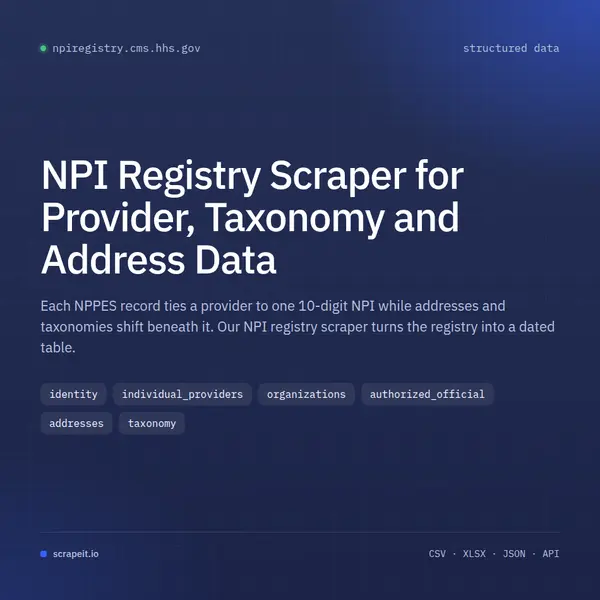
NPI Registry Scraper for Provider, Taxonomy and Address Data

Each NPPES record ties a provider to one 10-digit NPI while addresses and taxonomies shift beneath it. Our NPI registry scraper turns the registry into a dated table.

Plans from €169 a month · Free project assessment · Reply within 1 business day

CSV · Excel · JSON · XML · FTP · SFTP · Amazon S3 · Google Cloud

npiregistry.cms.hhs.gov
NPI Registry Scraper for Provider, Taxonomy and Address Data
npiregistry.cms.hhs.govwhat you get
Typical fields for health sites
namespecialtyaddresspriceratingreviews
Delivery

API, JSON feed or CSV, XLSX and JSON files

Schedule

One-time, monthly, weekly, daily or 3 times a day

Scrape NPI Registry Records as a Managed Service

  1. You send

    NPPES NPI Registry pages, filters, fields and a schedule

  2. We run the scrapers

    Built, monitored and repaired by our team

  3. You receive the data

    API, JSON feed or CSV, XLSX and JSON files

You tell us which providers matter - one taxonomy such as Pharmacy - Community/Retail Pharmacy, a group of states, or a list of NPIs from your own claims or CRM - and we build and run the NPI registry scraper against the public search and the NPI View page behind every hit. The search returns at most the first 2,100 results per query and refuses a state as the only criterion, so we cut each job by taxonomy description, city and postal code until every slice fits, then de-duplicate on the NPI. Pacing, proxy rotation and rendering of the script-built pages are handled on our side. You get a free project assessment first, field documentation with the file, and runs that are one-off or repeat on your schedule.

NPPES NPI Registry Data: Fields in Each Record

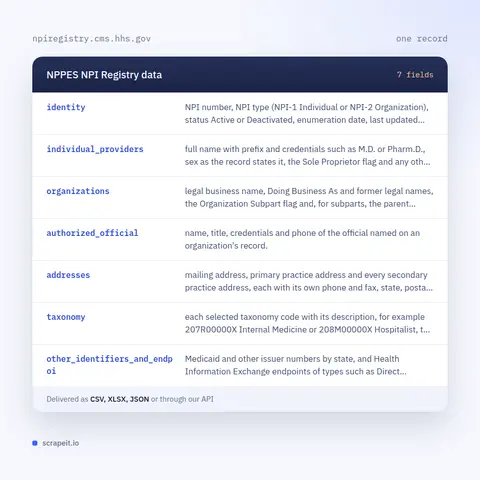
The unit of collection is the NPI View page - one per number, at /provider-view/ followed by the NPI - laid out the same way for both record types. We read it whole and return one row per NPI, with the repeating parts kept as nested lists or linked child tables.

  • IdentityNPI number, NPI type (NPI-1 Individual or NPI-2 Organization), status Active or Deactivated, enumeration date, last updated date and certification date.
  • Individual providersfull name with prefix and credentials such as M.D. or Pharm.D., sex as the record states it, the Sole Proprietor flag and any other names.
  • Organizationslegal business name, Doing Business As and former legal names, the Organization Subpart flag and, for subparts, the parent organization's legal business name.
  • Authorized officialname, title, credentials and phone of the official named on an organization's record.
  • Addressesmailing address, primary practice address and every secondary practice address, each with its own phone and fax, state, postal code and country.
  • Taxonomyeach selected taxonomy code with its description, for example 207R00000X Internal Medicine or 208M00000X Hospitalist, the state and license number filed with it, and which one is the primary taxonomy.
  • Other identifiers and endpointsMedicaid and other issuer numbers by state, and Health Information Exchange endpoints of types such as Direct Address, FHIR URL or Website URL, with use, content type and affiliation.

Flat output would lose what makes the record useful. One physician in the registry files a mailing address in Pennsylvania, a primary practice in Maryland, secondary sites in Pennsylvania, Virginia, Maryland and the District of Columbia, and a license in each of those jurisdictions, so taxonomies, licenses and practice locations come as repeatable groups keyed on the NPI rather than squeezed into one line.

NPPES NPI Registry Data: Fields in Each Record
NPPES NPI Registry Database Beyond Single Records

NPPES NPI Registry Database Beyond Single Records

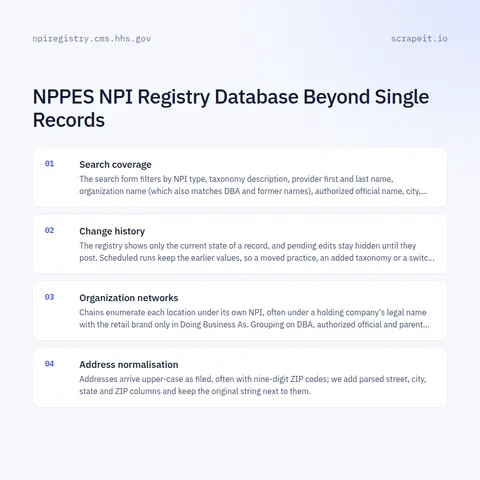
One NPI View answers a lookup. A provider directory is assembled from the search side of the registry and from repeat runs.

  • Search coveragethe search form filters by NPI type, taxonomy description, provider first and last name, organization name (which also matches DBA and former names), authorized official name, city, state, country, postal code and primary or secondary address type, with an exact-match switch. Result rows show NPI, name, primary practice address, phone and primary taxonomy, and we follow each one into its full record.
  • Change historythe registry shows only the current state of a record, and pending edits stay hidden until they post. Scheduled runs keep the earlier values, so a moved practice, an added taxonomy or a switch to Deactivated becomes a dated change event in your file.
  • Organization networkschains enumerate each location under its own NPI, often under a holding company's legal name with the retail brand only in Doing Business As. Grouping on DBA, authorized official and parent organization rebuilds the network a buyer actually means.
  • Address normalisationaddresses arrive upper-case as filed, often with nine-digit ZIP codes; we add parsed street, city, state and ZIP columns and keep the original string next to them.

About the NPPES NPI Registry

Source
npiregistry.cms.hhs.gov
Category
health sites
Delivery
API, JSON feed, CSV, XLSX
Plans
From €169 a month
Get a quote

The NPI Registry is the public search window onto NPPES, the National Plan and Provider Enumeration System run by the Centers for Medicare & Medicaid Services. Health care providers obtain a unique 10-digit National Provider Identifier through NPPES, and the registry shows the part of each record released under the Freedom of Information Act - name, specialty expressed as a taxonomy, practice addresses. The directory is free and needs no account.

Two record types share one number space. Type 1 NPIs belong to individual practitioners and carry a Sole Proprietor flag; Type 2 NPIs belong to organizations - hospitals, pharmacies, clinics, group practices - and carry an authorized official and, for subparts, a parent organization. Specialty is never free text but a Healthcare Provider Taxonomy code, and a provider can hold several, one marked primary, each tied to a state license.

The registry's help pages say information associated with NPIs is updated daily, and every record shows when it was last updated and certified. The registry also says plainly that holding an NPI does not prove a provider is licensed or credentialed, which is why buyers treat the taxonomy and license columns as a starting point for their own checks. Practice addresses abroad are searchable too, through a full country list.

25Developers
500+Customers
1.5BPages extracted
15,000+Hours saved for our clients

NPPES NPI Registry scraping plans and pricing

Airplane

€199one-time

Setup fee included

100,000
One-time
Up to 5 days
7 days

Helicopter

€169/ mo

Setup fee €499

250,000
Monthly
Up to 5 days
14 days

Glasses

€229/ mo

Setup fee €499

1,000,000
Weekly
Up to 5 days
30 days

Microscope popular

€349/ mo

Setup fee €499

2,000,000
Daily
Same day
60 days

DNA

€549/ mo

Setup fee €799

3,000,000
3 times daily
Same day
90 days

Delivery: CSV, JSON or XLSX files, our API or a JSON feed. MCP server on request.

Full plan details

What Teams Do With an NPI Registry Dataset

NPI records are the shared key of US health care billing and contracting, so registry data ends up in very different systems.

  • Provider directory accuracyHealth plans compare their directories with practice addresses, phones and status in the registry and chase the mismatches before members do.
  • Claims and enrollment checksBilling teams confirm that an NPI is active, that its NPI type fits the claim, and that the primary taxonomy matches the service billed.
  • Territory planningDevice and pharmaceutical sales teams count providers of one taxonomy by state, city and postal code and size territories on real addresses instead of purchased lists.
  • Network mappingRolling organization records up by DBA and authorized official shows how many locations a pharmacy chain or hospital system really runs.
  • Interoperability outreachDirect Address and FHIR URL endpoints tell an exchange or a vendor which organizations can already receive data electronically.

About ScrapeIt

ScrapeIt is a managed web scraping service: we build, run and repair the crawlers, and you receive the data. For a public health registry like NPPES that means provider records with every repeating group intact, columns documented, and delivery to Amazon S3, SFTP or straight into your database. Practitioner details are handled under GDPR, and we do not build dossiers on people. Plans start from EUR 169 a month, or EUR 199 for a one-time extract.

FAQ

Still unsure? Write to info@scrapeit.io

Do you offer an NPPES NPI Registry API for provider records?

Yes. The ScrapeIt NPI Registry API returns NPI number, NPI type, status, primary taxonomy, practice addresses and the last updated date as JSON from an endpoint we host, refreshed on the schedule you set. The same records also come as CSV or XLSX files, a JSON feed or a load into your database.

Is it legal to scrape the NPPES NPI Registry?

Yes. CMS publishes the registry as a free public directory: provider names, taxonomies, practice addresses and phone numbers are open to any visitor. We collect only publicly available data - everything a visitor can see on the NPI Registry - and we collect it legally. Practitioners appear in their professional capacity, and no patient information is involved.

How often is NPI Registry data updated, and how often should we refresh?

The registry says NPI information is updated daily, and each record carries its own last updated and certification dates. A weekly refresh suits most directories; claims validation usually runs daily. Each delivery flags new, changed and deactivated NPIs against the previous one.

Can you get every provider of one taxonomy in a state?

Yes. Because a search stops at 2,100 results and a state alone is not accepted, we split the state by city or postal code under the taxonomy description and merge the slices on the NPI. Organization and individual records come in one file with the NPI type column separating them.

Can your NPI data scraper check a list of NPIs we already hold?

Send the list in any spreadsheet. We open the NPI View of each number and return the current record next to your values, marking deactivated NPIs, changed practice addresses and new taxonomies, so the file reads as a to-do list for your data team.

How it works

  1. 1

    Make a request

    You share your needs, expectations, and desired timeframe. We'll suggest the best solution based on your request and budget.

  2. 2

    We configure the crawlers

    Our specialists configure the crawlers and extract a sample dataset for your review before proceeding with the full-scale extraction.

  3. 3

    Collect and deliver

    Once you approve the sample, we launch the project and start full data collection. We gather, filter, and structure the data for easy use, delivering it on time in your preferred format.

  4. 4

    Maintain and support

    Our team manages ongoing processes, monitors website changes, and supports all data extraction cycles. We can also help integrate data into your systems or create dashboards to simplify analysis.

Request a quote

Tell us which sites, which fields and how often. A couple of lines is enough to start.

  • We reply within 1 business day
  • A sample dataset before the full run
  • We sign an NDA on request
  • Delivery by API, JSON feed or files
Which sites, which fields, how often. A couple of lines is enough.

This form is protected by Google reCAPTCHA, which loads when you start filling it in; the Google Privacy Policy and Terms of Service apply. If you prefer not to use it, email us at info@scrapeit.io. Privacy & Cookie Policy

We reply within 1 business day. No obligation.

NPPES NPI Registry data from €169/month. Free project assessment, reply within 1 business day.