Remote OK Scraper for Remote Jobs and Open Salaries

Remote OK is the board that puts a dollar range on the job row. We scrape Remote OK, separate the stated pay from the filler, and keep the region lock in its own column.

Remote OK Scraper
Solutions

How We Deliver a Remote OK Job Data Feed

We run the crawl, you get the file. Remote OK scraping is delivered as CSV, JSON, XLSX or Parquet, pushed to S3, Google Cloud Storage, an FTP drop, a webhook or straight into your warehouse, and it can also come back as a private Remote OK API on our side with the same schema on every run. Schedules run hourly, daily or weekly, with a change log marking new postings, bumped postings and ads that have dropped off. Crawl pacing follows the rate the site asks for. Where a source fights automation, anti-bot handling, proxy rotation and CAPTCHA solving are part of the service rather than an extra line on the invoice. We do not sign in, so nothing behind a paid account is promised, and we do not collect contact details of the people doing the hiring.

Fields a Remote OK Scraper Pulls From Every Job Row

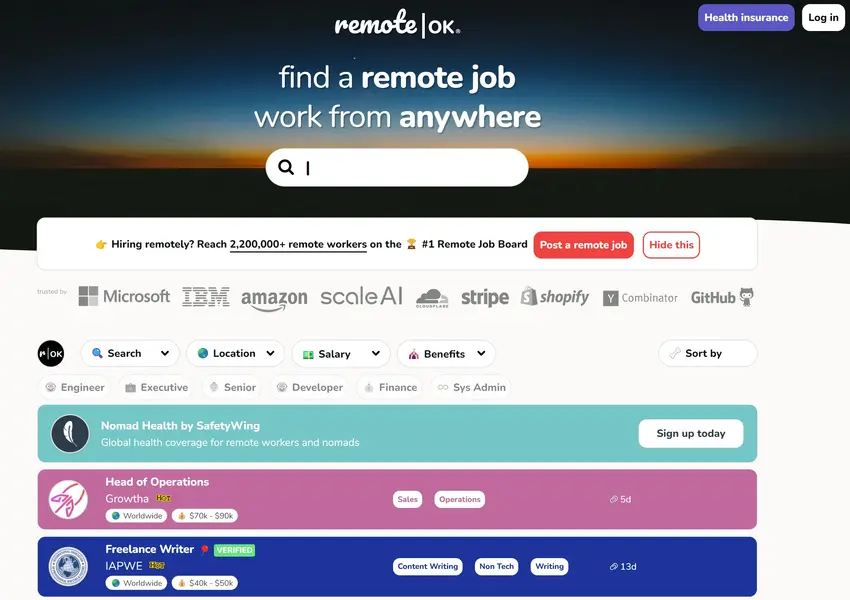
A Remote OK scraper works one job row at a time, and the row already carries most of the record before you open it:

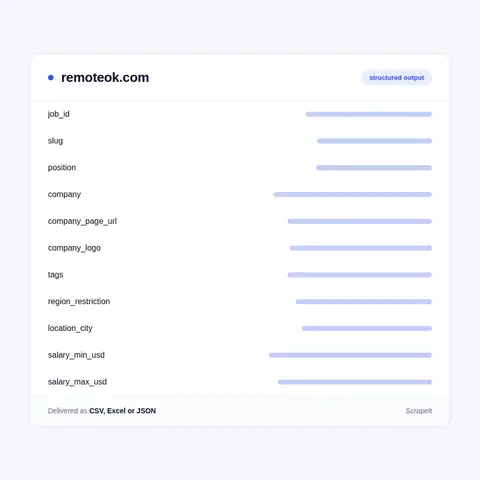
  • numeric job id, slug and canonical job URL
  • position title, employer name and a link to that employer page
  • tag list, region badges and the salary badge
  • posted timestamp in ISO form and in epoch seconds, plus the relative age shown as 10d
  • tracked apply link, a verified mark for listings from a checked source, and a balloon marker meaning the poster bumped the ad back to the front page

Open the posting and you also get the employer logo image or the initials tile tinted with the brand color taken from that logo, the company website, the benefits the employer ticked, and the full description as HTML with its headings and lists intact. Remote OK appends its own anti-spam line to the bottom of every description - a magic word the applicant has to quote, followed by a hashed token - so a clean text column means stripping that line off.

Under each row sits a JobPosting block in structured markup, and that is where a careless Remote OK data pull goes wrong. It carries datePosted, a validThrough date ninety days later, employmentType, a telecommute location type, applicantLocationRequirements as named countries, hiringOrganization pointing at the company page, occupationalCategory, jobBenefits and baseSalary in US dollars per year. Three of those are constants rather than facts: the industry field reads Startups on every posting, working hours read Flexible on every posting, and baseSalary falls back to a flat $80k to $150k whenever the employer stated no pay at all. We extract Remote OK jobs with that filler detected and blanked, so a stated range and a default range never share a column.

Fields a Remote OK Scraper Pulls From Every Job Row
Region Locks, Benefit Flags and Employer Profiles

Region Locks, Benefit Flags and Employer Profiles

Geography is the field buyers of remote job data get wrong most often, and this board keeps two that look alike. The badge on the row is the hiring restriction: Worldwide, a continent such as Europe, Latin America, Asia, Africa, Middle East, North America or Oceania, or a single named country - plus a hedged value that reads Probably worldwide when the employer never said. The same value sits in the structured block as applicantLocationRequirements. The other field, the one the free feed labels location, is a city string carried over from the source posting, often empty and sometimes just a town with a trailing comma, and it says nothing about who is allowed to apply. Read the second as the first and your Remote OK job data will show town-level roles open to the planet and worldwide roles that in fact accept one country. We keep them apart.

The country control runs on ISO codes across about 250 territories, so a country slice is exact rather than a text match. Benefits are a second structured layer: twenty-four flags including async work, a four day workweek, distributed team, no whiteboard interview, no monitoring system, pay in crypto, equity compensation and unlimited vacation. Employer pages add a company description, website, founding year, headcount, sector, an annual revenue figure, a headquarters country and that employer's live openings. The directory ranks employers by hiring over the past twelve months. Member profiles have their own address prefix and are personal pages, so we leave them out.

How Remote OK Is Built Around Open Salaries

Remote OK is a remote-only job board, and the front page sells its idea in its own title: open salaries. The whole site is one table. There is no separate results screen - the same job rows are filtered in place by a keyword box, a location box that resolves to country codes, a minimum salary set in thousands per year, a benefits picker, and a sort control that reorders by date, salary, views, applications, heat or count of benefits. Its own pitch to employers claims an audience above 14 million remote workers.

Addresses are flat and predictable. A job lives at /remote-jobs/ plus a slug built from the role, the employer and a numeric id, and the bare id on its own redirects to that slug, so the id survives a retitled posting. Employers get /company/ plus a slug. Every tag has its own page shaped as remote-tag-jobs, and two tags join with a plus sign to make an intersection page such as remote-dev+python-jobs.

The sitemap index splits the site into shards, with job pages, tag pages, company pages and member profiles each in their own group. Jobs run to roughly 70,000 addresses as of September 2026, tag pages number 230, and employer pages sit at about 22,500. Remote OK shares a nav bar with a small family of sibling sites - a Web3 job board, a digital nomad guide, a couple of image products - so its feed conventions repeat across them.

Get a Quote
dev_w
25

Developers

customers
500+

Customers worldwide

pages
1 500 000 000+

Pages extracted

stime
15000+

Hours saved for our clients

Plans

Airplane

€199 / one-time

setup fee - included

Data limits100,000
Frequencyone-time
Run timeup to 5 days
Data storing7 days

Helicopter

€169 / mo

setup fee €499

Data limits250,000
Frequencymonthly
Run timeup to 5 days
Data storing14 days

Glasses

€229 / mo

setup fee €499

Data limits1,000,000
Frequencyweekly
Run timeup to 5 days
Data storing30 days

DNA

€549 / mo

setup fee €799

Data limits3,000,000
Frequency3 times daily
Run timesame day
Data storing90 days

What Remote OK Salary and Tag Data Actually Answers

The reason to scrape Remote OK is pay. Hardly any board publishes a number, and this one built its identity on doing it: where an employer states a range, the site normalizes it to US dollars per year with a minimum and a maximum, so two ads from different continents compare without a currency table. That makes Remote OK salary data cheap to model - but it has to be read honestly. On the live feed only a small share of rows show a public figure; the rest swap the badge for an invitation to upgrade, and the free feed reports zero on both bounds. A pay dataset from this board is a sample of disclosed compensation, not a census of it, and an honest delivery states the disclosure rate next to the medians.

Past pay, the tag layer is what makes the board useful for tech hiring trends. Roles carry about seven tags each and some carry twenty, drawn from a controlled list of 230: languages such as python, golang and typescript, stacks such as react, docker and kubernetes, and role words such as senior, junior, exec and non tech. Slice the same feed by tag and you can watch which stacks are hiring remotely and at what money. For recruitment data and job market data, having pay, stack and hiring region on one row is what a scraped board rarely gives you.

Our Blog

Reads Our Latest News & Blog

Learn how to use web scraping to solve data problems for your organization

How Artificial Intelligence Is Used In Web Scraping

How Artificial Intelligence Is Used In Web Scraping

Leveraging advances in technology, the AI-powered web scraper has skyrocketed in demand and is helping to expand capabilities by automating tedious daily tasks and speeding up data collection from thousands of websites several times over.

What is Web Scraping and What is it Used For?

What is Web Scraping and What is it Used For?

Web scraping is a method of obtaining web data by extracting it from pages of web resources with the help of a program, that is, in automatic mode. It is used to syntactically convert web pages into more usable forms.

Web Scraping for Machine Learning

Web Scraping for Machine Learning

If you specialize in machine learning, you need to feed large amounts of data to the algorithms. Web scraping is the easiest and the most efficient method of collecting the data from all over the Internet.

scrapeit logo

About ScrapeIt

ScrapeIt is a managed web scraping agency. We build the crawler, run it, watch it when the target changes its markup, repair it, and hand you clean data on a schedule - there is no tool for you to learn and no proxy bill to manage. Job boards are a regular part of our work, and every job feed we ship keeps the fields that make roles comparable: pay, stack, employment type and who is allowed to apply. Tell us the slices you need and the format you want, and we will scope a Remote OK feed against them.

FAQ

Does Remote OK have a public API, and can you just use that?

Yes, and it is genuinely open - no key and no sign-up. The Remote OK API returns JSON, and adding .json to any tag page returns that tag sliced the same way. Two limits matter. It serves only the newest hundred postings, roughly ten days of hiring, and it ignores paging, so the archive is out of reach through it. Its apply link points back at the job page rather than at the employer, and its logo fields come back empty. The first element of every response is a licence note asking for a followed link back and credit to Remote OK, which we pass on to you along with the data.

Why do so many Remote OK jobs show no salary?

The board asks employers for a range and publishes it when it gets one, but most rows on the live feed replace the figure with a prompt to upgrade to a paid account, and the free feed reports zero on both bounds for those. The structured markup is worse: it fills the same gap with a flat $80k to $150k a year on every posting that has no stated pay. We detect that filler and leave the field empty rather than let it average into your numbers, and we report what share of postings disclosed a real range.

How do you handle the region restriction on remote jobs?

As its own column. Every posting carries a hiring restriction - Worldwide, a continent, or a named country - and that is not the same thing as the city string the free feed labels location, which is often empty and describes the source posting rather than who may apply. We keep both fields, map the continent badges to a fixed list, and flag the hedged Probably worldwide value separately so you can decide whether to count it. Without that split, a remote hiring dataset overstates how much of the market is genuinely open to anyone.

How many Remote OK jobs can you extract, and how fresh is it?

Coverage is built from the sitemap shards and the tag pages rather than from the feed, because the feed stops at a hundred rows. That path reaches roughly 70,000 job addresses plus about 22,500 employer pages, and the 230 tag pages give a second route into the same set for verification. Refresh is your call: hourly for a live board, daily for most monitoring, weekly for trend work. Each run is diffed against the last, so you get new, bumped, edited and disappeared postings instead of a fresh dump you have to compare yourself.

Is scraping Remote OK legal, and what about personal data?

We take public job listings only - pages any visitor can open without an account - and we do not sign in, so nothing gated behind a paid Premium account is part of the deliverable. Member profiles are excluded, and we do not gather names, direct emails or phone numbers of hiring staff. Crawl pacing follows what the site asks for, and where the free feed is used its attribution request travels with the data. Compliance with your own obligations stays yours, and we will narrow the scope to whatever your legal team signs off on.

How does it Work?

Step 1 - Make a Request

You share your needs, expectations, and desired timeframe. We’ll suggest the best solution based on your request and budget.

Step 2 - Configuring Custom Web Crawlers

Our specialists configure the crawlers and extract a sample dataset for your review before proceeding with the full-scale extraction.

Step 3 - Collect and Deliver

Once you approve the sample, we launch the project and start full data collection. We gather, filter, and structure the data for easy use, delivering it on time in your preferred format.

Step 4 - Maintain and Support

Our team manages ongoing processes, monitors website changes, and supports all data extraction cycles. We can also help integrate data into your systems or create dashboards to simplify analysis.

Request a Quote

Tell us more about you and your project information.
Which sites, which fields, how often. A couple of lines is enough.

We reply within 1 business day. No obligation.

scrapiet

Scrapeit Sp. z o.o.
10/208 Legionowa str., 15-099, Bialystok, Poland
NIP: 5423457175
REGON: 523384582