Google Jobs Scraper for Listings and Apply Links

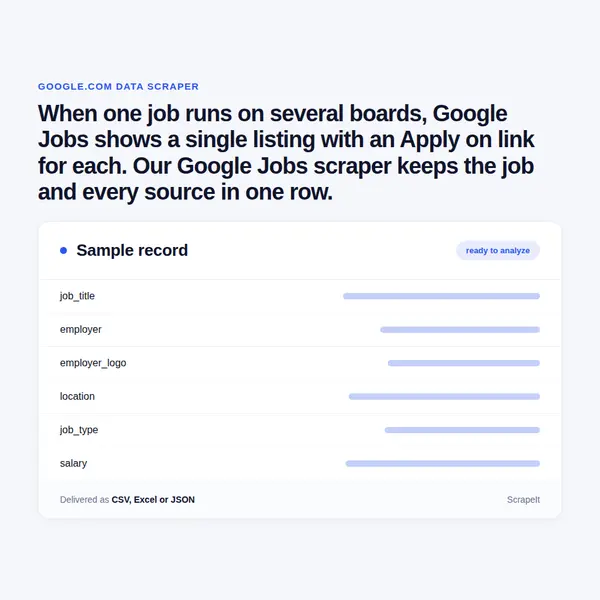
When one job runs on several boards, Google Jobs shows a single listing with an Apply on link for each. Our Google Jobs scraper keeps the job and every source in one row.

Plans from €169/month · Free project assessment · Reply within 1 business day

Google Jobs Scraper
Solutions

Scraping Google Jobs: How the Service Works

Google Jobs has no category tree to walk: every result list starts from a search and a place. So the brief is a set of job titles or keywords, the cities or countries, and any filters that matter. We build the query matrix, run it through each country's own version of Google Search, and repair the crawler whenever Google reshapes the jobs panel. Rendering, pacing, proxy rotation and CAPTCHA handling are part of the service.

You choose one-off or a schedule - daily for a live market view, weekly for trend reports. Delivery comes as CSV, Excel or JSONLines, through our API, by SFTP or into Google Drive or your database, with documentation for every field.

Google Jobs Data: Fields in Each Listing

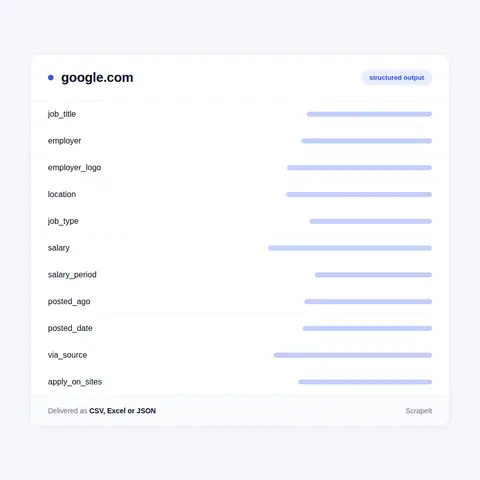
A Google Jobs listing is a card Google assembles from job ads it finds on employer career sites and job boards. Our Google Jobs scraper opens each card and returns one row per job:

  • Job - job title, employer name and employer logo, location as written (city and state or region), and the full job description text.
  • Terms - job type (Full-time, Part-time, Contractor, Internship) and the salary when the listing shows one, kept as printed with its period, for example an hour or a year.
  • Timing - posting age as Google prints it, such as 4 days ago, converted into a calendar date on the day of the run.
  • Highlights - the Qualifications, Responsibilities and Benefits blocks, plus attribute markers Google pulls from the ad text, such as health insurance, dental coverage or paid time off.
  • Sources - the via line naming the site Google took the card from, and every Apply on option with the site name and link, from job boards to the employer's own career page.
  • Work arrangement - the work from home flag Google sets for remote roles, whatever wording the ad uses.
  • Search context - query, location, filters, position in the result list and the run timestamp, so each row can be traced to the search that found it.

Employer details are business data and are delivered in full. Recruiter names, e-mail addresses and phone numbers that sometimes sit inside ad text are personal data and stay out by default; if a project needs them, they are handled under GDPR.

Google Jobs Data: Fields in Each Listing
Google Jobs Listings Across Searches, Places and Time

Google Jobs Listings Across Searches, Places and Time

One search returns one ranked list for one place. A useful dataset is many such lists merged, and the work is in how they are cut and joined.

  • Query matrix. Job titles crossed with cities, regions or whole countries, each search cut further by the filters Google offers - Date posted, job type, employer, company type, requirements such as no degree mentioned, and work from home - so long result lists are reached in full slices.
  • Removing duplicates across searches. The same job surfaces under several titles and nearby places. We merge on employer, title, location and apply links and keep every query that found it.
  • One job, several sources. The Apply on list shows which boards carry the same ad. Across a market it becomes a map of where ads travel: which employers post directly, which go through boards, and which boards cover which roles.
  • Posting history. Google drops expired postings, so repeated runs record when a job appeared, how long it stayed and when it left - a workable proxy for time to fill - and when new Apply on sources joined it.
  • Salary coverage. Pay appears on part of the listings only; repeated runs show which employers and roles publish it.

How Google Jobs Works

Google Jobs - often called Google for Jobs - is not a job board. Nobody posts an ad there. Google reads the job ads that employers publish on their career sites and that job boards carry, and shows them inside Google Search when someone searches for something like nurse jobs near me. A Jobs box opens the full list; the first results sit on the ordinary results page with a button to show more.

Google reads the title, employer, location, salary and dates from each ad. Google states that it does not allow expired job postings, so a job leaves the list once its source closes it. Listing providers do not pay to appear or to rank, and paid ads, when present, carry the label Ad at the top. Results are ordered by relevance by default, weighing the search terms, location and listing date.

The experience works in many countries across Europe, Asia, the Americas, Sub-Saharan Africa and parts of the Middle East and North Africa, though not in every language, and each country's Google returns the boards and career sites that serve it. A work from home filter collects remote roles whatever wording the ad uses.

Get a Quote
dev_w
25

Developers

customers
500+

Customers worldwide

pages
1 500 000 000+

Pages extracted

stime
15000+

Hours saved for our clients

Plans

Google Jobs Scraping Plans and Pricing

Airplane

€199 / one-time

setup fee - included

Data limits100,000
Frequencyone-time
Run timeup to 5 days
Data storing7 days

Helicopter

€169 / mo

setup fee €499

Data limits250,000
Frequencymonthly
Run timeup to 5 days
Data storing14 days

Glasses

€229 / mo

setup fee €499

Data limits1,000,000
Frequencyweekly
Run timeup to 5 days
Data storing30 days

DNA

€549 / mo

setup fee €799

Data limits3,000,000
Frequency3 times daily
Run timesame day
Data storing90 days

Delivery: CSV, JSON or XLSX files, our API or a JSON feed. MCP server on request.

Full plan details →

Why Scrape Google Jobs

Google Jobs is the closest thing to a cross-board view of a labour market: ads from employer career sites and many job boards in one result list, already grouped per job. That makes it useful in ways a single board is not.

  • Labour market analytics. Open roles by title, city and employer, with job type and posting age, without stitching a dozen boards together - and without counting the same ad three times.
  • Job board competition. The via line and the Apply on list show which boards win placement for which employers and roles, and how that share moves month to month.
  • Employer intelligence. Which companies are hiring, for what, where and how fast, read from the employer field and posting dates - useful to staffing agencies, investors and suppliers that sell to growing firms.
  • Pay benchmarking. Where a salary is printed, ranges by title and city build a benchmark that cites the ad it came from.
  • Remote work tracking. The work from home flag separates remote roles consistently, whatever words each ad uses.

Our Blog

Reads Our Latest News & Blog

Learn how to use web scraping to solve data problems for your organization

How Artificial Intelligence Is Used In Web Scraping

How Artificial Intelligence Is Used In Web Scraping

Leveraging advances in technology, the AI-powered web scraper has skyrocketed in demand and is helping to expand capabilities by automating tedious daily tasks and speeding up data collection from thousands of websites several times over.

What is Web Scraping and What is it Used For?

What is Web Scraping and What is it Used For?

Web scraping is a method of obtaining web data by extracting it from pages of web resources with the help of a program, that is, in automatic mode. It is used to syntactically convert web pages into more usable forms.

Web Scraping for Machine Learning

Web Scraping for Machine Learning

If you specialize in machine learning, you need to feed large amounts of data to the algorithms. Web scraping is the easiest and the most efficient method of collecting the data from all over the Internet.

scrapeit logo

About ScrapeIt

ScrapeIt runs scraping as a service: we design, operate and maintain the crawlers, and you receive the data. Job listings suit this model because they change daily - a listing expires, reappears under another source or changes its salary line - and a collector left alone drifts. We keep the history straight and the schema stable. Plans start from EUR 169 a month, or EUR 199 for a one-time extract, and a free project assessment comes first.

FAQ

Do you offer a Google Jobs API for listing data?

Yes. The ScrapeIt Google Jobs API returns job title, employer, location, job type, salary where shown and every Apply on link as JSON from an endpoint we host, refreshed on the schedule you set. Queries and places are configured with us once. The same records also come as CSV or Excel files, a JSON feed or a direct load into your database.

Is it legal to scrape Google Jobs?

Yes. Google Jobs shows job ads that employers and boards have published for anyone to read, inside ordinary Google Search results. We collect only publicly available data - everything a visitor can see on Google Jobs - and we collect it legally. Personal details found in ad text are left out by default.

Can your Google Jobs crawler cover countries outside the US?

Yes. The jobs experience runs across Europe, Asia, Latin America, North America, Sub-Saharan Africa and much of the Middle East and North Africa, though not in every language. We run each country through its own Google domain and language, so a German search returns listings from the boards and career sites that serve Germany.

Can you build a Google Jobs database with posting history?

Yes, by repeating the same query matrix on a schedule. Each run turns the posting age into a date, so the database shows when a job first appeared, which Apply on sources were added later and when it disappeared after the employer closed it. A daily schedule catches postings that stay up only a few days.

How do you handle the same job listed on several boards?

Google already groups many copies of an ad into one listing and shows the boards under Apply on; we keep that grouping and store every source with its link. Where duplicates still appear, under different titles or places, we merge the rows on employer, title, location and apply links and record which searches found them.

How does it Work?

Step 1 - Make a Request

You share your needs, expectations, and desired timeframe. We’ll suggest the best solution based on your request and budget.

Step 2 - Configuring Custom Web Crawlers

Our specialists configure the crawlers and extract a sample dataset for your review before proceeding with the full-scale extraction.

Step 3 - Collect and Deliver

Once you approve the sample, we launch the project and start full data collection. We gather, filter, and structure the data for easy use, delivering it on time in your preferred format.

Step 4 - Maintain and Support

Our team manages ongoing processes, monitors website changes, and supports all data extraction cycles. We can also help integrate data into your systems or create dashboards to simplify analysis.

Request a Quote

Tell us more about you and your project information.
Which sites, which fields, how often. A couple of lines is enough.

This form is protected by Google reCAPTCHA, which loads when you start filling it in. If you prefer not to use it, email us at info@scrapeit.io. Privacy & Cookie Policy

We reply within 1 business day. No obligation.

Google Jobs data from €169/month. Free project assessment, reply within 1 business day.

scrapiet

Scrapeit Sp. z o.o.
10/208 Legionowa str., 15-099, Bialystok, Poland
KRS: 0000996672
NIP: 5423457175
REGON: 523384582