Flexport Scraper for Market Research and Service Network

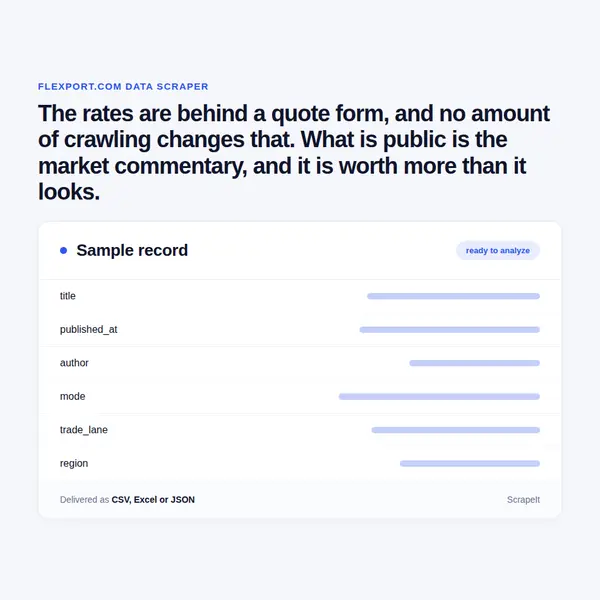
The rates are behind a quote form, and no amount of crawling changes that. What is public is the market commentary, and it is worth more than it looks.

Flexport Scraper
Solutions

Managed freight research data, run end to end by us

ScrapeIt runs the collection as a managed service. You name the lanes, modes or topics; we build the pipeline with numeric claims extracted as rows carrying their periods and sources, lane and mode as fields, and hand back CSV, JSON, Excel or a push into your warehouse.

Publication is irregular, so we collect on a schedule that catches new pieces promptly rather than one that re-reads a static library daily.

We collect published research only. There are no public rates on this source and we will tell you that before quoting rather than after. Crawl rules are honoured and requests paced. Content is copyrighted, so the dataset is for analysis rather than republication, and your counsel should see the use case before the project starts.

Flexport fields in every export

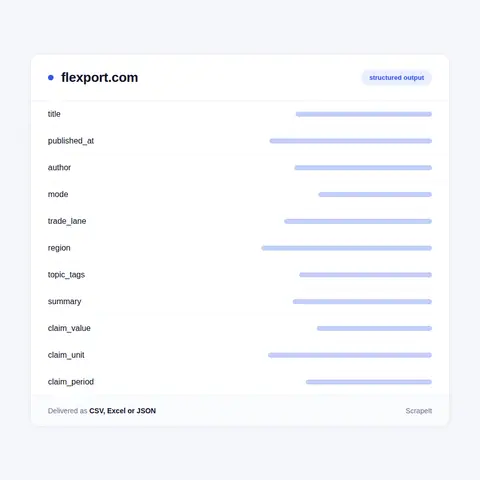
Research records carry the title, publication date, author or team as credited, trade lane or region, mode - ocean, air or ground - topic tags, summary and the full text where a client needs it for analysis.

Where a piece contains numeric claims - transit times, capacity changes, congestion figures, index values - those are extracted as their own records with the value, unit, the period it describes and the piece it came from. A number buried in prose is invisible to any query; the same number as a row with a source reference is usable and checkable.

Mode and lane are first class fields, because ocean and air behave differently enough that a combined analysis is rarely meaningful, and lane is how anybody in freight actually asks a question.

Service network data - the routes and services described publicly - is collected where published, since coverage is a structural fact about a forwarder that is otherwise hard to assemble.

Every row carries the collection timestamp and the source address.

Flexport fields in every export
Claim extraction, lane coverage and rights

Claim extraction, lane coverage and rights

Numeric claim extraction is the technique that makes this source worth the work, and it needs care: a figure without its period and its qualification is worse than no figure. We keep the surrounding claim text alongside the extracted value so a user can always see what the number was actually asserting.

Lane coverage analysis over the research corpus shows which trade lanes get attention and when, which is a rough but real proxy for where disruption and volume are concentrating.

Timeline analysis around disruptions - a canal closure, a port strike, a capacity withdrawal - shows how commentary builds and resolves, and is useful for anyone building an early warning process.

On rights we are direct. The research is copyrighted content published for marketing purposes. Structuring and measuring it is analysis; republishing it is not, and a product that would surface the text to end users is a permissions conversation rather than a scraping one. The content signal on the site is permissive about AI training, which is a licensing signal and not a transfer of copyright.

A forwarder that publishes what it sees

Flexport is a digital freight forwarder handling ocean, air and ground freight with a technology platform wrapped around traditional forwarding. It moves goods and it also publishes an unusual amount of commentary about the market it operates in.

The first thing to be clear about is what cannot be collected. Rates here are quoted, not listed. There is no public price list to scrape, and a brief that assumes otherwise needs correcting before anybody is charged for a pipeline that will come back empty.

What is public is genuinely useful: market research, capacity and congestion commentary, trade lane analysis and occasional indices, published as a research output rather than as a rate card. For a shipper or an analyst tracking conditions rather than shopping for a price, that is the right material.

Research sections respond directly and crawl rules are published, disallowing the API and fragment paths. They also carry an explicit content signal permitting search, AI input and AI training - a notably open position in a category where most publishers are restricting.

Get a Quote
dev_w
25

Developers

customers
500+

Customers worldwide

pages
1 500 000 000+

Pages extracted

stime
15000+

Hours saved for our clients

Plans

Airplane

€199 / one-time

setup fee - included

Data limits100,000
Frequencyone-time
Run timeup to 5 days
Data storing7 days

Helicopter

€169 / mo

setup fee €499

Data limits250,000
Frequencymonthly
Run timeup to 5 days
Data storing14 days

Glasses

€229 / mo

setup fee €499

Data limits1,000,000
Frequencyweekly
Run timeup to 5 days
Data storing30 days

DNA

€549 / mo

setup fee €799

Data limits3,000,000
Frequency3 times daily
Run timesame day
Data storing90 days

Why commentary is a dataset when it is structured

A research library looks like reading material rather than data, and that is why most of its value goes uncollected.

The numeric claims inside it are the dataset. Transit times, capacity commentary, congestion figures and index values published over months form a time series about market conditions that nobody assembles because each figure arrives wrapped in a paragraph. Extracted with the period and the source attached, they become a series a client can actually plot against their own costs.

The second reason is that forwarder commentary is a leading view. A company physically moving freight sees congestion, blank sailings and capacity shifts before they show in published indices, and the timing of what gets written about is itself informative.

The third is scope honesty, which on this source has to come first. No rates are public. Anyone needing actual prices needs a rate benchmarking provider or their own quotes, and we say so at scoping rather than delivering a research corpus to somebody who was expecting a price list.

The fourth is that this is one forwarder's view. It is a well-informed one and it is not the market, so a serious conditions dataset reads several sources and notes where they disagree.

Our Blog

Reads Our Latest News & Blog

Learn how to use web scraping to solve data problems for your organization

How Artificial Intelligence Is Used In Web Scraping

How Artificial Intelligence Is Used In Web Scraping

Leveraging advances in technology, the AI-powered web scraper has skyrocketed in demand and is helping to expand capabilities by automating tedious daily tasks and speeding up data collection from thousands of websites several times over.

What is Web Scraping and What is it Used For?

What is Web Scraping and What is it Used For?

Web scraping is a method of obtaining web data by extracting it from pages of web resources with the help of a program, that is, in automatic mode. It is used to syntactically convert web pages into more usable forms.

Web Scraping for Machine Learning

Web Scraping for Machine Learning

If you specialize in machine learning, you need to feed large amounts of data to the algorithms. Web scraping is the easiest and the most efficient method of collecting the data from all over the Internet.

scrapeit logo

Who builds and keeps your freight research feed

ScrapeIt is a managed extraction company, not a tool you have to learn. Our team builds the pipeline, retunes claim extraction as writing formats change, and repairs the collector before a conditions series misses the month something happened.

You see a sample first, in your format, over the lanes you actually ship, with numeric claims extracted and their source text attached so you can judge the extraction rather than trust it.

FAQ

Can you get me freight rates from this site?

No, and we will say so before quoting. Rates here are quoted rather than listed - there is no public price list, so a pipeline aimed at one comes back empty. For actual prices you need a rate benchmarking provider or your own quotes.

What is actually worth collecting then?

The numeric claims inside the research - transit times, capacity and congestion figures, index values - extracted with their periods and sources. Published over months they form a conditions series nobody assembles because each figure arrives wrapped in a paragraph.

How reliable is a number pulled out of an article?

As reliable as the claim it came from, which is why we keep the surrounding text on the row. A figure without its period and qualification is worse than no figure, so the extraction is auditable rather than presented as a clean measurement.

Is one forwarder's view enough?

No. It is well informed and it is one company's perspective. A serious conditions dataset reads several sources and notes where they disagree - the disagreements are often the most informative part.

The site permits AI training - can I do what I like?

It is a permissive licensing signal, not a transfer of copyright. It eases one question and leaves republication where it was: structuring and measuring the content is analysis, surfacing the text to your users is a permissions conversation.

How does it Work?

Step 1 - Make a Request

You share your needs, expectations, and desired timeframe. We’ll suggest the best solution based on your request and budget.

Step 2 - Configuring Custom Web Crawlers

Our specialists configure the crawlers and extract a sample dataset for your review before proceeding with the full-scale extraction.

Step 3 - Collect and Deliver

Once you approve the sample, we launch the project and start full data collection. We gather, filter, and structure the data for easy use, delivering it on time in your preferred format.

Step 4 - Maintain and Support

Our team manages ongoing processes, monitors website changes, and supports all data extraction cycles. We can also help integrate data into your systems or create dashboards to simplify analysis.

Request a Quote

Tell us more about you and your project information.
Which sites, which fields, how often. A couple of lines is enough.

We reply within 1 business day. No obligation.

scrapiet

Scrapeit Sp. z o.o.
10/208 Legionowa str., 15-099, Bialystok, Poland
NIP: 5423457175
REGON: 523384582