Brave Search Scraper for What the Brave Search API Leaves Out

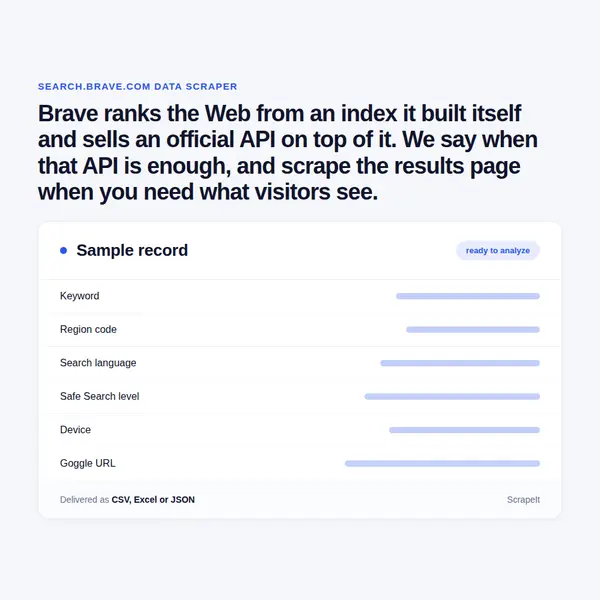
Brave ranks the Web from an index it built itself and sells an official API on top of it. We say when that API is enough, and scrape the results page when you need what visitors see.

Brave Search Scraper
Solutions

How We Scrape Brave Search for You

You send keywords, regions, languages and devices, plus any Goggle to apply. We run the Brave Search scraper from egress inside each region, render the page so AI answers and widgets load, and record every block with its position. Brave screens traffic at its own firewall, answers suspected bots with a proof-of-work captcha and turns some VPN and Tor exits away outright, so each capture is checked as a complete results page before it is stored. Anti-bot handling, proxy rotation and CAPTCHA solving are part of the service.

Where the API covers the job, we wire the pipeline to your own Brave Search API key instead. Delivery is CSV, JSON, XLSX or an endpoint, pushed to S3, SFTP or your warehouse.

Brave Search Data From Every Block on the Results Page

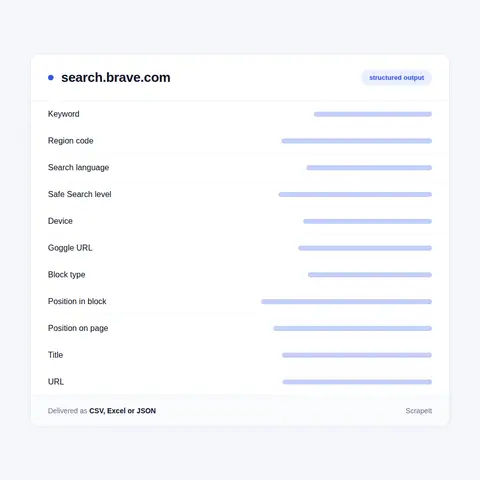
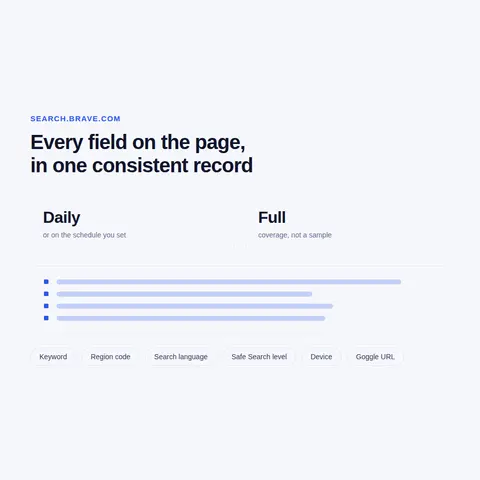
We extract Brave Search data from the rendered results page, one row per element, and stamp every row with the keyword, region, language, Safe Search level, device and any Goggle in force.

  • Web results. Position, title, URL, site name and favicon, snippet, and the date label where Brave prints one.
  • AI answer. Whether one appeared, its text and the sources it cites. Brave always shows where an answer comes from, so the citation list is the part worth tracking over time.
  • Discussions. Thread title, forum and URL for each Reddit or Stack Exchange thread Brave surfaces. Usernames and post authors stay out.
  • News and videos. Headline, source, date label and thumbnail, in the order Brave interleaves them with web results.
  • Snippets and infobox. Featured snippets at the top with the page they quote, and the side-column infobox with its source links.
  • Local results. Business name, address, rating, opening hours, price range and category, which Brave enriches in part with Tripadvisor data. Business records only.
  • Paid and partner slots. Brave Search Ads, marked as ads, plus the flights widget that links out to Kayak, Amazon product ads on shopping queries and Booking links, each flagged so organic rank is read net of them.

Positions are kept per block and for the page as a whole, so a third organic result can be read against the AI answer and the Discussions block above it. Brave Search Premium members, and Brave Rewards users with a connected wallet, see no search ads by default, so the ad count we record is the one an ordinary visitor gets.

Brave Search Data From Every Block on the Results Page
Brave Search API: What It Returns and Where It Stops

Brave Search API: What It Returns and Where It Stops

The Brave Search API is official and self-serve. A Brave Search API key, with the matching plan, opens Web Search, LLM Context, News, Images, Videos, Place Search, Autosuggest, Spellcheck and Answers, an OpenAI-compatible chat endpoint; agents reach it through the official Brave Search MCP server. Web Search returns up to 20 results a call and ten pages deep, with country, language, freshness, Safe Search, extra snippets and up to three Goggles as parameters. The Brave Search image search API returns up to 200 images a call. The old summarizer no longer has its own page in the docs and survives as a key in web results; documented AI answers come from the Answers endpoint.

When you need Brave's ranked results as data - URLs, snippets, news, discussions, infobox, places - the API is the cheaper and cleaner route, and we will say so. Keep two limits in view. The self-serve terms allow only transient storage of Brave Search API results and bar reselling them or training AI on them, so a stored rank history needs a plan that explicitly grants storage rights, which is worth asking Brave about first. And the response carries no ads and no partner widgets; its mixed object suggests where each block belongs in the top, main and side zones of your own page, a layout hint rather than a copy of the page a visitor in a region saw. Singapore, a region on the results page, is absent from the API country list. What a visitor saw is where a results page capture earns its place.

Where Brave Search Results Come From: an Index of Its Own

Brave Search is the search engine Brave Software runs at search.brave.com, built into the Brave browser and offered behind a paid developer API. A Brave Search scraper and that API draw on one source: the Brave Search index, which Brave put at over 30 billion pages in late September 2026, kept fresh by more than 100 million page updates a day. Brave calls it a completely independent index tuned to cut SEO spam, and counts it among only three independent, global-scale indexes in the western world. By default every web result is served from it, not bought from Google or Bing.

Two feeds build it. The Brave Search crawler does not identify itself separately, so sites that admit only Google do not turn it away, and it skips any page Googlebot may not crawl, so a site that shuts out Googlebot is missing here too. The Web Discovery Project, an opt-in in the Brave browser, adds anonymous signals from volunteers: queries, result clicks, visited URLs and time on page. Brave says it does not filter, downrank or censor results beyond what the law requires, such as copyright takedowns, right to be forgotten requests and government orders.

A visitor sees tabs for Ask, All, Images, News, Videos, Maps and Goggles. For certain searches the All tab opens with an AI answer that cites its sources, and Brave Search Discussions pulls in Reddit and Stack Exchange threads when a query scores as discussion-worthy. Featured snippets, an infobox, local results and clearly marked private ads fill the rest, while Ask Brave turns a query into a chat with a Deep Research mode.

Get a Quote
dev_w
25

Developers

customers
500+

Customers worldwide

pages
1 500 000 000+

Pages extracted

stime
15000+

Hours saved for our clients

Plans

Airplane

€199 / one-time

setup fee - included

Data limits100,000
Frequencyone-time
Run timeup to 5 days
Data storing7 days

Helicopter

€169 / mo

setup fee €499

Data limits250,000
Frequencymonthly
Run timeup to 5 days
Data storing14 days

Glasses

€229 / mo

setup fee €499

Data limits1,000,000
Frequencyweekly
Run timeup to 5 days
Data storing30 days

DNA

€549 / mo

setup fee €799

Data limits3,000,000
Frequency3 times daily
Run timesame day
Data storing90 days

Brave Search Rankings, Goggles and AI Answer Citations

The Brave Search engine ranks its own index with its own models, so a position on Google or Bing predicts little here. Brave's help pages give site owners a noindex route and a re-fetch request, but nothing like a search console report, so positions have to be collected. Rank tracking on Brave also reaches past Brave's own visitors: the same index grounds the LLM Context and Answers endpoints that chatbots and agents call, so a Brave position is an early reading of what those agents will find.

One query can hold many rankings. Brave Search Goggles re-rank the index with open rule files hosted on GitHub or GitLab, using $boost, $downrank and $discard against sites and URL patterns. The discovery page lists popular Goggles such as Tech blogs, No Pinterest, Rust programming and the AllSides pair News from the Left and News from the Right, and each one reorders the page. Rerank does the same for a single visitor, with raise and discard rules kept in cookies.

  • SEO teams watch the default ranking by region, plus chosen Goggles for niche audiences.
  • Brand teams see which sources and threads Brave's AI answers cite for their name.
  • Publishers measure how much of the page sits above their first organic link.

Our Blog

Reads Our Latest News & Blog

Learn how to use web scraping to solve data problems for your organization

What is the Scraping Web Data for Sentiment Analysis & How it Helps Marketers and Data Scientists

What is the Scraping Web Data for Sentiment Analysis & How it Helps Marketers and Data Scientists

The use of sentiment analysis tools in business benefits not only companies but also their customers by allowing them to improve products and services, identify the strengths and weaknesses of competitors' products, and create targeted advertising.

Empower Your Business with Google Maps Data

Empower Your Business with Google Maps Data

Using web scraping to extract Google Maps data will help you quickly and efficiently find businesses in any industry, city, state, or region. And the extracted contact information, such as phone or email address, social networks, or links to web pages, will help to contact them.

How to Generate Business Leads Using Web Scraping

How to Generate Business Leads Using Web Scraping

Lead scraping is a reliable way to get the right customer contacts to market your product, saves organizations time, and helps you better understand the audience you want to attract. Contacts include emails, phone numbers, or social media profiles.

scrapeit logo

Brave Search Scraping, Scoped Before It Starts

ScrapeIt is a managed web scraping agency: engineers who build, host and repair collectors and deliver the data, not a tool. A Brave Search project opens with three questions - which blocks you need, in which regions, and what you have to keep - because the answers decide between the API, a results page capture or a mix of the two.

The first delivery is a trial set of one keyword list in two regions, and the price is fixed before full collection starts.

FAQ

Does Brave Search have an API?

Yes, an official one. Brave Software sells the Brave Search API on the same independent index that serves search.brave.com, with endpoints for web, news, images, videos, places, LLM Context and cited AI answers. It returns ranked results as JSON, not the page a visitor sees: no ads, no partner widgets, no record of the page as rendered. Its general terms allow only transient storage and bar reselling results or training AI on them; keeping results, model training included, needs a plan that explicitly grants storage rights. Settle what you need to keep before you choose.

Is there a free tier, and how does Brave Search API pricing work?

The price list shows no separate free plan: each plan carries $5 of credit a month, and a card is required even so. In late September 2026 the Search plan costs $5 per 1,000 requests at up to 50 a second, so the credit covers about 1,000 calls. Answers currently costs $4 per 1,000 queries plus $5 per million input and output tokens at 2 a second; Spellcheck and Autosuggest are currently $5 per 10,000. Query logs are kept for up to 90 days, and Brave Search API zero data retention is an Enterprise option.

Which countries and languages does Brave Search cover?

The results page offers 38 countries plus All regions, from the US, UK, Germany and France to Brazil, India, Japan and Singapore. Left alone, Brave sets the region from the visitor's IP, and with anonymous local results on, local queries resolve to a general location taken from that IP. The interface comes in 49 languages, and the loc: and lang: search operators filter further. The API takes 37 of those countries plus ALL, with no Singapore, and 52 search-language codes. We run each region from egress inside that country, so rankings match what people there see.

Can Brave Search results be tracked daily, and under a Goggle?

Yes. Daily suits most keyword lists, weekly suits stable reference queries, and a short list around a launch or breaking story can run hourly. A Goggle is named by the URL of its rule file and has to be registered with Brave before use; we store that URL on every row, so default and re-ranked positions sit side by side. Through the API each keyword, region and page is one billed call, and Brave serves cached results unless a call asks for fresh ones, which it honours on a best-effort basis. Files arrive as CSV, JSON or XLSX, or through an endpoint.

Is it legal to scrape Brave Search?

That depends on where you operate and what you do with the data, and we are not lawyers. Brave's robots.txt disallows /search, /images, /news, /videos and /goggles for every crawler. Its Terms of Use forbid bypassing any measure Brave uses to restrict access or loading its systems disproportionately, and its help center says its captchas exist to make scraping Brave Search expensive for bots. The API is the route Brave licenses. We state this up front, agree scope and volume with your counsel before a run, collect only what an ordinary visitor sees and leave personal data out. The decision and the use of the data stay with you.

How does it Work?

Step 1 - Make a Request

You share your needs, expectations, and desired timeframe. We’ll suggest the best solution based on your request and budget.

Step 2 - Configuring Custom Web Crawlers

Our specialists configure the crawlers and extract a sample dataset for your review before proceeding with the full-scale extraction.

Step 3 - Collect and Deliver

Once you approve the sample, we launch the project and start full data collection. We gather, filter, and structure the data for easy use, delivering it on time in your preferred format.

Step 4 - Maintain and Support

Our team manages ongoing processes, monitors website changes, and supports all data extraction cycles. We can also help integrate data into your systems or create dashboards to simplify analysis.

Request a Quote

Tell us more about you and your project information.
Which sites, which fields, how often. A couple of lines is enough.

We reply within 1 business day. No obligation.

scrapiet

Scrapeit Sp. z o.o.
10/208 Legionowa str., 15-099, Bialystok, Poland
NIP: 5423457175
REGON: 523384582