Google Maps Data: Local Businesses from 1,000 US Cities Every Weekday
A weekday feed of local businesses from Google Maps for a local-marketing company: 1,000 US cities, three keywords a day, files by 10:00 UTC.
Learn More
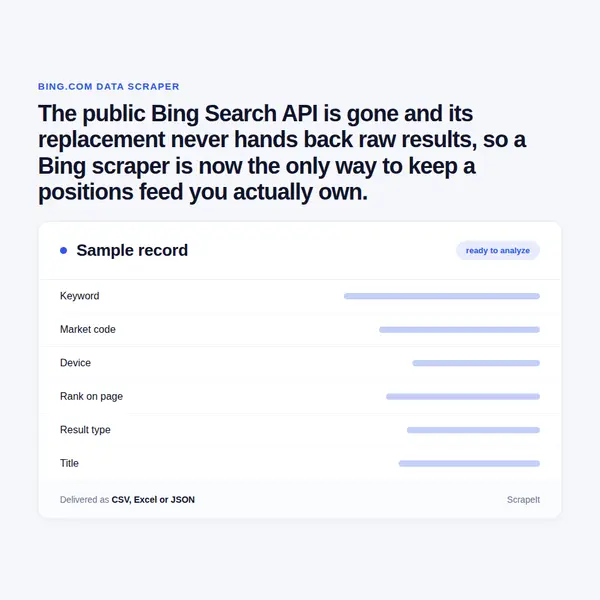
The public Bing Search API is gone and its replacement never hands back raw results, so a Bing scraper is now the only way to keep a positions feed you actually own.
Plans from €169/month · Free project assessment · Reply within 1 business day
ScrapeIt builds the Bing scraper, runs it and watches it. Bing rarely slams the door; it quietly serves a thinner page to traffic it does not trust, so a job that only asks whether a page came back will store the wrong result page for months without complaint. We validate rows by meaning rather than by delivery, and we keep the egress clean. Anti-bot handling, proxy rotation and CAPTCHA solving are part of the service, not a line item.
You approve a sample extract before the full run, so field names and coverage are settled early. After that we run to your schedule, hourly through monthly, per keyword list, market and device. Delivery is CSV, JSON, XLSX or an endpoint you call, pushed to S3, an SFTP drop or your warehouse.
A Bing scraper is only worth running if the rows come back complete. This is what each Bing surface publishes, in the platform's own field names.
Bing price rows from the shopping tab are the one place where a figure attaches to a product rather than to a document, so we extract Bing data from that tab on its own schedule and join it to the web feed afterwards.
Bing splits geography from language. The cc parameter takes a two letter country and leans on the request language header; mkt takes a language and country pair such as en-GB or pt-BR and travels with setLang, and the two schemes are mutually exclusive. Microsoft documents 38 market codes, 36 country codes and 50 interface languages, and the mapping is not one to one: Belgium appears as both nl-BE and fr-BE, the United States as en-US and es-US, Chinese as zh-CN, zh-HK and zh-TW. The same query in two markets returns a different result set, a different count line and locale formatting on the number itself, which is why a keyword list has to be run per market rather than translated.
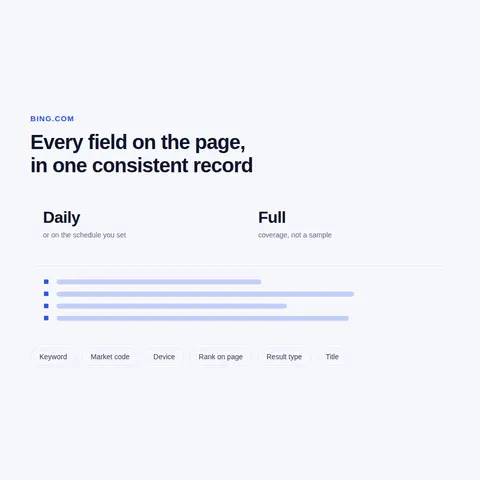
Every row carries the market, language, device and capture time it was collected under, next to the count line exactly as Bing printed it, locale formatting included. The time filter runs per market as well: all, past 24 hours, past week, past month, past year, or a custom start and end date, so a launch or a news cycle can be tracked inside a fixed window. Images, videos, news and shopping run as verticals of their own, each with its own fields, and join the web feed on keyword, market and capture time.
Bing is Microsoft's search engine, and bing.com is the front door to it. The same crawl and index sit under Copilot: Microsoft's webmaster guidelines describe a single crawling, indexing and ranking foundation behind Bing search, Copilot and grounding results, and treat eligibility for citations in AI answers as an extension of ordinary indexing. That makes a Bing position worth more than the engine's search share alone suggests.
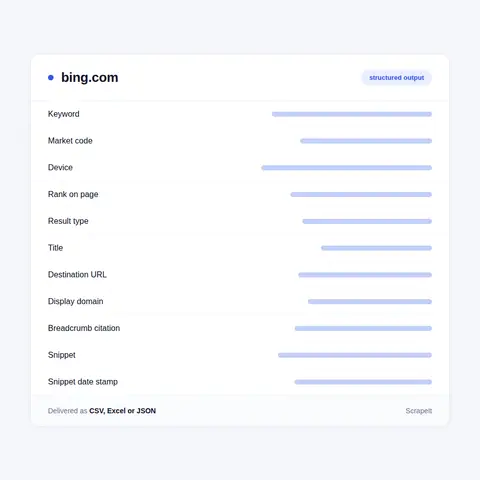
The result page has a stable skeleton. Organic results sit in an ordered list of b_algo items, ten to a page. Each carries a linked heading with the matched terms in bold, a display domain, a breadcrumb citation line, a two line snippet, a site favicon and, where Bing holds a date, a date stamp printed inside the snippet. Above the list sits the count line, written as About N results, and the scope bar for the verticals Bing serves separately: web, images, video, shop, news, local, flights, menu and Copilot search. A time filter offers all, past 24 hours, past week, past month, past year, or a custom start and end date.
Two details decide whether a Bing scraper produces clean rows. Every organic and paid link is wrapped in a bing.com/ck/a redirect, and the real destination is base64 in the u parameter behind an a1 prefix, so the target has to be decoded rather than read off the page. Bing also bolts its own msockid tracking parameter onto many destinations, and leaving it in place splits one URL into several rows. Paging runs on first=11, first=21 and so on, ten results a step, next to a per session token that the pagination links carry.
Get a Quote
Developers

Customers worldwide

Pages extracted

Hours saved for our clients
€199 / one-time
setup fee - included
€169 / mo
setup fee €499
€229 / mo
setup fee €499
€349 / mo
setup fee €499
€549 / mo
setup fee €799
Delivery: CSV, JSON or XLSX files, our API or a JSON feed. MCP server on request.
Full plan details →Bing Webmaster Tools is free and useful, and it is also the reason people end up buying a Bing scraper. It reports only on sites you have verified, it holds search performance for about the past six months, and it starts collecting on the day you add the property, so there is no backfill and no sight of a competitor at all. Average position comes back only for the web and chat sources; news, images, videos and knowledge panel rows arrive with clicks, impressions and click through rate but no position.
Aggregated impressions also hide the shape of the page. A keyword can hold the same average position across a quarter while the first organic result slides below an extra ad block, a video carousel or an answer panel. Only a captured result page shows that, and only a stored series shows when it changed. Bing scraping earns its place exactly there: rank by market and device, paid density above the fold, share of voice against named competitors, and the title and snippet Bing chose to show for your page rather than the ones you wrote.
There is a newer reason too. Bing's own guidelines tie eligibility for grounding results and citations to the same indexing that decides ordinary ranking, so a Bing position feed doubles as an early read on where a brand surfaces in AI answers. We collect what Bing publishes to any visitor; names, contact details and anything tied to a private individual stay out of the extract by default.
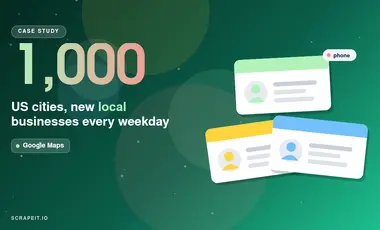
A weekday feed of local businesses from Google Maps for a local-marketing company: 1,000 US cities, three keywords a day, files by 10:00 UTC.
Learn MoreLearn how to use web scraping to solve data problems for your organization

Where opinion text lives on the public web, what a review record contains on each kind of site, which fields a model needs besides the text, and what quietly breaks a sentiment dataset - with examples from our own projects.
Using web scraping to extract Google Maps data will help you quickly and efficiently find businesses in any industry, city, state, or region. And the extracted contact information, such as phone or email address, social networks, or links to web pages, will help to contact them.

Lead scraping is a reliable way to get the right customer contacts to market your product, saves organizations time, and helps you better understand the audience you want to attract. Contacts include emails, phone numbers, or social media profiles.
ScrapeIt is a managed data collection agency. We write the crawlers, run them on our own infrastructure, repair them when a page changes, and hand over clean files. You do not maintain code and you do not manage proxies.
Every project starts with a free assessment: you name the keywords, markets and devices, we confirm the fields and the schedule, and you approve a sample before the full run. Plans start from EUR 169 a month, or EUR 199 for a one-time extract.
Yes. The ScrapeIt Bing API returns rank, title, the decoded destination URL, snippet, paid slots and news headlines as JSON from an endpoint we host, refreshed on the schedule you set. The same data also comes as CSV or XLSX files or straight into your database.
Microsoft documents 38 market codes, 36 country codes and 50 interface languages for Bing, and we work from that list. A market is a language and country pair such as en-GB, de-DE or pt-BR, set with mkt and setLang; the older cc parameter takes a country on its own and reads the language from the request headers, and the two cannot be combined. Several countries carry more than one market: Belgium as nl-BE and fr-BE, Canada as en-CA and fr-CA, the United States as en-US and es-US. We run each market as its own job, with egress in that country, because a keyword list translated instead of re run returns a result set nobody there sees.
Daily is the usual cadence for a keyword list, and hourly is workable for a short watchlist where the page is expected to move, such as a launch, a promotion or a news cycle. Bing publishes no quota for the result page, so the limit is practical rather than formal: refresh rate, keyword count, market count and device split all draw on the same budget. We size the job around the smallest interval that changes your decisions, and we keep every capture, because Bing publishes nothing that lets you reconstruct a past result page.
CSV, JSON, XLSX, or an endpoint your systems call. Delivery goes to S3, an SFTP drop, a webhook or straight into your warehouse. One row per result with the capture timestamp, keyword, market, device and rank is the default shape; a wide layout with the top ten flattened into columns is common for reporting decks. Destination URLs arrive decoded and stripped of Bing's tracking parameter, so the same page does not turn up as two different rows.
Yes. We collect only publicly available data - everything a visitor can see on Bing, from rank, titles, snippets and ads to images, videos, news and shopping prices - and we collect it legally. We exclude personal data: names, contact details and anything tied to a private individual stay out of the extract.
Step 1 - Make a Request
You share your needs, expectations, and desired timeframe. We’ll suggest the best solution based on your request and budget.
Step 2 - Configuring Custom Web Crawlers
Our specialists configure the crawlers and extract a sample dataset for your review before proceeding with the full-scale extraction.
Step 3 - Collect and Deliver
Once you approve the sample, we launch the project and start full data collection. We gather, filter, and structure the data for easy use, delivering it on time in your preferred format.
Step 4 - Maintain and Support
Our team manages ongoing processes, monitors website changes, and supports all data extraction cycles. We can also help integrate data into your systems or create dashboards to simplify analysis.
Bing data from €169/month. Free project assessment, reply within 1 business day.

Scrapeit Sp. z o.o.
10/208 Legionowa str., 15-099, Bialystok, Poland
KRS: 0000996672
NIP: 5423457175
REGON: 523384582