Google Maps Data: Local Businesses from 1,000 US Cities Every Weekday
A weekday feed of local businesses from Google Maps for a local-marketing company: 1,000 US cities, three keywords a day, files by 10:00 UTC.
Learn More
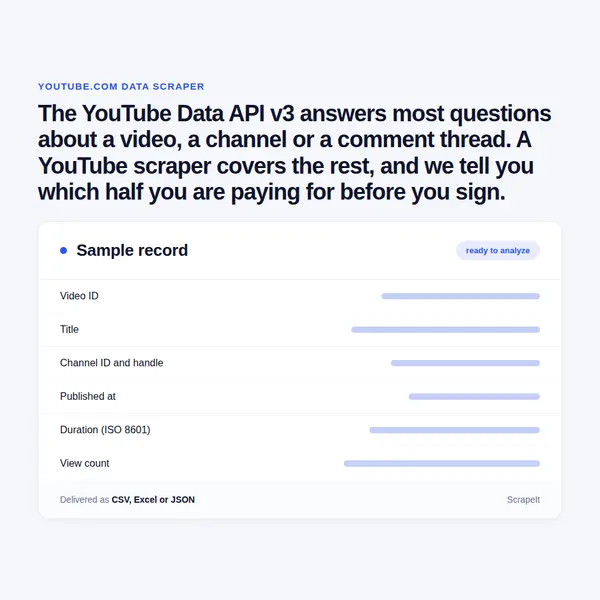
The YouTube Data API v3 answers most questions about a video, a channel or a comment thread. A YouTube scraper covers the rest, and we tell you which half you are paying for before you sign.
Plans from €169/month · Free project assessment · Reply within 1 business day
ScrapeIt builds the collector, runs it on our own infrastructure and repairs it when the platform moves. Anti-bot handling, proxy rotation and CAPTCHA solving are part of the managed service, and they matter here because YouTube meets automated clients with a bot check before it releases playback, and because one address cannot hold a steady rate across markets.
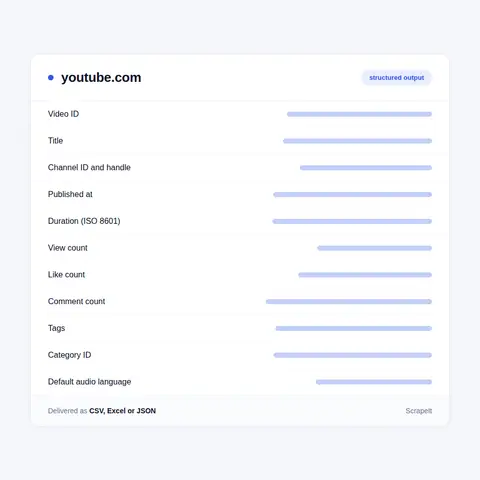
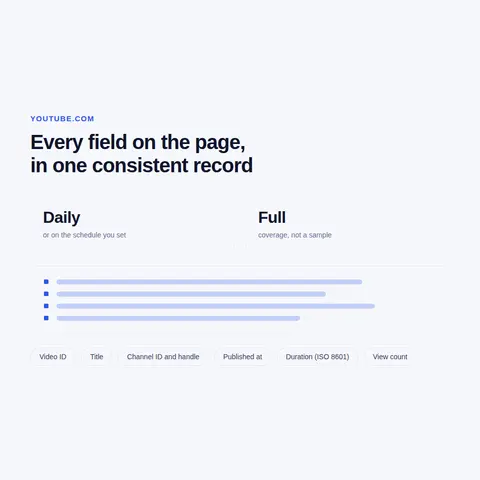
We collect every field listed above from public pages and merge videos, channels and comments into one file. A sample extract comes before the full run, so field names and coverage can be checked against what you expected. After sign off we run to your schedule, hourly through monthly, and watch for layout changes so a YouTube data feed does not quietly go stale. Delivery is CSV, JSON, XLSX or an endpoint you call, pushed to S3, SFTP or your warehouse.
A single video object carries more than buyers expect. The field names below are the platform's own.
Comments are a separate object with their own paging, ordered by time or relevance, filterable by search term, each thread carrying its reply set.
YouTube is not one catalogue. Trending charts are computed per country, are not personalized, and show one ranking to everyone in that market, which is why a chart can fill with videos in a language the viewer cannot read. They refresh roughly every half hour and split by category, with separate lists for music videos, movie trailers and gaming. Ranking leans on how fast views are climbing rather than on the raw total, and views bought through ads are excluded from that measurement, so the day's most watched clip often is not first.
Availability differs the same way. A video record can allow or block an explicit list of ISO country codes; a channel record carries the set of markets where it can be seen at all, a list of 249 codes. Category lists are themselves per country, so a category present in one market is missing in another, while interface language and content region are separate settings that both change what comes back.
There is a priced surface as well. YouTube Premium plans are published per market in local currency, with monthly, annual, family and lite tiers on separate pages, so YouTube price monitoring across countries is a real product feed rather than a metaphor.
Counting rules move too. Shorts views changed in March 2025 to count on play or replay, and from August 2026 the same rule reaches every format on a channel. A series spanning those dates is not comparable end to end unless someone recorded the break, which a stored feed catches and a one-off pull does not. Comments and their authors we treat as a data type only: we do not build named person profiles or contact lists.
YouTube is built on four object types, each with one identifier. A video is an eleven character ID that appears in every URL form the platform uses: the watch page, the youtu.be short link, the /shorts/ path for vertical video and the /embed/ player. A channel is a twenty four character ID beginning with UC, and every channel also carries a human readable handle that resolves to the same object. A playlist ID begins with PL, and one playlist per channel is special: swap the UC prefix of a channel ID for UU and you have that channel's uploads playlist, which lists its public videos in order. Hashtag pages sit on their own path as well.
A channel is a set of tabs, not a single page. Home, Videos, Shorts, Live, Podcasts, Playlists, Posts and an in-channel Search each hold a different slice of the same catalogue, so a YouTube scraper that reads only the Videos tab misses Shorts and past live streams entirely. Shorts run up to three minutes and are listed apart from long-form uploads even though they carry the same eleven character video ID.
One fact shapes any attempt to scrape YouTube at all. The sitemap index the platform publishes contains no videos and no channels: it covers marketing sites for Kids, Trends, Creators, Jobs and Premium, so there is no crawl frontier to walk. We plan collection from seed lists of channels, playlists and video IDs instead of from a spider.
Get a Quote
Developers

Customers worldwide

Pages extracted

Hours saved for our clients
€199 / one-time
setup fee - included
€169 / mo
setup fee €499
€229 / mo
setup fee €499
€349 / mo
setup fee €499
€549 / mo
setup fee €799
Delivery: CSV, JSON or XLSX files, our API or a JSON feed. MCP server on request.
Full plan details →Buyers scrape YouTube for what the platform does not keep for them: history. A view count, a like total or a trending position is the number of the moment, so a series over months exists only if someone captured it on a schedule. Scheduled runs build that record, so growth curves, chart positions and the effect of a launch can be read back later, and a counting change such as the new Shorts view rule shows up as a dated break.
Scale is the second reason. Collection from seed lists of channels, playlists and video IDs covers every tab of a channel - Videos, Shorts, Live and Podcasts - and lines up a whole category of channels on the same fields and dates, so a competitor set or an entire market can be compared side by side.
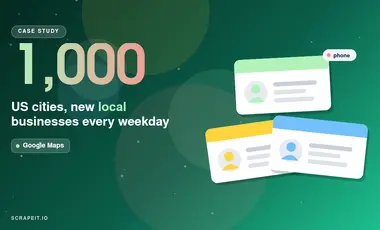
A weekday feed of local businesses from Google Maps for a local-marketing company: 1,000 US cities, three keywords a day, files by 10:00 UTC.
Learn MoreLearn how to use web scraping to solve data problems for your organization

Where opinion text lives on the public web, what a review record contains on each kind of site, which fields a model needs besides the text, and what quietly breaks a sentiment dataset - with examples from our own projects.
Using web scraping to extract Google Maps data will help you quickly and efficiently find businesses in any industry, city, state, or region. And the extracted contact information, such as phone or email address, social networks, or links to web pages, will help to contact them.

Lead scraping is a reliable way to get the right customer contacts to market your product, saves organizations time, and helps you better understand the audience you want to attract. Contacts include emails, phone numbers, or social media profiles.
ScrapeIt is a managed data collection agency. We write the crawlers, run them on our own machines, fix them when a site moves, and hand over clean files. You do not maintain code and you do not manage proxies.
Every project starts with a free assessment: you name the channels, playlists, video IDs or countries, and we confirm the fields before the first run.
Yes. The ScrapeIt YouTube API returns video IDs, titles, publish times, durations, view, like and comment counts, tags and region availability as JSON from an endpoint we host, refreshed on the schedule you set. The same data also comes as CSV or XLSX files or straight into your database.
Volume follows your seed lists of channels, playlists and video IDs: every tab of each channel, every video record and the comment threads under it. Runs follow your schedule, hourly through monthly, and the result comes as CSV, JSON, XLSX or an endpoint you call, pushed to S3, SFTP or your warehouse.
Comments yes, as a data type. Comment threads come back with text, timestamps, like counts and reply sets, ordered by time or relevance, filterable by search term, and available for a single video or a whole channel. Subtitles too: we record each caption track with its language tag and track kind, along with the transcript text a visitor can open on the watch page. On comments we deliver content and counts and leave out named private individuals and their contact details by default.
Because rounding happens in different places. The channel header shows a channel's subscriber count rounded for display. Lifetime channel views and video counts are exact in the about panel but rounded in the header and in listing tiles. On a watch page the view total is exact, while the same video shows a rounded figure in any grid that links to it. We record whichever version the source actually gives, label it, and never mix the two in one column.
Yes, per country and per category. The site publishes trending charts per country and category that are identical for everyone in the same market. They refresh roughly every half hour and rank on how fast views are growing rather than on the raw total. The site shows only the current chart, so a history exists only if somebody captured it on a schedule, and the earliest date in such a dataset is the day collection started.
Step 1 - Make a Request
You share your needs, expectations, and desired timeframe. We’ll suggest the best solution based on your request and budget.
Step 2 - Configuring Custom Web Crawlers
Our specialists configure the crawlers and extract a sample dataset for your review before proceeding with the full-scale extraction.
Step 3 - Collect and Deliver
Once you approve the sample, we launch the project and start full data collection. We gather, filter, and structure the data for easy use, delivering it on time in your preferred format.
Step 4 - Maintain and Support
Our team manages ongoing processes, monitors website changes, and supports all data extraction cycles. We can also help integrate data into your systems or create dashboards to simplify analysis.
YouTube data from €169/month. Free project assessment, reply within 1 business day.

Scrapeit Sp. z o.o.
10/208 Legionowa str., 15-099, Bialystok, Poland
KRS: 0000996672
NIP: 5423457175
REGON: 523384582