Wikipedia Scraper for Infobox, Table and Cross-Language Data

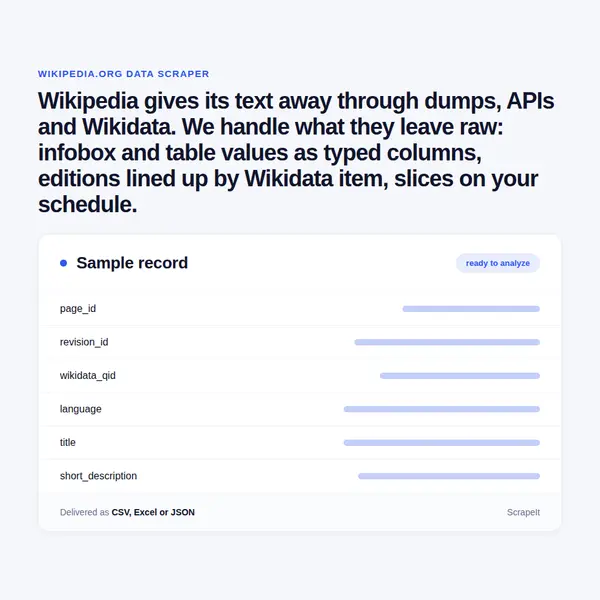
Wikipedia gives its text away through dumps, APIs and Wikidata. We handle what they leave raw: infobox and table values as typed columns, editions lined up by Wikidata item, slices on your schedule.

Wikipedia Scraper
Solutions

Wikipedia data scraping inside the robot policy, delivered your way

We run Wikipedia data scraping as an identified client: a descriptive User-Agent with our contact details, gzip, a handful of parallel requests and a pause whenever the servers ask for one. Bulk text comes from the dumps or Wikimedia Enterprise, and we never run a Wikipedia crawler that walks every link - live requests fetch only the pages in scope. Anti-bot handling, proxy rotation and CAPTCHA solving are part of our managed service, and on Wikimedia projects we keep them switched off: Wikimedia asks automated clients to identify themselves, not to hide. They stay in use for outside sources you want joined to the rows. Delivery is CSV, JSON Lines, Parquet or XLSX, to S3, BigQuery or SFTP, or through our Wikipedia scraper API, which serves the stored dataset with attribution on every row, never a live mirror.

Scraping Wikipedia tables and infoboxes into typed columns

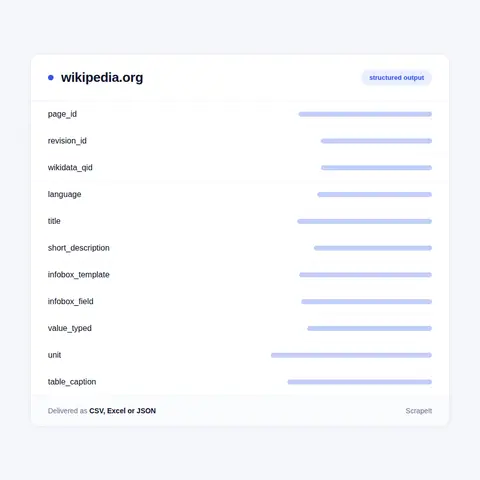
We extract Wikipedia data at three levels - article, infobox and table - and stamp every row with language, page ID, revision ID and Wikidata QID, so each value traces back to the exact version it came from.

  • Article: title, URL, short description, lead text, section headings, first-publication and last-edit timestamps, page length, coordinates where present, main image file and interlanguage links.
  • Infobox: template name and every row, split into typed fields. A Founded line such as April 5, 1993, in Sunnyvale, California becomes a date and a place; Revenue US$215.9 billion (FY26) becomes amount, currency, scale and fiscal year. That is how Wikipedia company information - industry, founders, headquarters, key people, revenue, employees, website - ends up in columns you can sort.
  • Tables: every wikitable with caption, section, header rows and cells. Merged headers are unfolded, footnote markers move to their own column, flag icons become ISO country codes and thousands separators are dropped, so Wikipedia election results tables with two-row headers come out as one row per constituency and candidate.
  • Categories: visible ones kept, maintenance ones dropped, and the category tree walked to the depth you set, with loops cut.
  • References: cited URL, title, publisher, date and identifiers such as DOI or ISBN from the citation templates.
  • Revisions: revision ID, parent ID, timestamp, size, size change, edit summary and tags - the Wikipedia edit history of the article.

Wikimedia Enterprise now returns parsed infoboxes and tables in its Structured Contents beta, and we build on that output where it fits. Its infobox values remain display strings, and tables whose layout scores below its confidence threshold - merged cells, irregular columns - are listed but not parsed. Those are the rows we finish with rules written per template and language.

Scraping Wikipedia tables and infoboxes into typed columns
Wikipedia page views statistics, edit history and joins to your data

Wikipedia page views statistics, edit history and joins to your data

Wikipedia page views statistics come from the Analytics API, long known as the Pageviews API, and from the pageview dumps, both released under CC0. The API returns daily or monthly views per article from July 2015, split by access - desktop, mobile web, mobile app - and by agent, so self-declared spiders and automated traffic stay apart from readers. It also lists the 1,000 most-viewed pages per project per day, and per country; country figures come in buckets, and pages with 1,000 views or fewer are withheld to protect readers. The Pageview complete dumps reach back to December 2007, and a monthly clickstream shows how readers move between articles in five languages. From these we build Wikipedia traffic statistics by category or topic, and Wikipedia statistics by language for the markets you compare.

Edit history comes from the API or the monthly history exports, never from crawling history pages: revision counts, dates, size changes, reverts and protection changes per article.

Joining is where the data earns its keep. The Wikidata item behind each article carries identifiers such as ISIN, VIAF or GeoNames, so Wikipedia rows meet your own records with far less fuzzy name matching. Names of public figures are part of the encyclopedia and stay in the rows; user pages and an editor's contribution trail are never collected as a profile of that person.

How Wikipedia data is organized across languages, revisions and Wikidata

Wikipedia is not one website but a family of separately written encyclopedias, one per language, each on its own subdomain such as en.wikipedia.org or de.wikipedia.org. In September 2026 Meta-Wiki lists 348 active editions holding 68.4 million articles, 7.2 million of them in English. A Wikipedia scraper has to follow that shape. Every article sits at a /wiki/Title address, carries a numeric page ID that differs from one language to the next, gains a new revision ID with every saved edit and in most cases links to one Wikidata item: Nvidia is Q182477 in every edition that covers it.

The page is wikitext rendered into HTML. The Wikipedia infobox in the top corner is a template - Infobox company, Infobox person, Infobox settlement - whose rows are label and value pairs written for readers, not for machines. Data tables carry the wikitable class, are often sortable, and mix footnote markers, flag icons and hidden sort keys into their cells. Below the text sit the visible Wikipedia categories and a second, hidden set of maintenance categories such as CS1 maint or date-format tags. Each article also embeds a schema.org Article block with the Wikidata link, the first-publication and last-edit timestamps and the short description.

Some data never shows on the article at all: page views, the full revision history and search live behind separate interfaces, and Chinese articles switch between simplified and traditional script by address variant.

Get a Quote
dev_w
25

Developers

customers
500+

Customers worldwide

pages
1 500 000 000+

Pages extracted

stime
15000+

Hours saved for our clients

Plans

Airplane

€199 / one-time

setup fee - included

Data limits100,000
Frequencyone-time
Run timeup to 5 days
Data storing7 days

Helicopter

€169 / mo

setup fee €499

Data limits250,000
Frequencymonthly
Run timeup to 5 days
Data storing14 days

Glasses

€229 / mo

setup fee €499

Data limits1,000,000
Frequencyweekly
Run timeup to 5 days
Data storing30 days

DNA

€549 / mo

setup fee €799

Data limits3,000,000
Frequency3 times daily
Run timesame day
Data storing90 days

When to scrape Wikipedia, and when dumps, API or Wikidata are enough

Plenty of Wikipedia projects need no scraper, and we say so on the first call. Full article text for any language is free in the monthly dumps on dumps.wikimedia.org, and the MediaWiki Content File Exports now replacing them carry current and full-history wikitext for every public wiki. A Wikipedia database download of English articles alone runs to tens of gigabytes compressed, and each Wikipedia dump download is limited to three connections per address. Company facts often sit in Wikidata already, under CC0, dated and referenced: Nvidia's employee count is stored per fiscal year, each figure sourced to an annual report. For a few thousand pages, the Action API and REST API are enough.

Scraping pays for itself when you need:

  • infobox and table values as typed columns rather than wikitext or display strings;
  • one entity lined up across languages, with each edition's own figures side by side;
  • a slice - a category tree, a list article, a WikiProject - refreshed weekly or daily with changes flagged, while dumps arrive monthly;
  • Wikipedia rows joined to your CRM, catalog or registry by QID, ISIN or name;
  • output in your schema and warehouse instead of XML files to parse.

Our Blog

Reads Our Latest News & Blog

Learn how to use web scraping to solve data problems for your organization

What is the Scraping Web Data for Sentiment Analysis & How it Helps Marketers and Data Scientists

What is the Scraping Web Data for Sentiment Analysis & How it Helps Marketers and Data Scientists

The use of sentiment analysis tools in business benefits not only companies but also their customers by allowing them to improve products and services, identify the strengths and weaknesses of competitors' products, and create targeted advertising.

Empower Your Business with Google Maps Data

Empower Your Business with Google Maps Data

Using web scraping to extract Google Maps data will help you quickly and efficiently find businesses in any industry, city, state, or region. And the extracted contact information, such as phone or email address, social networks, or links to web pages, will help to contact them.

How to Generate Business Leads Using Web Scraping

How to Generate Business Leads Using Web Scraping

Lead scraping is a reliable way to get the right customer contacts to market your product, saves organizations time, and helps you better understand the audience you want to attract. Contacts include emails, phone numbers, or social media profiles.

scrapeit logo

ScrapeIt scopes, builds and maintains your Wikipedia dataset

ScrapeIt is a managed web scraping agency. On Wikipedia that sometimes means telling you the free route is enough. When it is not, we write the parsing rules per template and language, run the schedule and repair it when editors restructure an infobox or a table. Work starts with a sample: one category or list article in two languages, checked field by field against the live pages, with source URL, revision ID and license note on every row, so a Wikipedia dataset CSV can be reused without guessing where it came from.

FAQ

Does Wikipedia have an API, and when is it enough?

Yes, several, and the Wikipedia API documentation lives on mediawiki.org. The MediaWiki Action API returns wikitext, links, categories and revisions and doubles as the Wikipedia search API; the REST API serves cached page HTML and summaries; the Analytics API reports page views; Wikidata answers SPARQL queries. Reading needs no Wikipedia API key, and Wikipedia API pricing is simple: free, within rate limits. Wikimedia Enterprise sells volume, daily snapshots and a realtime feed, with 50,000 free on-demand requests a month. For text, single pages or view counts that is enough. None returns typed infobox values or one entity's articles merged across languages; that part we build.

Is scraping Wikipedia legal, and what do CC BY-SA and GFDL require?

Wikipedia is built for reuse, so the real question is how you republish it. Article text is licensed under CC BY-SA 4.0 and, for most pages, the GFDL; commercial use is allowed if you credit the authors with a link to the article, name the license, state what you changed and release modified text under CC BY-SA. Facts carry no attribution duty, Wikidata and page-view data are CC0, and images keep their own licenses, some fair use only. The terms of use forbid automated use that burdens the servers, so we stay inside the robot policy. We are not lawyers; confirm your intended use with counsel.

What are the Wikipedia API rate limits and User-Agent rules?

The limits rolled out in 2026 are tiered by identity: 10 requests a minute for a client known only by IP, 200 for a bot with a compliant User-Agent, 2,000 for established editors, with approved bots exempt. The Wikipedia scraping policy - officially the Wikimedia robot policy - adds concurrency caps: one request at a time on the Action API and three on the REST API without login, and under 10 parallel requests and 20 a second for article pages. The Wikipedia API user agent must name the tool and a contact; bot traffic behind a copied browser string is assumed malicious. So Wikipedia does allow web scraping of articles within those limits, while bulk copies belong to the dumps.

How do you scrape Wikipedia tables and infoboxes into flat columns?

A generic Wikipedia web scraper stops at the HTML. We read rendered pages through the cached /wiki/ path or Wikimedia Enterprise, find each infobox and wikitable, and apply rules per template and language: merged headers unfolded, footnotes moved to their own column, sort keys used for numbers and dates, flags mapped to ISO codes, units and fiscal years split out. A spreadsheet can import one table once; to export Wikipedia tables to Excel every week with stable columns, we keep a mapping per table and tell you when editors restructure it.

How often can a Wikipedia dataset be refreshed, and in what formats?

Monthly from the dumps, weekly or daily for a defined slice, and close to real time when edits are followed through the public EventStreams feed or the paid Enterprise Realtime API. Revision IDs let each run ship as a full snapshot or only the pages that changed. Formats are CSV, JSON Lines, Parquet and XLSX. A Wikipedia dataset for LLM training usually ships as section-level text with titles; a Wikipedia dataset for RAG adds the URL, revision ID and license line each passage needs for citation. The popular wikimedia/wikipedia copy on Hugging Face is built from the November 2023 dump.

How does it Work?

Step 1 - Make a Request

You share your needs, expectations, and desired timeframe. We’ll suggest the best solution based on your request and budget.

Step 2 - Configuring Custom Web Crawlers

Our specialists configure the crawlers and extract a sample dataset for your review before proceeding with the full-scale extraction.

Step 3 - Collect and Deliver

Once you approve the sample, we launch the project and start full data collection. We gather, filter, and structure the data for easy use, delivering it on time in your preferred format.

Step 4 - Maintain and Support

Our team manages ongoing processes, monitors website changes, and supports all data extraction cycles. We can also help integrate data into your systems or create dashboards to simplify analysis.

Request a Quote

Tell us more about you and your project information.
Which sites, which fields, how often. A couple of lines is enough.

We reply within 1 business day. No obligation.

scrapiet

Scrapeit Sp. z o.o.
10/208 Legionowa str., 15-099, Bialystok, Poland
NIP: 5423457175
REGON: 523384582