Google Search Scraper for Rankings, Ads and AI Overviews

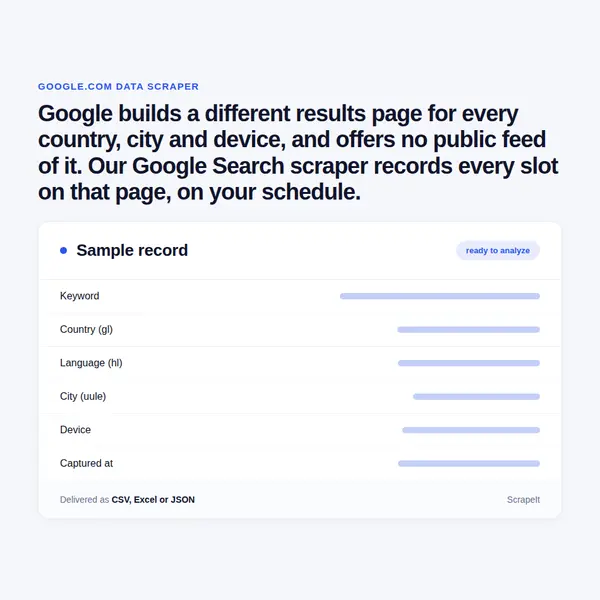
Google builds a different results page for every country, city and device, and offers no public feed of it. Our Google Search scraper records every slot on that page, on your schedule.

Plans from €169/month · Free project assessment · Reply within 1 business day

Google Search Scraper
Solutions

Managed SERP Scraping With a Google SERP API We Host

We build the Google SERP scraper, run it in real browsers from IP addresses in the country you target, and keep it working as Google reshuffles the page. Anti-bot handling, proxy rotation and CAPTCHA solving are ours to run, and the quote already covers them. Pages are captured signed out, with no Google account or search history attached, and every capture is checked for the blocks it should contain, so a challenge page or an empty shell is retried rather than stored as a ranking.

You see a sample for a handful of your keywords before the full run and sign off the columns. After that the schedule is yours, from hourly watchlists to monthly audits, with files in CSV, JSON or XLSX, an endpoint your systems poll, or a push to S3, SFTP or a warehouse table.

Extract Google Search Data by Position, Block and Market

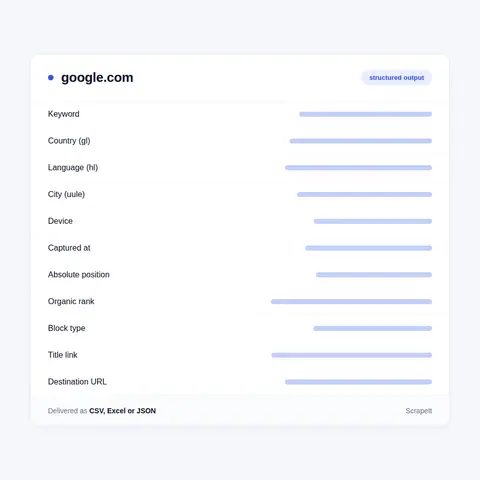
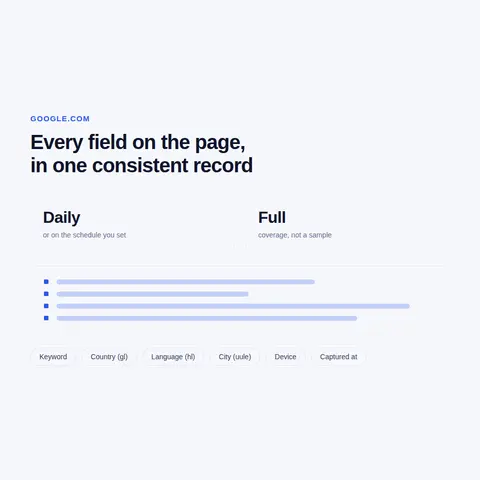
Each row carries its context: keyword, country, interface language, city when one is set, device, page number and capture time. Position is stored twice, as the absolute slot counting every block on the page and as organic rank counting text results only, because a site can hold organic rank two and still sit below a screen of ads and answers.

  • Text results. Title link, destination URL, site name, visible URL and breadcrumb, snippet, byline date, sitelinks, and rich attributes such as rating, review count, price and availability taken from product markup.
  • Google sponsored results. Top or bottom group, order inside the group, advertiser name and domain, headline, description and ad sitelinks. The first ad of the top group is what Google Ads reports as absolute top, so we flag it separately.
  • AI Overview. Whether one appeared, its text as rendered, and every linked source in display order, including links that only show after the overview is expanded.
  • People also ask and featured snippets. The questions in the order shown and, on request, the answer revealed when a question is opened, which Google fills with a featured snippet from a named page.
  • Local pack. Business name, rating, review count, category and slot. That is enough for Google rank tracking by city; full business profiles are a separate Maps job.
  • Products, top stories and videos. Product name, price and merchant from product units; headline, publisher and age from top stories; title, source site and upload date from video results.
  • Knowledge panel and related searches. Whether a panel showed and which entity it describes, and the related searches Google lists at the bottom of the page.

SERP features and text results land in one table, so share of voice can be measured per block as well as per page, and a lost featured snippet shows up next to the organic slot it used to sit above.

Extract Google Search Data by Position, Block and Market
Google Search API from ScrapeIt: Fields, Key and Pricing

Google Search API from ScrapeIt: Fields, Key and Pricing

The ScrapeIt Google Search API returns the same rows as our files: keyword, country, language, city, device and capture time, absolute position and organic rank, title link, URL and snippet, sponsored results, the AI Overview with its cited sources, People also ask, featured snippets and the local pack. It serves JSON from an endpoint we host, refreshed on the schedule you set, and access is by a Google Search API key we issue to you. Documentation of every field comes with the dataset.

Is the Google Search API free to try? The project assessment is free, and a sample for a handful of your keywords can be ordered before the full run. Google Search API pricing then follows your plan: plans start from EUR 169 a month, or EUR 199 for a one-time extract. The Google Search API limits are the ones your project sets - keywords, markets, devices and schedule - and the quote covers them.

Anatomy of a Google Search Results Page

A Google search scraper has to read a page that Google assembles fresh for every query, country, language and device, so the same words can return a different page in the next city. Google's own documentation breaks the Google search results page into visual elements. The basic unit is the text result, which Google used to call a web result: a title link, a snippet, a byline date when Google estimates one, and an attribution line with favicon, site name and a visible URL made of domain and breadcrumb. Sitelinks and rich attributes such as review stars, price and availability can sit underneath.

Around those links Google stacks other blocks only when its systems expect them to help: sponsored results at the top and bottom, an AI Overview, a related questions group better known as People also ask, a featured snippet, a local pack with a map, product units, top stories, video results, discussions and forums, a knowledge panel for entities it recognizes, and related searches at the foot of the page. Their order changes from query to query, which is why a rank number means little without the layout above it.

Three platform changes decide how collection works today. Google answers traffic it does not recognize with a JavaScript challenge before it releases results. It no longer honors the parameter that once put 100 results on a single page. And its country domains now redirect to google.com, so the market a result belongs to is set by location and request parameters rather than by the address.

Get a Quote
dev_w
25

Developers

customers
500+

Customers worldwide

pages
1 500 000 000+

Pages extracted

stime
15000+

Hours saved for our clients

Plans

Google Search Scraping Plans and Pricing

Airplane

€199 / one-time

setup fee - included

Data limits100,000
Frequencyone-time
Run timeup to 5 days
Data storing7 days

Helicopter

€169 / mo

setup fee €499

Data limits250,000
Frequencymonthly
Run timeup to 5 days
Data storing14 days

Glasses

€229 / mo

setup fee €499

Data limits1,000,000
Frequencyweekly
Run timeup to 5 days
Data storing30 days

DNA

€549 / mo

setup fee €799

Data limits3,000,000
Frequency3 times daily
Run timesame day
Data storing90 days

Scrape Google Search Results for What Search Console Omits

Search Console is free, and it is built for one site: yours. It reports only properties you have verified, gives position as the average of your topmost result, leaves out anonymized queries that too few people typed, and caps an export from the interface at 1,000 rows. AI Overviews and AI Mode are folded into the ordinary web totals, and the newer generative AI performance report shows how often your pages appeared in those features by page, country, device and date, with no queries and no clicks.

None of that shows who else ranked, which blocks pushed your link down, or how the page looked on a given morning. That is what teams buy SERP data for: Google search rankings for a keyword set by city and device, share of voice across a competitor set, paid pressure measured as sponsored results above the first organic link, the domains a Google AI Overview cites for your topics, and who holds each featured snippet. Google keeps no public archive of past result pages, so a record of Google search results over time exists only if someone captured it, and that record is what shows who gained when your traffic fell after a core update.

We work from keyword lists. Searches built around the name of a private person, and results about individuals, are outside what we sell.

Our Blog

Reads Our Latest News & Blog

Learn how to use web scraping to solve data problems for your organization

What is the Scraping Web Data for Sentiment Analysis & How it Helps Marketers and Data Scientists

What is the Scraping Web Data for Sentiment Analysis & How it Helps Marketers and Data Scientists

The use of sentiment analysis tools in business benefits not only companies but also their customers by allowing them to improve products and services, identify the strengths and weaknesses of competitors' products, and create targeted advertising.

Empower Your Business with Google Maps Data

Empower Your Business with Google Maps Data

Using web scraping to extract Google Maps data will help you quickly and efficiently find businesses in any industry, city, state, or region. And the extracted contact information, such as phone or email address, social networks, or links to web pages, will help to contact them.

How to Generate Business Leads Using Web Scraping

How to Generate Business Leads Using Web Scraping

Lead scraping is a reliable way to get the right customer contacts to market your product, saves organizations time, and helps you better understand the audience you want to attract. Contacts include emails, phone numbers, or social media profiles.

scrapeit logo

Google Search Results Scraper Projects We Take and Decline

ScrapeIt is the team behind the collector: we write it, host it and fix it when Google moves things, and you receive data rather than code to maintain. On Google we take rank tracking, SERP feature and AI Overview monitoring, paid search research and market studies built on keyword lists.

We turn down people searches and harvesting contact details from results.

FAQ

Do you offer a Google Search API?

Yes. The ScrapeIt Google Search API returns positions, title links, URLs and snippets, sponsored results, AI Overview sources and People also ask questions as JSON from an endpoint we host, refreshed on the schedule you set. The same data also comes as CSV or XLSX files or straight into your database.

How do you get Google search results by country, language and city?

Three Google search URL parameters do most of the work: the hl parameter sets the interface language, the gl parameter sets the country as a two letter code, and the uule parameter, which Google has never documented, carries a location name from Google's published geotarget list, down to cities, neighborhoods and postal codes. Country domains such as google.de now redirect to google.com, so the domain no longer picks the market. Google also reads location from the connection and ranks local results partly by distance, so each job runs from an IP address in the target country, with desktop and mobile kept apart.

How deep and how often can you track Google search rankings?

Depth drives the cost: Google stopped honoring the parameter that showed 100 results on one page, saying it never formally supported it, so a top 100 check now means reading about ten pages, while many projects stop after the first two. Daily runs suit a keyword list, and hourly runs suit a short watchlist during a launch or a core update. Ad Rank is recalculated on every search and AI Overviews appear only when Google judges them useful, so for both we report how often they showed across several captures instead of a single yes or no.

Can you track which sites a Google AI Overview cites?

Yes. For every query we record whether an AI Overview appeared, its text, and the cited links in display order, including those behind the expand control, so you can see which domains Google leans on for your topics and whether yours is among them. Search Console's generative AI report counts impressions of your own pages in AI Overviews and AI Mode, but it has no query data and says nothing about other sources. Google AI Mode is a separate conversational surface, and when a brief needs it we capture its answers for a fixed list of prompts.

Is scraping Google search results legal?

Yes. The Google search data we collect is what any visitor sees on a results page - positions, titles, URLs and snippets, ads, AI Overview sources, People also ask and the local pack - so we collect only publicly available data, and we collect it legally. It arrives as files or through our SERP API, and personal data stays out.

How does it Work?

Step 1 - Make a Request

You share your needs, expectations, and desired timeframe. We’ll suggest the best solution based on your request and budget.

Step 2 - Configuring Custom Web Crawlers

Our specialists configure the crawlers and extract a sample dataset for your review before proceeding with the full-scale extraction.

Step 3 - Collect and Deliver

Once you approve the sample, we launch the project and start full data collection. We gather, filter, and structure the data for easy use, delivering it on time in your preferred format.

Step 4 - Maintain and Support

Our team manages ongoing processes, monitors website changes, and supports all data extraction cycles. We can also help integrate data into your systems or create dashboards to simplify analysis.

Request a Quote

Tell us more about you and your project information.
Which sites, which fields, how often. A couple of lines is enough.

We reply within 1 business day. No obligation.

scrapiet

Scrapeit Sp. z o.o.
10/208 Legionowa str., 15-099, Bialystok, Poland
NIP: 5423457175
REGON: 523384582