Reuters Data Collection Within Written Permission

The first lines of the Reuters crawl rules are a legal notice, not a technical setting. We read them as one, and so should anyone quoting you a Reuters scraper.

Reuters Scraper
Solutions

Managed collection within permission, run end to end by us

ScrapeIt runs the work as a managed service. If you hold written permission or a licence from Reuters, we build and run the pipeline within its terms, with the permitted purpose and licence reference recorded on every row, and hand back CSV, JSON, Excel or a push into your warehouse.

If you do not hold permission, we tell you so before quoting, point you to the agency's licensing route, and scope the parts of your question that can be answered without it, such as wire pickup across other outlets.

Your counsel should see the permission and the intended use before the project starts. On this source that review is part of the job, not a formality.

What a permitted Reuters pipeline carries

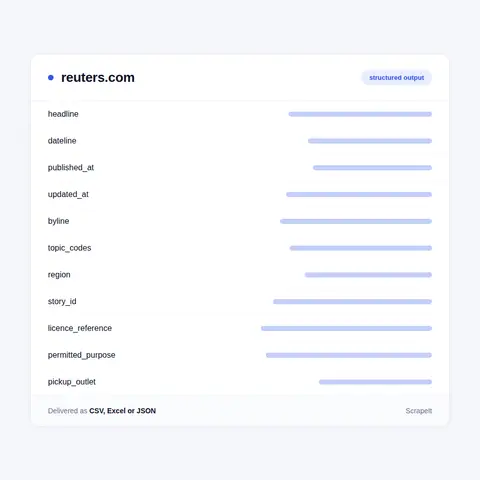
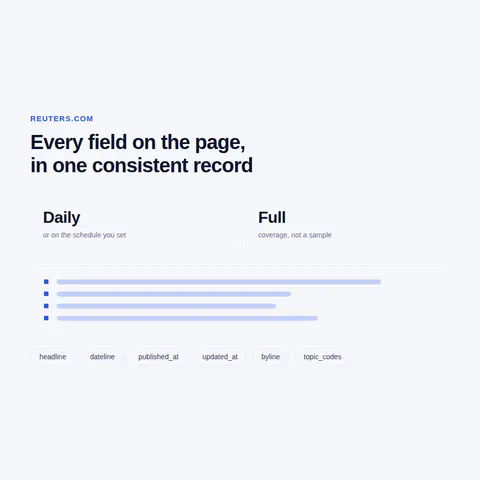
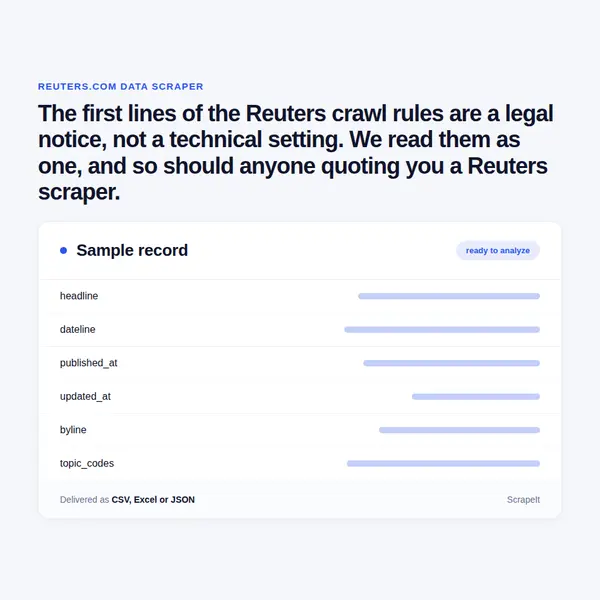
Where a client holds written permission or a licence, story records carry the headline, dateline, publication and update timestamps, byline, topic codes, region and the story identifier, in the form the permission allows.

The permitted purpose is recorded on every row. The notice ties consent to specific purposes, so a dataset collected under permission should say what it was collected for. That protects the client when the data is reused months later by a team that never saw the agreement.

The licence reference travels with the data for the same reason: provenance you can show is worth more than provenance you remember.

Wire pickup records are a separate table and do not touch reuters.com at all. They record where Reuters copy appears in other outlets, identified by the attribution line, collected from sites whose own rules permit it.

Every row carries the collection timestamp and the source type, so licensed feed data and pickup observations are never confused.

What a permitted Reuters pipeline carries
Pickup tracking, purpose scoping and what we refuse

Pickup tracking, purpose scoping and what we refuse

Wire pickup tracking is the strongest product that needs no permission from the agency: which Reuters stories are republished, by which outlets, with what delay, and how the headline changes on the way. It runs on outlets whose rules permit collection.

Purpose scoping is the work that makes a permitted project safe. We map what the permission covers against what the client wants to do, and we build the pipeline to stop at the boundary rather than trusting everyone downstream to remember it.

Timing analysis around market events is common and belongs on the licensed feed, where timestamps are authoritative.

What we refuse is plain: collection from reuters.com without written consent, any attempt to get past the authentication wall or the named allow-list, and any use outside the permitted purpose. If a brief needs those, we are the wrong supplier and we say so on the first call.

A news agency that states its terms in the crawl rules

Reuters is one of the largest news agencies in the world. Most of its journalism reaches readers through other organisations: newspapers, broadcasters, financial terminals and websites that license its copy. The reuters.com site is one outlet among thousands carrying Reuters stories.

Its crawl rules begin with a notice rather than a directive. Collection of content, data or information from the site through automated means is prohibited unless you have prior written consent from Reuters, and even then only for the purposes described in that permission. The notice points to the agency's licensing enquiry route.

The rest of the file is built the same way: a long list of named crawlers - search engines, link preview services, monitoring tools - that the agency has chosen to let in, rather than a general permission with exceptions. Without authentication the site answers with 401.

That combination settles the question most briefs start with. There is no honest version of scraping reuters.com without the agency's consent, and we do not offer one.

Get a Quote
dev_w
25

Developers

customers
500+

Customers worldwide

pages
1 500 000 000+

Pages extracted

stime
15000+

Hours saved for our clients

Plans

Airplane

€199 / one-time

setup fee - included

Data limits100,000
Frequencyone-time
Run timeup to 5 days
Data storing7 days

Helicopter

€169 / mo

setup fee €499

Data limits250,000
Frequencymonthly
Run timeup to 5 days
Data storing14 days

Glasses

€229 / mo

setup fee €499

Data limits1,000,000
Frequencyweekly
Run timeup to 5 days
Data storing30 days

DNA

€549 / mo

setup fee €799

Data limits3,000,000
Frequency3 times daily
Run timesame day
Data storing90 days

Why the notice changes the project, not just the method

The notice does not say never. It says not without written consent, and only for the stated purpose. That turns a scraping question into a permission question, and most of the useful work happens once it is framed that way.

Briefs that ask for Reuters data usually want one of three things, and each has a better answer than crawling the site. The first is fast headlines for trading or monitoring, where a licensed feed from the agency beats any crawler on latency and completeness. The second is archive research, where licensed archive access gives complete, corrected text that a crawl never would. The third is measuring how Reuters stories spread through the media, and that needs no access to reuters.com at all.

The third case is the one clients most often overlook. Wire copy carries an attribution line wherever it is republished, so counting pickups across outlets that permit collection shows which stories travelled, how fast and where. That is a legitimate media analysis built entirely from other sources.

What we will not do is treat 401 as a puzzle to solve. Rotating identities or credentials to get past an allow-list is collecting against an explicit written prohibition, and no dataset is worth that exposure.

Our Blog

Reads Our Latest News & Blog

Learn how to use web scraping to solve data problems for your organization

How Artificial Intelligence Is Used In Web Scraping

How Artificial Intelligence Is Used In Web Scraping

Leveraging advances in technology, the AI-powered web scraper has skyrocketed in demand and is helping to expand capabilities by automating tedious daily tasks and speeding up data collection from thousands of websites several times over.

What is Web Scraping and What is it Used For?

What is Web Scraping and What is it Used For?

Web scraping is a method of obtaining web data by extracting it from pages of web resources with the help of a program, that is, in automatic mode. It is used to syntactically convert web pages into more usable forms.

Web Scraping for Machine Learning

Web Scraping for Machine Learning

If you specialize in machine learning, you need to feed large amounts of data to the algorithms. Web scraping is the easiest and the most efficient method of collecting the data from all over the Internet.

scrapeit logo

Who builds and keeps a permitted feed

ScrapeIt is a managed extraction company, not a tool you have to learn. Our team builds pipelines that stay inside the permission you hold, keeps the purpose and licence attached to the data, and repairs the collection when formats change.

You see a sample first, in your format. Where permission is not yet in place, the sample is a pickup analysis from other outlets, so you can judge the value before any licensing conversation.

FAQ

Can you scrape Reuters for me?

Not without written consent from Reuters. The agency's crawl rules state that automated collection is prohibited without prior written consent and only for the purposes that consent describes. With permission, we build within its terms. Without it, we scope what can be done from other sources.

What exactly does the notice prohibit?

Automated collection of content, data or information from reuters.com unless you have prior written consent, and even then only for the purposes described in that permission. It is written at the top of the crawl rules, the one file every crawler reads first.

How do I get permission?

Through the licensing enquiry route that Reuters links from the same notice. For most commercial uses the agency's own licensed feeds or archive are the practical outcome, and they are better data than a crawl would produce.

Can I measure Reuters coverage without their site?

Yes. Wire copy carries an attribution line wherever it is republished, so pickups can be counted across outlets that permit collection. That shows which stories travelled, how fast and where, without touching reuters.com.

Why record the permitted purpose on every row?

Because consent here is tied to specific purposes, and data outlives the people who negotiated the agreement. A purpose field on every row keeps the boundary attached to the data when it is reused later by someone who never saw the terms.

How does it Work?

Step 1 - Make a Request

You share your needs, expectations, and desired timeframe. We’ll suggest the best solution based on your request and budget.

Step 2 - Configuring Custom Web Crawlers

Our specialists configure the crawlers and extract a sample dataset for your review before proceeding with the full-scale extraction.

Step 3 - Collect and Deliver

Once you approve the sample, we launch the project and start full data collection. We gather, filter, and structure the data for easy use, delivering it on time in your preferred format.

Step 4 - Maintain and Support

Our team manages ongoing processes, monitors website changes, and supports all data extraction cycles. We can also help integrate data into your systems or create dashboards to simplify analysis.

Request a Quote

Tell us more about you and your project information.
Which sites, which fields, how often. A couple of lines is enough.

We reply within 1 business day. No obligation.

scrapiet

Scrapeit Sp. z o.o.
10/208 Legionowa str., 15-099, Bialystok, Poland
NIP: 5423457175
REGON: 523384582