Guardian Scraper for Articles, Tags and Timestamps

The Guardian runs one of the few genuinely open news APIs. Knowing exactly where it stops is what tells you whether you need a scraper at all.

The Guardian Scraper
Solutions

Managed Guardian scraping, run end to end by us

ScrapeIt runs the Guardian collector as a managed service. You name the sections, tags, editions and live blogs you care about; we build the crawl, run it on your cadence and hand back CSV, JSON, Excel or a push into your warehouse. Where the Open Platform API is the better route for part of the brief we use it and say so, and the output lands in the same schema either way.

Cadence is per source. Fronts and live blogs during an active story justify minute level passes; tag pages and archive work run hourly or daily.

We collect what the site renders publicly and no more. Guardian content is copyrighted, and their terms restrict reuse, so the dataset is built for analysis rather than republication. We do not collect commenter identities. Bring the use case to your own counsel before the project starts, and we scope the work to what counsel signs off.

Guardian fields in every export

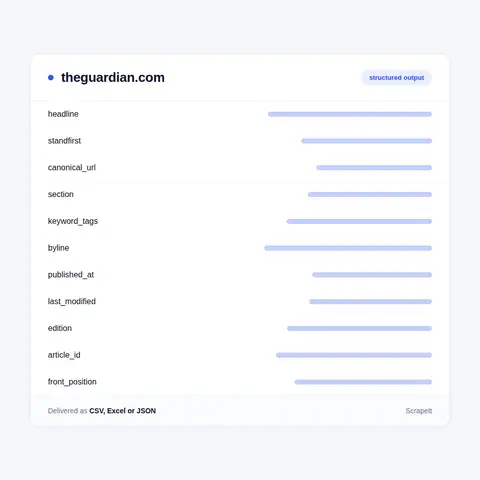
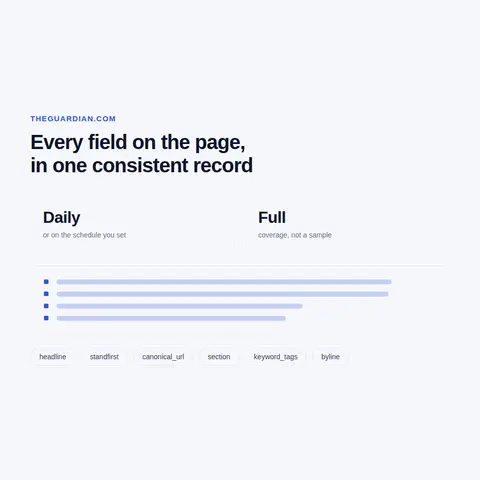
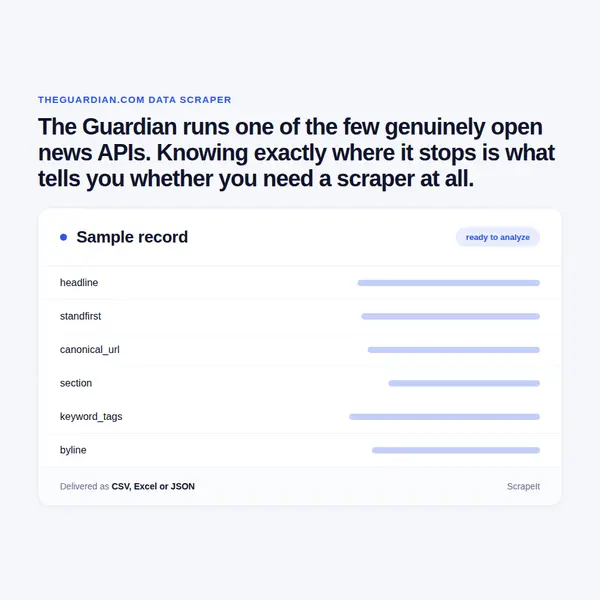
The article record covers canonical URL, headline, standfirst, section and its path, the full list of keyword tags, byline and contributor, publication timestamp, last modified timestamp, edition, and the article identifier used across Guardian URLs.

Tags are the field that repays the most attention here. Guardian articles carry several, mixing subject, place, organisation and format, and they are published rather than guessed at. That makes filtering precise: everything tagged to a company, everything tagged to a competition, everything tagged both to a country and to a policy area. We keep them as a list rather than flattening them into a string.

Front observations sit alongside the articles. Each pass over a section front records which stories were on it, in what order, under which headline at that moment, and when the pass ran. That is where promotion and rewriting become visible, and it is the part no API returns.

Live blogs are collected as entries: entry text, entry timestamp, author where credited, and any embedded quote, image or link, all keyed to the parent blog. The parent keeps an entry count and the timestamp of its most recent entry.

Then the usual context: language, word count of the publicly rendered body, lead image URL and caption, outbound links, item type for video and audio pieces, and the collection timestamp on every row.

Guardian fields in every export
Live blogs, editions and the tag graph

Live blogs, editions and the tag graph

Guardian live blogs are among the most heavily used pages on the site and among the worst handled by generic collectors. Treated as an article, a live blog is one row with a headline that changes and a body that grows for twelve hours. Treated properly it is a parent record with a stream of timestamped entries, each attributable and quotable. We do the second.

Regional editions matter for anyone measuring reach. The Guardian runs distinct editions, and the same article can be promoted prominently in one and not appear on the front of another. Collecting fronts per edition is what turns a vague sense that a story was big into a number you can put in a report.

The tag graph is the quiet advantage of this source. Because tags are published, you can build the corpus by subject rather than by keyword search: everything tagged to an organisation over five years, everything tagged both to a country and to an industry. That is a far cleaner selection than string matching over headlines, and it is available without any inference on our side.

Historical backfill runs from tag and section pagination, which reaches a long way back. It is a one time job separate from the ongoing feed, and where the API covers the same range we will use it instead, because it is cheaper for both sides.

How the Guardian publishes, and what the Open Platform covers

The Guardian is unusual among large outlets: it has no hard paywall and it runs a public developer programme, the Open Platform, with a content API and a registration key. For a lot of briefs that API is the right answer, and we will say so rather than sell a crawl that duplicates it.

Where it stops is specific. An API returns the article record, not the newspaper. It does not tell you that a story sat second on the international front for three hours, or that the same piece was promoted on the business front as well. It does not carry the live blog structure in the form most clients want it. Rate limits and result caps shape how far back a single query reaches, and a key is per project rather than per client. And an API for one publisher does not help when the same dashboard has to hold forty of them.

The site itself is arranged in a way that suits collection. Section fronts cover the desks, and every article carries a set of keyword tags that the Guardian also exposes in its news sitemap, so the taxonomy is public rather than inferred. Live blogs sit under a live path with their own entry structure. Editions differ by region, and the same story can surface with a different promotion in each.

Our usual recommendation is a hybrid: pull the article record from the API where it fits, collect fronts, positions and live blog entries from the site, and join the two on the article identifier so the client has one table rather than two systems.

Get a Quote
dev_w
25

Developers

customers
500+

Customers worldwide

pages
1 500 000 000+

Pages extracted

stime
15000+

Hours saved for our clients

Plans

Airplane

€199 / one-time

setup fee - included

Data limits100,000
Frequencyone-time
Run timeup to 5 days
Data storing7 days

Helicopter

€169 / mo

setup fee €499

Data limits250,000
Frequencymonthly
Run timeup to 5 days
Data storing14 days

Glasses

€229 / mo

setup fee €499

Data limits1,000,000
Frequencyweekly
Run timeup to 5 days
Data storing30 days

DNA

€549 / mo

setup fee €799

Data limits3,000,000
Frequency3 times daily
Run timesame day
Data storing90 days

Why an open API still leaves a gap worth filling

The honest starting question for the Guardian is whether you need a scraper. If you want article records for a research corpus and the API covers your date range, use the API. It is supported, it is documented and it will not break when a class name changes.

The gap opens as soon as the question becomes editorial rather than archival. Which stories did the Guardian promote, in what order and for how long. How quickly did a headline change after publication. What did the live blog say at the moment the market moved. None of that is in an article record, because none of it is a property of the article. It is a property of the page at a moment in time, and the only way to have it is to have been looking.

The second gap is uniformity. A media monitoring product does not track one outlet. When the same dashboard has to carry forty publishers, one of which has a good API, running a separate integration for that one costs more to maintain than it saves. We usually take the API where it is cheaper and fold it into the same schema as everything else, so downstream nothing knows the difference.

The third is the tail. Sport and football coverage in particular is enormous and highly structured, and a lot of it never reaches the fronts. Collected directly by tag it becomes a usable dataset in its own right.

Our Blog

Reads Our Latest News & Blog

Learn how to use web scraping to solve data problems for your organization

How Artificial Intelligence Is Used In Web Scraping

How Artificial Intelligence Is Used In Web Scraping

Leveraging advances in technology, the AI-powered web scraper has skyrocketed in demand and is helping to expand capabilities by automating tedious daily tasks and speeding up data collection from thousands of websites several times over.

What is Web Scraping and What is it Used For?

What is Web Scraping and What is it Used For?

Web scraping is a method of obtaining web data by extracting it from pages of web resources with the help of a program, that is, in automatic mode. It is used to syntactically convert web pages into more usable forms.

Web Scraping for Machine Learning

Web Scraping for Machine Learning

If you specialize in machine learning, you need to feed large amounts of data to the algorithms. Web scraping is the easiest and the most efficient method of collecting the data from all over the Internet.

scrapeit logo

Who builds and keeps your Guardian feed

ScrapeIt is a managed extraction company, not a tool you have to learn. Our team builds the pipeline, watches it as the site changes, and repairs it before your dashboard goes quiet.

You see a sample first, in your format, over the sections and tags you actually track. Approve it and the full run follows on the cadence you choose.

FAQ

Should I use the Open Platform API instead of a scraper?

For article records inside your date range, very possibly yes, and we will tell you so. The API is documented and supported, and duplicating it with a crawl is wasted money. What it cannot give you is page state: front position, how long a story was promoted, headline changes after publication, live blog entries in the shape most clients want. If your questions are about those, you need collection as well. Most of our Guardian projects use both.

Can you collect live blogs entry by entry?

Yes, and it is the main reason clients come to us for this source. Each entry keeps its own text, timestamp and author where credited, along with embedded quotes and links, all keyed to the parent blog. The parent carries an entry count and the time of the latest entry, so a blog that has gone quiet is distinguishable from one still running.

Do the article tags come from you or from the Guardian?

From the Guardian. Tags are published on the article and in the news sitemap, so nothing is inferred on our side. We keep them as a list, which means you can select a corpus by subject, place, organisation or format rather than by matching strings in a headline.

How often can the feed refresh, and in what formats?

From a daily digest up to minute level on fronts and active live blogs, set per source rather than uniformly. Delivery is CSV, Excel, JSON, JSONLines or XML over FTP, SFTP, Amazon S3, Google Cloud Storage, Dropbox, Google Drive or email, or written straight into your database.

Can I republish Guardian articles from the dataset?

No, and the dataset is not built for it. Guardian journalism is copyrighted and their terms restrict reuse, whether the text came from the API or from the page. What you get is metadata plus publicly rendered text for analysis: monitoring, measurement, sentiment, and model training only where your own licence permits. We work on public pages, never behind a login, and we collect nothing that identifies commenters. Have your counsel approve the use case first.

How does it Work?

Step 1 - Make a Request

You share your needs, expectations, and desired timeframe. We’ll suggest the best solution based on your request and budget.

Step 2 - Configuring Custom Web Crawlers

Our specialists configure the crawlers and extract a sample dataset for your review before proceeding with the full-scale extraction.

Step 3 - Collect and Deliver

Once you approve the sample, we launch the project and start full data collection. We gather, filter, and structure the data for easy use, delivering it on time in your preferred format.

Step 4 - Maintain and Support

Our team manages ongoing processes, monitors website changes, and supports all data extraction cycles. We can also help integrate data into your systems or create dashboards to simplify analysis.

Request a Quote

Tell us more about you and your project information.
Which sites, which fields, how often. A couple of lines is enough.

We reply within 1 business day. No obligation.

scrapiet

Scrapeit Sp. z o.o.
10/208 Legionowa str., 15-099, Bialystok, Poland
NIP: 5423457175
REGON: 523384582