El Pais Scraper for Every Edition and the Archive Back to 1976

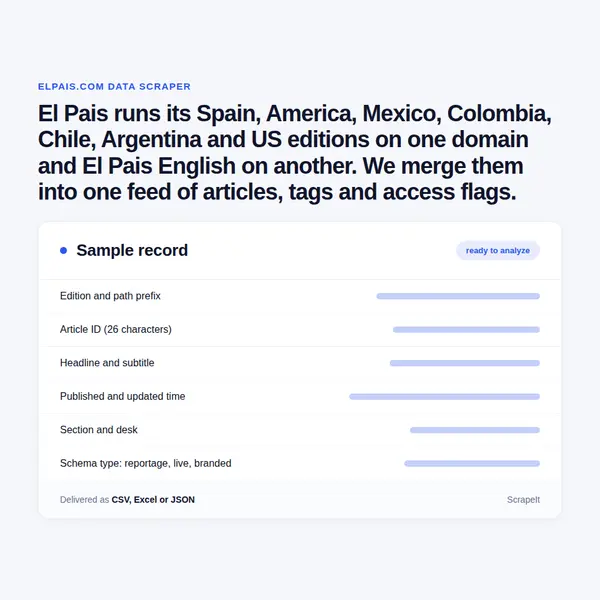
El Pais runs its Spain, America, Mexico, Colombia, Chile, Argentina and US editions on one domain and El Pais English on another. We merge them into one feed of articles, tags and access flags.

El Pais Scraper
Solutions

How We Scrape El Pais: Editions Mapped, Premium Text Left Out

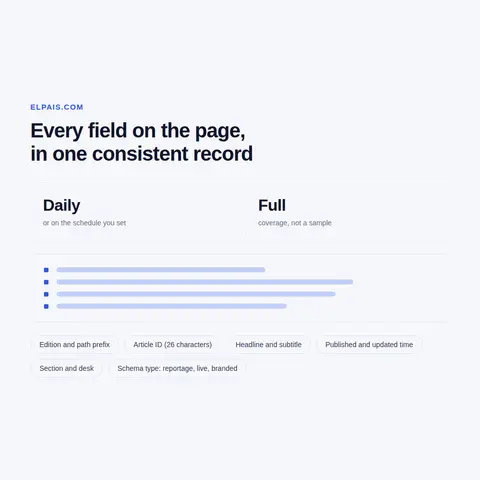
ScrapeIt runs El Pais data scraping as a managed service: we build the collector, host it and fix it when templates change. Anti-bot handling, proxy rotation and CAPTCHA solving are part of the job, because the site screens automated traffic hard. We extract El Pais data from public pages, feeds and sitemaps only, never logged in, and for premium pieces the record stops at the metadata and the opening the feeds already publish. Every row carries edition, language, access flag and the time it was read. A sample comes first; after sign-off, runs follow your schedule, from a five-minute headline monitor to a one-off archive pull, with delivery as CSV, JSON or XLSX to S3, SFTP or your warehouse, or through an El Pais scraper API endpoint you call.

El Pais Headlines, Bylines, Tags and Update Times in Each Record

El Pais articles carry NewsArticle markup and a page data layer, and together they give a clean record without parsing the layout.

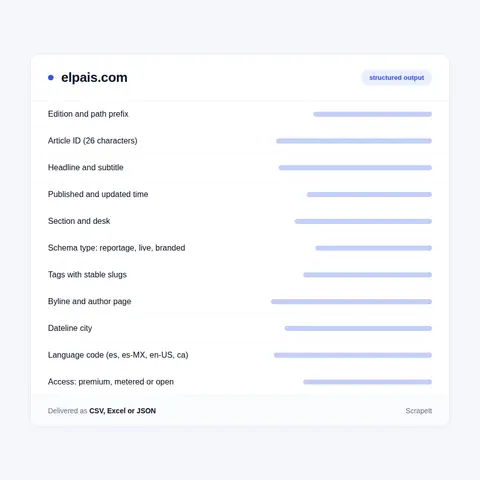
  • Headline and subtitle. The headline field, plus the standfirst in description - the same text the feeds send as dcterms:alternative. A kicker above the headline links to the topic page.
  • Dates. datePublished and dateModified with their UTC offset. The page prints both: the dateline time links to that day's archive page, and a separate Updated line appears once a story is revised.
  • Section and type. articleSection names the desk, for example the housing desk under /economia/vivienda/, and the schema type separates standard reporting (ReportageNewsArticle), El Pais branded content (AdvertiserContentArticle, under a /branded/ path segment) and live blogs (LiveBlogPosting, with timed entries and a coverage start and end). A typology field in the data layer also marks cartoons and specials.
  • Tags. The keywords field repeats as article:tag, and the data layer adds a stable slug per tag, such as donald-trump-a, so a relabelled tag still joins.
  • Bylines. Authors come as Person entries linked to an /autor/ page. The markup uses a short display name, sometimes an initial and surname, while the feed and the data layer carry the full name, so the author URL is the join key. Agency copy is bylined EFE, house copy EL PAIS.
  • Dateline and language. contentLocation holds the city line (Madrid, Lima, Washington / Miami) and inLanguage the edition language.
  • Identity and access. A 26-character article ID in the data layer gives a key that does not depend on the URL slug; isAccessibleForFree, the product ID and the signwall type tell premium, metered, registration-only and open pieces apart.
  • Images. The lead photo comes with caption, photographer and rights holder, often an agency such as REUTERS or AP.

El Pais Headlines, Bylines, Tags and Update Times in Each Record
El Pais Archive: Monthly Sitemaps Back to May 1976

El Pais Archive: Monthly Sitemaps Back to May 1976

The El Pais historical archive is mapped in public. /sitemaps/index.xml lists one sitemap per month from May 1976, the month of the first issue, to the current one, and each file lists that month's URLs with a lastmod stamp. Three address generations appear: print-era pieces such as /diario/1976/05/30/espana/ plus a numeric ID and the suffix _850215, early web stories such as /internacional/2005/03/31/actualidad/ with a ten-digit ID, and today's /section/YYYY-MM-DD/slug.html. The English archive starts in October 2010 under /elpais/.../inenglish/ with the suffix _850210 before moving to english.elpais.com.

Every day also has a listing page, linked from each article's dateline, with the day's stories, bylines, desks, times and subtitles in paged blocks. Beside it sit web front pages saved in morning, afternoon and night slots, and print front pages as images.

Old pieces need care. Print-archive items carry a midnight timestamp that some displays shift to 23:00 the evening before, so the issue date comes from the URL. Archive pages can carry a 2020 update stamp in the data layer that marks a re-save, not an edit. Access differs too: archive pieces ask for a free registration rather than a subscription, yet still report isAccessibleForFree as false, so the product ID is what separates registration from payment.

El Pais Data Across Its Spanish and English Editions

An El Pais scraper has to start from the edition map, because one domain carries several newspapers. El Pais, founded in Madrid on 4 May 1976 and published by Ediciones EL PAIS within PRISA Media, runs its Spain edition at the root of elpais.com and the others as path prefixes on the same host: /america/ for El Pais America, /mexico/ for El Pais Mexico, /america-colombia/ for Colombia, /chile/, /argentina/ and /us/ for El Pais US in Spanish. El Pais English, labelled US English in the edition switcher, lives on its own host, english.elpais.com, with English section paths such as /usa/ and /economy-and-business/.

Two older editions are gone. The Brazil host, brasil.elpais.com, redirects to the home page, and its feed stops in December 2021. The Catalan host, cat.elpais.com, now points to /quadern/, the Catalan-language section for culture and essays: Catalan edition URLs under /cat/ run until autumn 2022, while Catalonia coverage today is written in Spanish under /espana/catalunya/. Cinco Dias, the group's business daily, sits on cincodias.elpais.com with feeds of its own.

The path alone does not settle the edition. Shared desks such as /internacional/ or /cultura/ appear on several fronts, so the Argentina front feed can carry a piece from the /cultura/ desk. Each record therefore keeps the language code the markup declares - es, es-MX, es-AR, es-US, en-US or ca - and the edition value from the page data layer.

Get a Quote

dev_w
25

Developers

customers
500+

Customers worldwide

pages
1 500 000 000+

Pages extracted

stime
15000+

Hours saved for our clients

Plans

Airplane

€199 / one-time

setup fee - included

Data limits100,000
Frequencyone-time
Run timeup to 5 days
Data storing7 days

Helicopter

€169 / mo

setup fee €499

Data limits250,000
Frequencymonthly
Run timeup to 5 days
Data storing14 days

Glasses

€229 / mo

setup fee €499

Data limits1,000,000
Frequencyweekly
Run timeup to 5 days
Data storing30 days

DNA

€549 / mo

setup fee €799

Data limits3,000,000
Frequency3 times daily
Run timesame day
Data storing90 days

Is There an El Pais API? Feeds, News Sitemaps and What They Miss

El Pais publishes no API for its journalism. The web service under api.elpais.com answers lottery lookups for the Christmas draw, and robots.txt closes that path. What the paper does publish is syndication: MRSS feeds on feeds.elpais.com for the front page, for each edition (/section/mexico/portada, /section/chile/portada), for sections such as Opinion or El Pais Ideas, for subsections like /section/espana/subsection/catalunya, and for the most-read list. List feeds run newest first; page feeds mirror the curated front and can hold items weeks old.

Feeds are thin by design. An item carries headline, subtitle, full byline names, tags, the lead image with credit and only the opening paragraphs, and its pubDate follows the latest update rather than first publication. The news sitemap at /sitemaps/news.xml keeps about two days of URLs with first publication and last change as separate fields, and the English edition keeps its own. For a live board of El Pais headlines today, a monitor polls these every few minutes and reads each new page once for what feeds leave out. Buyers use the result for media monitoring across Spain and Latin America, for comparing what the Mexico and Spain fronts lead with, and for El Pais subscription price tracking, since the offer shown on premium pages moves by region and campaign.

Our Blog

Reads Our Latest News & Blog

Learn how to use web scraping to solve data problems for your organization

How Artificial Intelligence Is Used In Web Scraping

How Artificial Intelligence Is Used In Web Scraping

Leveraging advances in technology, the AI-powered web scraper has skyrocketed in demand and is helping to expand capabilities by automating tedious daily tasks and speeding up data collection from thousands of websites several times over.

What is Web Scraping and What is it Used For?

What is Web Scraping and What is it Used For?

Web scraping is a method of obtaining web data by extracting it from pages of web resources with the help of a program, that is, in automatic mode. It is used to syntactically convert web pages into more usable forms.

Web Scraping for Machine Learning

Web Scraping for Machine Learning

If you specialize in machine learning, you need to feed large amounts of data to the algorithms. Web scraping is the easiest and the most efficient method of collecting the data from all over the Internet.

scrapeit logo

Ordering an El Pais Dataset From ScrapeIt

ScrapeIt is a managed web scraping agency. You name the editions, desks, tags and date range; we design the crawl, run it and deliver an El Pais dataset that loads into your tools without cleaning. Projects usually start with one edition and a month of history, add the Americas fronts and the English translations once the matching rules are agreed, and settle on a refresh rate that fits the use, from minutes for a newsroom monitor to monthly for research. Pricing follows volume and frequency, and a sample of your own selection comes first.

FAQ

Does El Pais have an API?

Not for its journalism. El Pais offers no documented API or developer keys for articles, and the one web service under api.elpais.com, the Christmas lottery results lookup, sits on a path robots.txt closes and carries no news. Structured access comes from the MRSS feeds, the news sitemap and the NewsArticle markup on each page, and that is what our collector reads, El Pais English and the Americas editions included. Delivery can still work like an API: an endpoint that returns your filtered records.

Which El Pais RSS feed covers each edition, and is there one in English?

Every edition has one: the front-page feed of elpais.com for Spain, then /section/america/, /mexico/, /america-colombia/, /chile/, /argentina/ and /us/ on the same feeds.elpais.com pattern. The El Pais English RSS feed covers english.elpais.com, and sections, subsections and the most-read list have feeds as well. Topic and byline feeds are built from tag and author pages. A feed holds from about 25 to 150 items and drops older ones, which is why a monitor polls often and keeps what it has already seen.

What does the El Pais paywall leave open, and is El Pais free to read?

It depends on the article, not the edition. Premium pieces are marked isAccessibleForFree false with the product elpais.com:premium, metered pieces stay free until a registration wall, El Pais English is open, and branded content and live blogs can be flagged as outside the wall. So a Mexico report and a US edition analysis from the same weekend can fall on different sides of the wall. Premium, metered and El Pais free articles look alike in a feed; only the page tells them apart. How much an El Pais subscription costs depends on region: on 28 September 2026 the European flash offer was one year for EUR 8.99 with six months of the PDF edition.

Can you pair El Pais news in English with the Spanish original?

Yes. El Pais English translates a selection of El Pais news in Spanish, and a translated page carries an hreflang link to its original, which can sit under another edition path such as /us/ and carry an earlier date. We keep both records and link them, so you can filter English coverage or measure what gets translated. Tags need one cleaning step: the English feed can carry a Spanish tag label, Iran with an accent for example, while the page shows the English one, so tags are matched on their slug.

Is it legal to scrape El Pais, and what stays out of the data?

The legal notice of Ediciones EL PAIS reserves machine reading of its content under article 67.3 of Royal Decree-law 24/2021, opposes use in press reviews and any use by AI systems, and sends reuse licences through PRISA Media. So projects stay on public pages and on paths robots.txt leaves open, keep premium text out and are scoped with your counsel: monitoring and metadata analysis on one side, republication or model training on the other. Reader comments and letters to the editor are not collected, since they name private people.

How does it Work?

Step 1 - Make a Request

You share your needs, expectations, and desired timeframe. We’ll suggest the best solution based on your request and budget.

Step 2 - Configuring Custom Web Crawlers

Our specialists configure the crawlers and extract a sample dataset for your review before proceeding with the full-scale extraction.

Step 3 - Collect and Deliver

Once you approve the sample, we launch the project and start full data collection. We gather, filter, and structure the data for easy use, delivering it on time in your preferred format.

Step 4 - Maintain and Support

Our team manages ongoing processes, monitors website changes, and supports all data extraction cycles. We can also help integrate data into your systems or create dashboards to simplify analysis.

Request a Quote

Tell us more about you and your project information.
Which sites, which fields, how often. A couple of lines is enough.

We reply within 1 business day. No obligation.

scrapiet

Scrapeit Sp. z o.o.
10/208 Legionowa str., 15-099, Bialystok, Poland
NIP: 5423457175
REGON: 523384582