Engadget Scraper for Reviews, Buying Guides, Deals and News

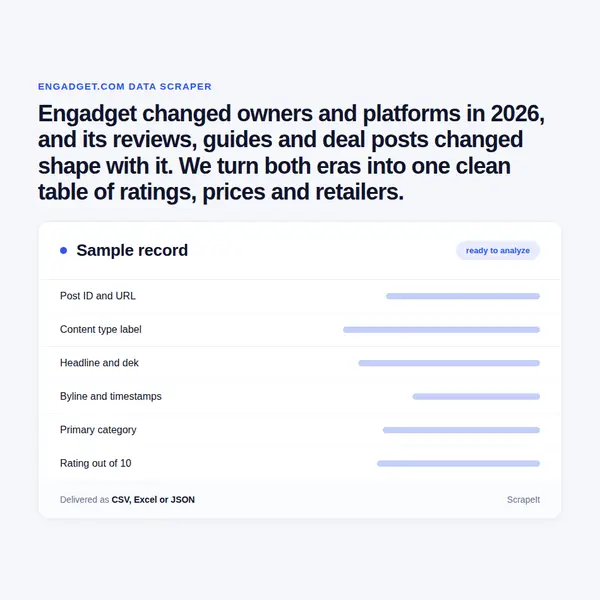
Engadget changed owners and platforms in 2026, and its reviews, guides and deal posts changed shape with it. We turn both eras into one clean table of ratings, prices and retailers.

Engadget Scraper
Solutions

How We Scrape Engadget Data: Discovery, Snapshots and Delivery

ScrapeIt runs Engadget data scraping as a managed service: we build the collector, run it on our own infrastructure and repair it when the site changes, as it did in 2026 when new pages began to appear beside the migrated archive. Anti-bot handling, proxy rotation and CAPTCHA solving are part of the service. We extract Engadget data from public pages only, with no login and at a measured pace, and use the sitemaps, the archive and the feeds for discovery. Guides and deal posts change in place, so each run keeps a dated snapshot and every change becomes a row of its own. Ratings arrive both as printed and normalized, records are deduplicated on post id and URL across both generations, and a sample comes first. Delivery is CSV, JSON or XLSX, or a push to S3, SFTP or your warehouse.

Engadget Reviews Fields: Rating, Pros and Cons, Price and Retailer

Engadget reviews carry the richest record on the site, and on pages published since the move most of it also sits in structured data, so values come out exactly as the site states them.

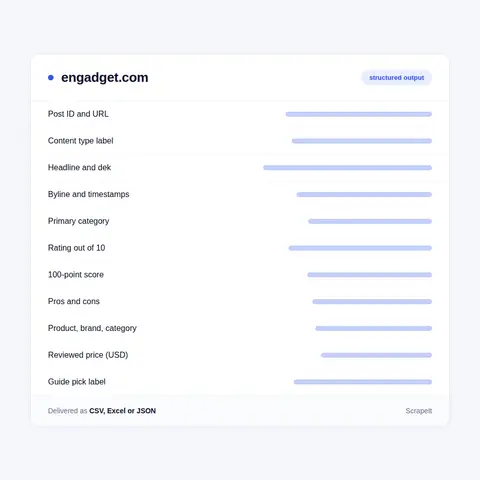
  • Review record. Post id and URL, headline, dek, byline, published and modified timestamps, primary category and the content type label.
  • Rating. The printed rating, such as 7.8 / 10 or 9.3 / 10, plus the same value on the 100-point scale the reviews policy describes, where 80-89 is Recommended and 90-100 is Editors' Choice. Games, films, software and cars are reviewed without a score, so the field stays empty rather than zero.
  • Pros and cons. Each as an ordered list of the short phrases the reviewer chose, kept word for word.
  • Product. Reviewed product name, brand and a free-text product category such as Smartwatch, Soundbar or Ereader.
  • Price and retailer. The price Engadget reviewed the product at, in US dollars, and the outbound buy links, whether Amazon, Walmart or the maker's own store. The structured price comes with a stock flag fixed at out of stock, so we drop the flag rather than pass it off as availability.
  • Yahoo-era reviews. A product module with an Expert Score out of 100, product name, current price, a one-line verdict, pros and cons and a See at Best Buy style button. Older reviews may carry no score at all.
  • Every post. Headline, dek, categories, byline, timestamps, lead image and word count, for News and Short Article pieces as much as for reviews.

The byline is kept as printed. The structured data also lists author biographies, education and social profiles, and the meta label names the staff who pitched and approved each headline; none of that goes into the dataset, and neither do reader comments, which load from a third-party conversation widget.

Engadget Reviews Fields: Rating, Pros and Cons, Price and Retailer
Engadget Buying Guides and the Deals Archive: Picks, Retailers, Prices

Engadget Buying Guides and the Deals Archive: Picks, Retailers, Prices

Buying guides. An Engadget buyers guide names each pick in a heading that pairs a use with a product - best budget laptop, best wireless earbuds for iPhone - then adds other products tested, a how-we-test note and FAQs. Rewritten guides send most picks to Amazon through affiliate links that carry the ASIN and a Static Media tag. Guides not yet rewritten keep Yahoo-era buttons such as See at Best Buy or See at Retroid, whose Yahoo Shopping redirect names the merchant, the item and the landing page, and often a Recent updates log that says month by month which pick replaced which. The Engadget best laptops guide and the seasonal Engadget gift guide pages follow the same pattern, so picks can be tracked over time: when a product entered, when it dropped out, what replaced it.

Deals. Engadget ran a deals desk until February 2026, and /deals/ now redirects to Buying Guides. Its output stays online. Deal posts under /deals/ from mid-2024 mostly carry a price module with deal price, original price and merchant, down to subscription offers priced per plan term, and name the percent off; years of Engadget Prime Day deals and Engadget Black Friday deals posts before that hold the prices in headline and text. That is a price history of what an editor judged worth buying, not a live price feed.

Uses. Brand and PR teams chart ratings and pros and cons for their products against rivals; retail and pricing analysts compare the reviewed price with later deal prices; commerce teams see which retailers win the buy buttons, category by category.

Engadget Data Across Two Platforms: Yahoo Years and Static Media

Engadget has reviewed and reported on consumer tech since 2004. In 2026 Static Media, the publisher behind BGR, SlashGear and Jalopnik, acquired it and moved it to a new publishing system, and that move shapes every Engadget scraper built today: one domain now serves two generations of pages, each with its own addresses, product module and scoring.

Posts from the early years live at dated addresses such as /2008-03-31-slug.html. From 2020 on, addresses end in a nine-digit suffix, as in /gaming/slug-140018863.html, and the digits read as a clock time, not a running number. Everything published since the end of April 2026 sits at /{post id}/{slug}/, with a seven-digit id that rises over time but skips numbers, so neither pattern can be walked. Older buying guides keep their Yahoo-era addresses and are updated in place.

Each page names its own content type in a meta label. Engadget tech news posts are labeled News; Short Article marks the explainers, how-tos and versus pieces that now make up most of the daily output; then come Review, Buyer's Guides, Mini-Feature - List for the Engadget review recap that runs about every two weeks, and Legacy Article for everything migrated. Engadget laptop reviews, Engadget phone reviews and Engadget tablet reviews each have a category page, alongside gaming, headphones, wearables, photography, home and smart home.

The archive index at /sitemap/ counts posts by year: in September 2026 it listed about 529,000, some 750 of them from that month alone. There is one US English edition; the old Chinese and Japanese editions no longer resolve.

Get a Quote

dev_w
25

Developers

customers
500+

Customers worldwide

pages
1 500 000 000+

Pages extracted

stime
15000+

Hours saved for our clients

Plans

Airplane

€199 / one-time

setup fee - included

Data limits100,000
Frequencyone-time
Run timeup to 5 days
Data storing7 days

Helicopter

€169 / mo

setup fee €499

Data limits250,000
Frequencymonthly
Run timeup to 5 days
Data storing14 days

Glasses

€229 / mo

setup fee €499

Data limits1,000,000
Frequencyweekly
Run timeup to 5 days
Data storing30 days

DNA

€549 / mo

setup fee €799

Data limits3,000,000
Frequency3 times daily
Run timesame day
Data storing90 days

Engadget API, RSS Feeds and Sitemaps: What Machines Can Read

There is no public Engadget API and no developer program. The machine-readable outputs are RSS feeds and XML sitemaps. The main feed lives at engadget.com/feed/, the old rss.xml address serves the same feed, and every category has its own at /category/{slug}/feed/. Each carries the latest 20 items with headline, link, time, byline, categories, the one-line dek and a lead image, and nothing else: no article body, no rating, no pros and cons, no prices. On a busy news day the main feed turns over within a few hours, so it works as a doorbell rather than a record.

The Engadget sitemap index splits the way the site does: post sitemaps for everything published on the new system, a long run of legacy sitemaps reaching back to 2004, and author and category sitemaps. The Google News sitemap that robots.txt points to carries no entries. The archive at /sitemap/ lists every year and month, and a month page groups posts under category headings with the headline and, for recent years, the dek and byline.

Category pages show only the latest couple of dozen posts and site search is closed to crawlers, so complete coverage comes from the sitemaps and the archive, while freshness comes from the feeds. The fields buyers pay for - ratings, pros and cons, reviewed prices, guide picks, retailer links - exist only on the pages, which is why the job is scraping rather than feed reading.

Our Blog

Reads Our Latest News & Blog

Learn how to use web scraping to solve data problems for your organization

How Artificial Intelligence Is Used In Web Scraping

How Artificial Intelligence Is Used In Web Scraping

Leveraging advances in technology, the AI-powered web scraper has skyrocketed in demand and is helping to expand capabilities by automating tedious daily tasks and speeding up data collection from thousands of websites several times over.

What is Web Scraping and What is it Used For?

What is Web Scraping and What is it Used For?

Web scraping is a method of obtaining web data by extracting it from pages of web resources with the help of a program, that is, in automatic mode. It is used to syntactically convert web pages into more usable forms.

Web Scraping for Machine Learning

Web Scraping for Machine Learning

If you specialize in machine learning, you need to feed large amounts of data to the algorithms. Web scraping is the easiest and the most efficient method of collecting the data from all over the Internet.

scrapeit logo

ScrapeIt and Your Engadget Dataset

ScrapeIt is a managed web scraping agency. For an Engadget dataset we agree the scope with you in writing - review categories, buying guides, the deals archive, how far back and how often - then keep the pipeline running through redesigns and ownership changes, so your series does not break when the site does. You receive finished tables, not a tool to operate. Pricing follows volume and refresh rate, and a sample built on your own categories comes before any commitment.

FAQ

Does Engadget have an API, and what is the Engadget RSS feed URL?

No, there is no public API and no developer portal, and reuse of articles is licensed through Wright's Media. The Engadget RSS feed URL is engadget.com/feed/, the rss.xml address returns the same feed, and each category has one at /category/{slug}/feed/. Every feed holds the latest 20 items with headline, link, time, byline, categories, dek and image, but no body text, rating or price. The sitemaps list every URL back to 2004. We use feeds and sitemaps to find new and changed pages and read the fields from the pages themselves.

Can you extract Engadget review scores, pros and cons and reviewed prices?

Yes. Reviews published since the 2026 move print a rating out of 10, such as 8.7 / 10, and carry that rating, the pros and cons lists, the product name, brand and category and the reviewed price in US dollars in structured data. The reviews policy still describes a 1-100 scale, so we deliver the printed value and a 100-point one that maps onto its Recommended (80-89) and Editors' Choice (90-100) bands. Yahoo-era reviews show an Expert Score out of 100 in a product module, and unscored reviews of games, films, software and cars keep an empty score.

How far back does the Engadget archive go, and how often can the data be refreshed?

To 2004, with dated URLs from the first years and a year-by-month archive index. A historical backfill runs once as its own job. After that most clients take News and Short Article posts daily or several times a day, reviews daily and buying guides weekly, since guides change in place and each run is a dated snapshot; the deals archive is a one-time pull. There is a single US English edition, so no regional versions to merge. Delivery is CSV, JSON, JSON Lines or XLSX, or a push to S3, SFTP, cloud storage or your database.

Is it legal to scrape Engadget, and can the article text be republished?

Engadget content belongs to Static Media, whose terms of use allow personal, noncommercial use, rule out reproducing material portions of the site and require written permission for anything else; republication licenses go through Wright's Media. So the dataset carries facts and metadata - ratings, pros and cons, prices, retailers, headlines, dates, links - rather than article bodies for reuse. We collect public pages at a measured pace, stay out of anything behind a login and leave out author profiles and reader comments. Whether your use fits is a question for your legal adviser before the first delivery.

Can you still track Engadget deals and prices now that the deals desk has closed?

Yes, in two layers. The archive keeps the deal posts from mid-2024 to February 2026, mostly with deal price, original price, percent off and merchant, and years of Prime Day and Black Friday posts before them with prices in the text, which together give a price history per product. Going forward, prices come from reviews, as the reviewed price, and from buying guides, whose snapshots show a price or a pick changing between runs. Amazon links carry ASINs and Yahoo-era links carry the merchant's landing page, so picks can be joined to a retailer price feed if you need live shelf prices.

How does it Work?

Step 1 - Make a Request

You share your needs, expectations, and desired timeframe. We’ll suggest the best solution based on your request and budget.

Step 2 - Configuring Custom Web Crawlers

Our specialists configure the crawlers and extract a sample dataset for your review before proceeding with the full-scale extraction.

Step 3 - Collect and Deliver

Once you approve the sample, we launch the project and start full data collection. We gather, filter, and structure the data for easy use, delivering it on time in your preferred format.

Step 4 - Maintain and Support

Our team manages ongoing processes, monitors website changes, and supports all data extraction cycles. We can also help integrate data into your systems or create dashboards to simplify analysis.

Request a Quote

Tell us more about you and your project information.
Which sites, which fields, how often. A couple of lines is enough.

We reply within 1 business day. No obligation.

scrapiet

Scrapeit Sp. z o.o.
10/208 Legionowa str., 15-099, Bialystok, Poland
NIP: 5423457175
REGON: 523384582