NPR Scraper for Broadcast Segments, Transcripts and Stories

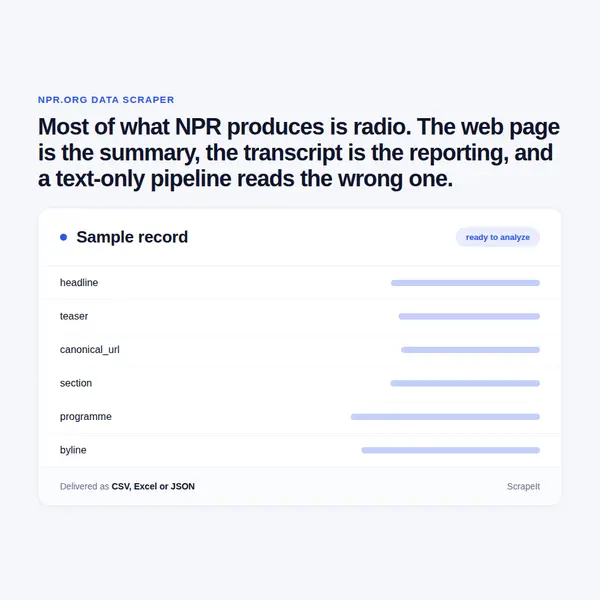
Most of what NPR produces is radio. The web page is the summary, the transcript is the reporting, and a text-only pipeline reads the wrong one.

NPR Scraper
Solutions

Managed public radio data, run end to end by us

ScrapeIt runs the collection as a managed service. You name the sections, programmes and member stations; we build the pipeline, capture transcripts where they exist, type audio items separately and hand back CSV, JSON, Excel or a push into your warehouse with both the air date and the publication timestamp.

Where the official interfaces cover part of the brief we use them and say so. Paying for a crawl that duplicates a supported endpoint is a waste of your budget and our time.

We collect what the site renders publicly and do not download audio files. NPR content is copyrighted and the terms restrict reuse, so the dataset is metadata plus publicly rendered text, including published transcripts, for analysis rather than republication. Bring the use case to your own counsel before the project starts.

NPR fields in every export

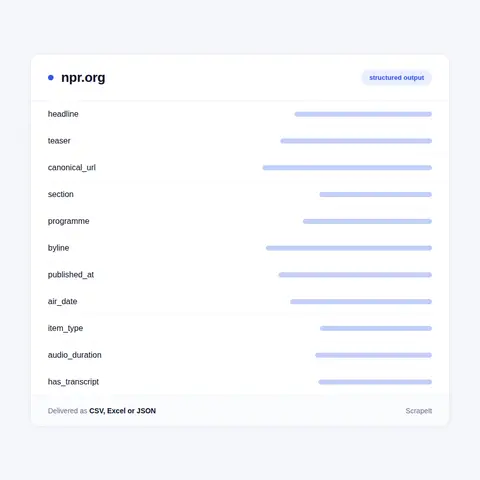
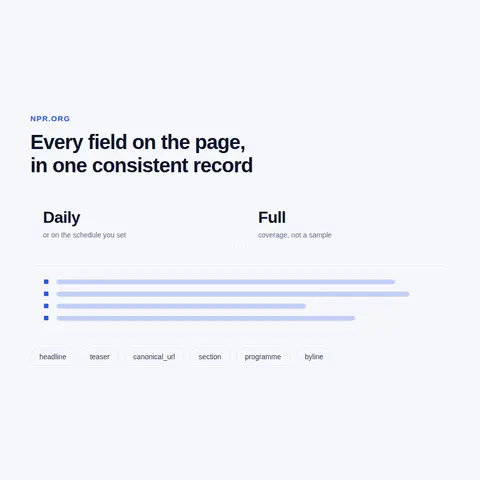
The story record covers canonical URL, headline, teaser, section and programme where the item came from a show, byline, publication timestamp, last updated timestamp, item type and the story identifier.

Item type separates written story, broadcast segment with audio, segment with transcript, and the combinations, because those are genuinely different objects. A three minute segment with a fifty word web summary is not a thin article, and only typing prevents it being counted as one.

Audio fields are captured where published: duration, the programme it aired on and the air date, which can differ from the web publication timestamp and frequently does.

Transcripts are collected where NPR publishes them, and they are the substantive text for broadcast items. Word count for those rows comes from the transcript rather than the summary, which is the only way length based measures mean anything on this source.

Source is recorded per row: national or which member station, so regional coverage can be separated from national without recollecting anything.

NPR fields in every export
Member stations, programmes and the official interfaces

Member stations, programmes and the official interfaces

Member station collection is scoped per client rather than taken wholesale. There are a great many stations and most clients care about a handful of markets, so we agree the list at the start and collect those properly instead of everything thinly.

Programme level analysis is available because the programme is published on the item. Which shows cover a subject, how often, and how that has changed is a question that cannot be asked of a newspaper at all and is straightforward here.

The official developer interfaces are worth checking before any crawl is designed. Where they cover a client's need they are supported, steadier and cheaper than collection, and we will recommend them and build the pipeline around them rather than duplicating them with a crawl.

Historical backfill is practical because URLs are stable and section pagination reaches back, and transcripts for older segments generally remain available. It runs as a one time job separate from the ongoing feed.

A broadcaster whose web output is a companion to the radio

NPR is public radio first. A great deal of what appears on its site is the web companion to a broadcast segment: a short written summary, the audio itself, and frequently a full transcript of what was actually said.

That ordering matters for collection. On a newspaper the article is the reporting. Here the segment is the reporting and the page is a pointer to it, so a pipeline that collects only the written summary captures a fraction of the content and misreads the length of everything.

The network structure is the second feature. NPR is a national organisation with a large membership of local stations, each producing its own journalism and each with its own site. National coverage and member station coverage are different things, and for anyone monitoring a specific region the local output is where the coverage actually is.

Section fronts respond directly, RSS feeds are published and respond, and the organisation runs a developer programme with documented interfaces. Where a client can use those, they are the better route and we will say so.

Get a Quote
dev_w
25

Developers

customers
500+

Customers worldwide

pages
1 500 000 000+

Pages extracted

stime
15000+

Hours saved for our clients

Plans

Airplane

€199 / one-time

setup fee - included

Data limits100,000
Frequencyone-time
Run timeup to 5 days
Data storing7 days

Helicopter

€169 / mo

setup fee €499

Data limits250,000
Frequencymonthly
Run timeup to 5 days
Data storing14 days

Glasses

€229 / mo

setup fee €499

Data limits1,000,000
Frequencyweekly
Run timeup to 5 days
Data storing30 days

DNA

€549 / mo

setup fee €799

Data limits3,000,000
Frequency3 times daily
Run timesame day
Data storing90 days

Why transcripts change what the dataset is worth

A media monitoring pipeline pointed at this source without transcript handling produces a dataset that looks sparse and reads wrong. Items come back with fifty words of summary, sentiment scoring has almost nothing to work with, and a broadcaster that reaches millions ranks below a blog on every length based measure.

Transcripts fix that completely. Where they exist they carry the full reporting, including the quotes, which is what most monitoring is actually looking for. Collecting them turns this from a thin source into one of the richer ones in an American media dataset.

The second reason is the air date. A segment aired at one time and published to the web at another, and for anything measuring when a message reached an audience the broadcast time is the real one. Keeping both is cheap and keeping only one is a mistake nobody notices until they try to build a timeline.

The third is the member network. A national story and a member station story are different reach, and for a company with operations in one region the station coverage is where its mentions live. A national-only collection reports quiet while the local conversation is running.

The fourth is the programme. Coverage on a flagship morning programme and coverage in a weekend filler slot are not equivalent, and the programme name is published, so weighting by it requires no inference.

Our Blog

Reads Our Latest News & Blog

Learn how to use web scraping to solve data problems for your organization

How Artificial Intelligence Is Used In Web Scraping

How Artificial Intelligence Is Used In Web Scraping

Leveraging advances in technology, the AI-powered web scraper has skyrocketed in demand and is helping to expand capabilities by automating tedious daily tasks and speeding up data collection from thousands of websites several times over.

What is Web Scraping and What is it Used For?

What is Web Scraping and What is it Used For?

Web scraping is a method of obtaining web data by extracting it from pages of web resources with the help of a program, that is, in automatic mode. It is used to syntactically convert web pages into more usable forms.

Web Scraping for Machine Learning

Web Scraping for Machine Learning

If you specialize in machine learning, you need to feed large amounts of data to the algorithms. Web scraping is the easiest and the most efficient method of collecting the data from all over the Internet.

scrapeit logo

Who builds and keeps your NPR feed

ScrapeIt is a managed extraction company, not a tool you have to learn. Our team builds the pipeline, watches it as programmes and templates change, and repairs it before your transcripts stop arriving.

You see a sample first, in your format, over the sections, programmes and stations you actually track, with transcripts included so you can see the difference against a summary-only feed.

FAQ

Why are transcripts so important on this source?

Because without them the dataset is fifty word summaries and a broadcaster reaching millions ranks below a blog on every length based measure. Transcripts carry the full reporting including the quotes, which is what most monitoring is actually looking for. They turn this from a thin source into one of the richer ones in an American dataset.

Do you keep the air date separately from publication?

Yes, and they frequently differ. For anything measuring when a message reached an audience, the broadcast time is the real one. Keeping both costs nothing; keeping only one produces timelines that are quietly wrong.

Can you cover member stations?

Yes, scoped to the markets you care about rather than all of them. National and member station coverage are different reach, and for a company with operations in one region the station coverage is where its mentions live - a national-only collection will report quiet while the local conversation is running.

Should I use the official developer interfaces instead?

Where they cover your need, yes, and we will say so rather than quoting for a crawl that duplicates them. They are supported and steadier. What we add is everything around them: member stations, transcript handling, item typing and delivery into your warehouse.

Do you download the audio?

No. We capture the audio metadata - duration, programme, air date - and the published transcript where one exists. The audio files themselves are copyrighted content and collecting them serves no analytical purpose that the transcript does not serve better.

How does it Work?

Step 1 - Make a Request

You share your needs, expectations, and desired timeframe. We’ll suggest the best solution based on your request and budget.

Step 2 - Configuring Custom Web Crawlers

Our specialists configure the crawlers and extract a sample dataset for your review before proceeding with the full-scale extraction.

Step 3 - Collect and Deliver

Once you approve the sample, we launch the project and start full data collection. We gather, filter, and structure the data for easy use, delivering it on time in your preferred format.

Step 4 - Maintain and Support

Our team manages ongoing processes, monitors website changes, and supports all data extraction cycles. We can also help integrate data into your systems or create dashboards to simplify analysis.

Request a Quote

Tell us more about you and your project information.
Which sites, which fields, how often. A couple of lines is enough.

We reply within 1 business day. No obligation.

scrapiet

Scrapeit Sp. z o.o.
10/208 Legionowa str., 15-099, Bialystok, Poland
NIP: 5423457175
REGON: 523384582