TechCrunch Scraper for Posts, Authors and Topics

TechCrunch runs on WordPress and leaves its REST API open. That gets you halfway, and the second half is where every funding tracker actually breaks.

TechCrunch Scraper
Solutions

Managed TechCrunch scraping, run end to end by us

ScrapeIt runs the TechCrunch collector as a managed service. You name the categories, tags, authors and date ranges you care about; we build the pipeline, run it on your cadence and hand back CSV, JSON, Excel or a push into your warehouse. Where the public REST API is the cheaper route we use it, resolve the identifiers, clean the body text and deliver the same schema as everything else in your feed.

Cadence is per source. The home page and main category fronts justify frequent passes; the archive and quiet tags run daily. Requests are paced rather than hammered, which is both polite and the reason access stays stable.

We collect what the site publishes openly and no more. TechCrunch articles are copyrighted, so the dataset is built for analysis rather than republication, and we collect nothing that identifies commenters. Bring the use case to your own counsel before the project starts, and we scope the work to what counsel signs off.

TechCrunch fields in every export

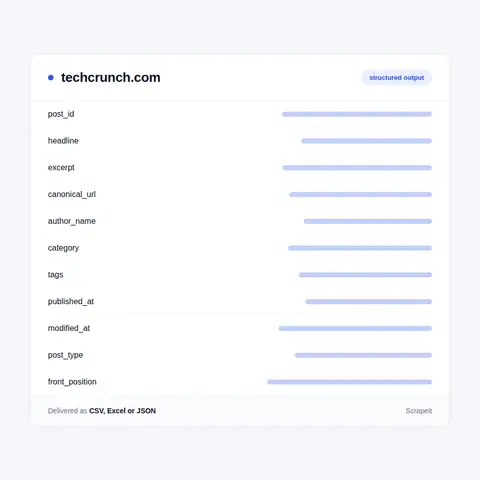
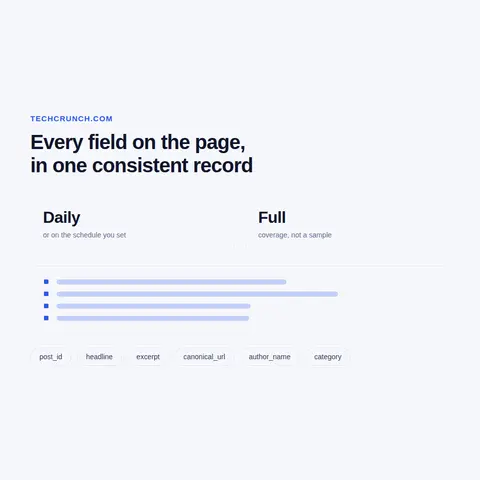
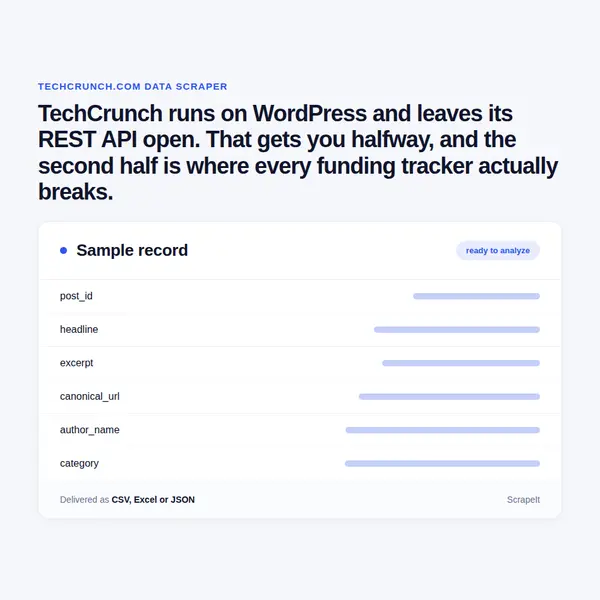
The post record covers post identifier, canonical URL, headline, subheading or excerpt, publication timestamp, modification timestamp, slug, and post type so that sponsored and event posts are separable from editorial ones.

Author and taxonomy fields arrive resolved. Author identifiers are looked up to names and profile URLs, category and tag identifiers to their labels, so what lands in your table is TechCrunch Startups and a named reporter rather than a pair of integers. This is dull work and it is exactly the part that clients arrive having given up on.

Body text is delivered clean: the rendered HTML stripped of newsletter blocks, embed wrappers and promotional inserts, with word count and reading structure preserved. Outbound links are kept as a separate list, which is what makes the funding use case work at all, since a round announcement almost always links to the company and often to the investor.

Front and category observations sit alongside, recording which posts were featured, in what order and when. On a site with this much volume the difference between a featured post and one that appeared only in the firehose is most of the signal.

Where a post is about funding we extract the entity mentions that are actually present in the text: company names, investor names, round labels and amounts as written. We do not infer a round that the article does not state, and every extracted value keeps a pointer to the sentence it came from.

TechCrunch fields in every export
Funding coverage, events and the archive

Funding coverage, events and the archive

Funding is the highest value slice of this source and the one most often mishandled. A round announcement typically names the company, the amount, the stage and one or more investors, and links to at least the company. We collect those as separate fields with the source sentence attached, so an analyst can check any value in one click rather than trusting a black box. Where the article hedges, the field stays empty and is marked as such.

Event coverage needs deliberate handling. Volume spikes hard around conference weeks, and a naive time series reads that as a trend in the market rather than a fact about the calendar. We tag event posts by type so they can be included or excluded, and the same applies to sponsored and partner content, which is separable rather than silently mixed into editorial counts.

Author level analysis is straightforward once identifiers are resolved. Who covers which beat, how coverage of a topic shifts between reporters, which desks a company keeps landing on. For a communications team that is usually more actionable than the raw count.

Historical backfill is practical because the archive is stable and addressable by date and by taxonomy. It runs as a one time job separate from the ongoing feed, sliced by date range to stay inside sensible pagination limits, and it is normally the cheaper half of the project.

How TechCrunch is built, and what that means for collection

TechCrunch is a WordPress site and behaves like one. Its REST API is reachable without a key and returns posts as JSON, with an identifier, publication and modification timestamps, the rendered title and body, and the category and tag identifiers attached to each post. For a first pass that is a gift, and any collector that ignores it is doing needless work.

The catch is that a WordPress payload is normalised for the database, not for a reader. Authors come back as numeric identifiers that need a second lookup. Categories and tags come back as identifiers too, so the taxonomy has to be resolved before anything is filterable by name. The body arrives as rendered HTML with embedded markup, shortcodes and newsletter blocks that have to be stripped before the text is usable. And the API says nothing about what the site chose to feature.

Alongside it the site publishes a news sitemap and a latest feed, both of which are cheap ways to know that something new exists. Article pages carry structured markup with headline, author and timestamps, which is a useful cross check when a payload looks wrong.

Editorially, TechCrunch is organised by category and by tag, with startups, funding, venture and the hardware and software beats as the main axes. Event coverage clusters heavily around conference dates, which matters when you are measuring volume over time and do not want a conference week to look like a trend.

Get a Quote
dev_w
25

Developers

customers
500+

Customers worldwide

pages
1 500 000 000+

Pages extracted

stime
15000+

Hours saved for our clients

Plans

Airplane

€199 / one-time

setup fee - included

Data limits100,000
Frequencyone-time
Run timeup to 5 days
Data storing7 days

Helicopter

€169 / mo

setup fee €499

Data limits250,000
Frequencymonthly
Run timeup to 5 days
Data storing14 days

Glasses

€229 / mo

setup fee €499

Data limits1,000,000
Frequencyweekly
Run timeup to 5 days
Data storing30 days

DNA

€549 / mo

setup fee €799

Data limits3,000,000
Frequency3 times daily
Run timesame day
Data storing90 days

Why the open API is not the end of the job

Almost every TechCrunch project starts the same way. Someone finds the REST API, pulls a few hundred posts, and then discovers that the table is unusable: the author is 4172, the category is 20905, the body is full of embed markup, and there is no way to tell which of yesterday's forty posts anyone actually saw.

Resolving that is straightforward and tedious. Author and taxonomy identifiers need their own lookups and a cache, because doing it naively multiplies your request count by three. Rendered HTML needs a cleaning pass that survives template changes. Pagination has practical limits, so a deep historical pull has to be sliced by date rather than walked page by page. None of this is hard; all of it is work that has to keep working after the next site update.

The part the API genuinely cannot supply is prominence. TechCrunch publishes a lot, and a post's position on the home page or its category front is the difference between an item and a story. We record it by observation, with a timestamp, which is also how you catch a headline being rewritten after publication.

Finally there is the reason most people are here: funding coverage. Tracking rounds from a technology blog only works if the extraction is honest about what the article says. We pull the amounts, companies and investors that appear in the text, keep the sentence they came from, and leave blanks where the article is vague rather than filling them with a guess.

Our Blog

Reads Our Latest News & Blog

Learn how to use web scraping to solve data problems for your organization

How Artificial Intelligence Is Used In Web Scraping

How Artificial Intelligence Is Used In Web Scraping

Leveraging advances in technology, the AI-powered web scraper has skyrocketed in demand and is helping to expand capabilities by automating tedious daily tasks and speeding up data collection from thousands of websites several times over.

What is Web Scraping and What is it Used For?

What is Web Scraping and What is it Used For?

Web scraping is a method of obtaining web data by extracting it from pages of web resources with the help of a program, that is, in automatic mode. It is used to syntactically convert web pages into more usable forms.

Web Scraping for Machine Learning

Web Scraping for Machine Learning

If you specialize in machine learning, you need to feed large amounts of data to the algorithms. Web scraping is the easiest and the most efficient method of collecting the data from all over the Internet.

scrapeit logo

Who builds and keeps your TechCrunch feed

ScrapeIt is a managed extraction company, not a tool you have to learn. Our team builds the pipeline, watches it as the site and its templates change, and repairs it before your dashboard goes quiet.

You see a sample first, in your format, over the categories and date range you actually need. Approve it and the full run follows on the cadence you choose.

FAQ

TechCrunch has a public REST API, so why would I pay for scraping?

Because the payload is not the dataset. Authors and taxonomies come back as numeric identifiers that need their own lookups, the body arrives as rendered HTML full of embeds and newsletter blocks, deep pagination has practical limits, and nothing in the API tells you what was featured or that a headline changed after publication. We use the API where it is the cheapest route and deliver the finished table, resolved and cleaned, in the same schema as the rest of your sources.

Can you extract funding rounds, amounts and investors?

Yes, from what the article actually says. We pull company, amount, stage and investor names as written, and keep a pointer to the source sentence for each value so an analyst can verify it. Where the article is vague, the field stays empty and is flagged rather than filled with an inference. A funding tracker built on guessed values is worse than no tracker.

Can sponsored posts and event coverage be separated out?

Yes, and you should separate them. Post type is recorded, so sponsored and partner content is filterable rather than silently mixed into editorial counts. Event posts are tagged too, because volume spikes around conference weeks and an untagged time series reads that spike as a market trend.

How far back can you go, and in what formats?

The archive is addressable by date and by taxonomy, so a deep backfill is practical; we slice it by date range rather than walking pagination, and run it as a one time job separate from the ongoing feed. Delivery is CSV, Excel, JSON, JSONLines or XML over FTP, SFTP, Amazon S3, Google Cloud Storage, Dropbox, Google Drive or email, or written straight into your database.

Is scraping TechCrunch legal, and can I republish the text?

The articles are copyrighted, so republication is not what this dataset is for. We collect only what the site publishes openly, never behind a login, we pace requests rather than hammer the site, and we collect nothing that identifies commenters. Metadata, structured fields and publicly rendered text for analysis are standard practice in media monitoring, but the use case is yours: have your own counsel approve it before the project starts.

How does it Work?

Step 1 - Make a Request

You share your needs, expectations, and desired timeframe. We’ll suggest the best solution based on your request and budget.

Step 2 - Configuring Custom Web Crawlers

Our specialists configure the crawlers and extract a sample dataset for your review before proceeding with the full-scale extraction.

Step 3 - Collect and Deliver

Once you approve the sample, we launch the project and start full data collection. We gather, filter, and structure the data for easy use, delivering it on time in your preferred format.

Step 4 - Maintain and Support

Our team manages ongoing processes, monitors website changes, and supports all data extraction cycles. We can also help integrate data into your systems or create dashboards to simplify analysis.

Request a Quote

Tell us more about you and your project information.
Which sites, which fields, how often. A couple of lines is enough.

We reply within 1 business day. No obligation.

scrapiet

Scrapeit Sp. z o.o.
10/208 Legionowa str., 15-099, Bialystok, Poland
NIP: 5423457175
REGON: 523384582