Politico Data and the Primary Sources Behind Policy News

The refusal starts at the rules file itself. For policy tracking that rarely matters: the bills, rules and dockets Politico reports on are public at the source.

Politico Scraper
Solutions

Managed policy data, run end to end by us

ScrapeIt runs the work as a managed service. You name the jurisdictions, bodies and topics; we collect the primary public records with every stage date kept, and hand back CSV, JSON, Excel or a push into your warehouse.

If you license Politico content, we build within the licence and record its reference on every row.

We do not collect the site and do not work around its refusal. Where your question is really about policy movement, we will tell you that the primary record is the better source, because it usually is.

What a policy dataset can honestly carry

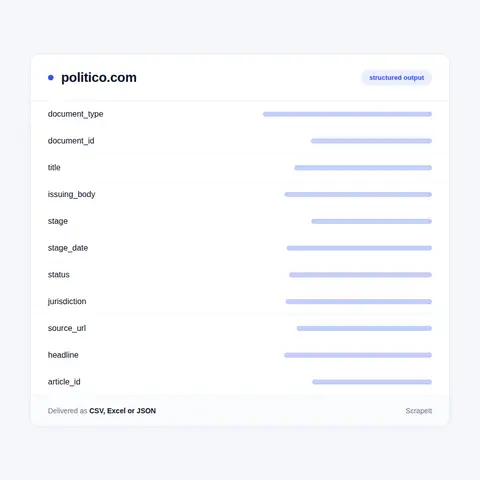
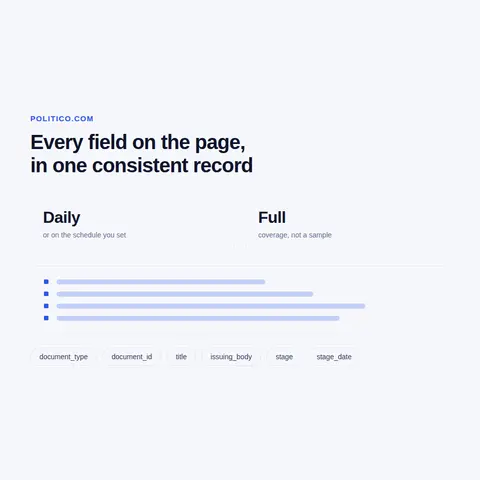
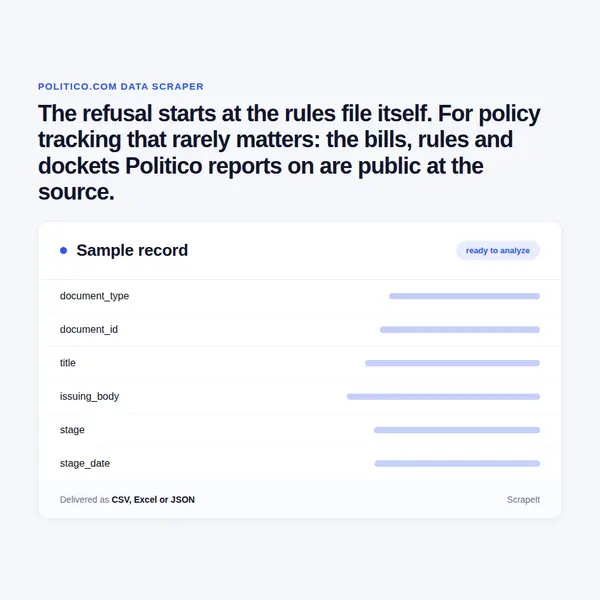
Primary-source records carry the document type - bill, rule, notice, hearing - its identifier, title, issuing body, the dates that matter at each stage, status and the source address, collected from the public bodies that publish them.

Stage dates are kept separately rather than collapsed into one date. A bill introduced, amended, passed by one chamber and signed has several dates, and a tracking product that keeps only one will mislead the people relying on it.

Where a client licenses Politico content, article records carry the headline, byline, section, publication timestamp and article identifier, within the licence's scope and with its reference on every row.

Citation records, built without the site, show where other outlets follow Politico reporting.

Every row carries the collection timestamp and its source type, so primary records and journalism are never mixed.

What a policy dataset can honestly carry
Stage tracking, citation analysis and limits

Stage tracking, citation analysis and limits

Legislative and regulatory stage tracking from primary sources is the strongest product: every document with its stages and dates, updated as bodies publish, which is what government affairs teams actually monitor.

Citation analysis shows how Politico reporting is followed by other outlets, collected from sources that permit collection, which measures its agenda-setting role without touching its site.

Licensed content work, where a client holds the right terms, is ordinary structuring and delivery with the licence reference attached.

Limits: no collection from politico.com, no attempt to get past its refusal, and no presentation of journalism as primary record or the other way round.

Policy journalism with a subscription business

Politico covers politics and policy in Washington, Brussels and elsewhere, with a large subscription business selling specialist policy coverage to professionals in government affairs, law and lobbying.

Its site refused our requests with 403 - not only for pages, but for the crawl rules file itself. That is unusual: most sites that restrict crawling still publish the rules so crawlers can read them. Here the refusal starts before the rules can be read at all.

For a data project that settles the access question quickly. Politico's journalism is available through subscription and licensing, and not through collection.

It also points to where the underlying data actually lives. Politico reports on bills, regulations, hearings and dockets - public records published by legislatures and agencies, which are open, structured and, for most tracking purposes, the better source.

Get a Quote
dev_w
25

Developers

customers
500+

Customers worldwide

pages
1 500 000 000+

Pages extracted

stime
15000+

Hours saved for our clients

Plans

Airplane

€199 / one-time

setup fee - included

Data limits100,000
Frequencyone-time
Run timeup to 5 days
Data storing7 days

Helicopter

€169 / mo

setup fee €499

Data limits250,000
Frequencymonthly
Run timeup to 5 days
Data storing14 days

Glasses

€229 / mo

setup fee €499

Data limits1,000,000
Frequencyweekly
Run timeup to 5 days
Data storing30 days

DNA

€549 / mo

setup fee €799

Data limits3,000,000
Frequency3 times daily
Run timesame day
Data storing90 days

Why the primary record usually beats the story

Most briefs that name Politico are really asking for policy tracking: what is moving, where, and when the next stage happens. For that question, the journalism is a secondary source, and the primary records are public.

Legislatures publish bills and their status. Agencies publish proposed and final rules, often through official journals with structured interfaces of their own. Committees publish hearings. That material is authoritative, complete for its scope, and in many cases free of the copyright and licensing questions that surround journalism. A tracking product built on it is sturdier than one built on reporting about it.

What Politico adds is judgement: which developments matter, what is happening behind the formal record, who is likely to move. That value is real, and it is sold through the paper's subscriptions and licences.

The access picture confirms the split. The site refuses automated requests before the crawl rules can be read. We take that at face value and do not attempt to get around it.

Our Blog

Reads Our Latest News & Blog

Learn how to use web scraping to solve data problems for your organization

How Artificial Intelligence Is Used In Web Scraping

How Artificial Intelligence Is Used In Web Scraping

Leveraging advances in technology, the AI-powered web scraper has skyrocketed in demand and is helping to expand capabilities by automating tedious daily tasks and speeding up data collection from thousands of websites several times over.

What is Web Scraping and What is it Used For?

What is Web Scraping and What is it Used For?

Web scraping is a method of obtaining web data by extracting it from pages of web resources with the help of a program, that is, in automatic mode. It is used to syntactically convert web pages into more usable forms.

Web Scraping for Machine Learning

Web Scraping for Machine Learning

If you specialize in machine learning, you need to feed large amounts of data to the algorithms. Web scraping is the easiest and the most efficient method of collecting the data from all over the Internet.

scrapeit logo

Who builds and keeps your policy feed

ScrapeIt is a managed extraction company, not a tool you have to learn. Our team follows public bodies as they publish, keeps every stage of every document, and repairs collection before a deadline goes unnoticed.

You see a sample first, in your format, over the bodies and topics you actually track, so you can compare primary-source coverage with what you currently read.

FAQ

Can you scrape Politico?

No. The site refuses automated requests with 403, including for its crawl rules file. Its journalism is available through subscription and licensing, and we build within a licence where you hold one.

Then how do I track policy?

From the primary records: bills, rules, notices and hearings published by legislatures and agencies. They are authoritative, public, and often available through structured interfaces - a sturdier base than reporting about them.

Why keep every stage date?

Because a bill introduced, amended, passed by one chamber and signed has several dates, and each matters to someone. A tracking product that keeps only one date will eventually cause a missed deadline.

What does Politico add over the primary record?

Judgement: which developments matter and what is happening behind the formal record. That is genuinely valuable, and it is what the paper sells through subscriptions and licences rather than something to collect.

Is a 403 on the rules file unusual?

Yes. Most sites that restrict crawling still publish their rules so crawlers can read them. Refusing the rules file itself means the refusal starts before any rule can be consulted, which we take as a clear answer.

How does it Work?

Step 1 - Make a Request

You share your needs, expectations, and desired timeframe. We’ll suggest the best solution based on your request and budget.

Step 2 - Configuring Custom Web Crawlers

Our specialists configure the crawlers and extract a sample dataset for your review before proceeding with the full-scale extraction.

Step 3 - Collect and Deliver

Once you approve the sample, we launch the project and start full data collection. We gather, filter, and structure the data for easy use, delivering it on time in your preferred format.

Step 4 - Maintain and Support

Our team manages ongoing processes, monitors website changes, and supports all data extraction cycles. We can also help integrate data into your systems or create dashboards to simplify analysis.

Request a Quote

Tell us more about you and your project information.
Which sites, which fields, how often. A couple of lines is enough.

We reply within 1 business day. No obligation.

scrapiet

Scrapeit Sp. z o.o.
10/208 Legionowa str., 15-099, Bialystok, Poland
NIP: 5423457175
REGON: 523384582