PR Newswire Scraper for Releases and Distribution Data

A press release is the one kind of news text written to be copied. That changes what you can do with it, and it makes pickup the only interesting measurement.

PR Newswire Scraper
Solutions

Managed PR Newswire collection, run end to end by us

ScrapeIt runs the PR Newswire collector as a managed service. You name the industries, categories, companies or tickers; we build the pipeline, run it on your cadence and hand back CSV, JSON, Excel or a push into your warehouse, with the body already split from the boilerplate.

Where pickup measurement is the point we run the outlet side in the same pipeline and deliver the matched table: release, outlet, first seen time, share of text retained. Two collections, one output.

We collect what the wire publishes openly. Releases are distributed for press use, which makes the position on reuse less restrictive than it is for journalism, but the wire operator still has terms on automated access and the release text remains the issuer copyright. Personal contact details are handled as described above rather than shipped by default. Bring the use case to your own counsel before the project starts.

PR Newswire fields in every export

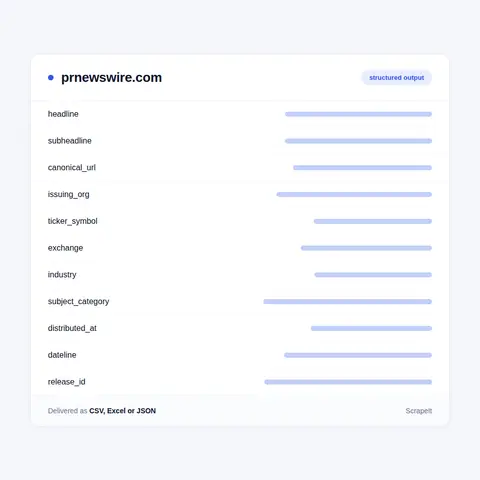
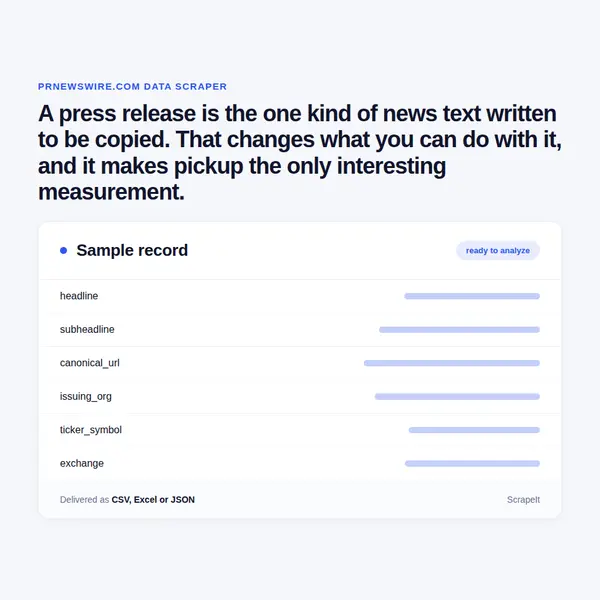
The release record covers canonical URL, headline, subheadline, distribution timestamp, issuing organisation, industry and subject categories, dateline, and the release identifier.

Financial fields are separated out where present: ticker symbol, exchange, and the release type where the wire labels it, such as earnings, merger and acquisition activity or a product announcement. For an investor relations or equity research use case those are the columns that carry the value, and they are published rather than inferred.

The body is delivered structured rather than as a blob. Headline, subheadings, main text, the about the company boilerplate and the media contact block are separate fields, because the boilerplate repeats across every release from the same company and will wreck any text analysis if it is left mixed into the body.

Contact blocks need a decision and we make it explicitly. A media contact on a release is a named person with an email address, published deliberately for press use. We deliver contact fields only where a client has a lawful basis for them, and by default we deliver the company and the department rather than the individual.

Then the fields that make pickup work: outbound links, quoted spokespeople, mentioned organisations, and the collection timestamp on every row.

PR Newswire fields in every export
Boilerplate, contacts and matching releases to coverage

Boilerplate, contacts and matching releases to coverage

Boilerplate separation is not cosmetic. Every release from a company ends with the same paragraphs about that company, and if those stay in the body then term frequency analysis, sentiment scoring and near duplicate detection all skew towards text that carries no information. We cut it into its own field, keep it, and leave it out of the analysable body.

Contact handling is a data protection question rather than a technical one. Media contacts are named individuals with direct email addresses, published for press use but personal data all the same. Our default is to deliver the organisation and the department and to omit the individual, and we deliver named contacts only where the client states a lawful basis for processing them. We would rather have that conversation at the start than hand over a file that creates a problem later.

Matching releases to coverage is the same machinery as wire pickup and usually runs alongside it. The release is the reference text; outlet articles are matched against it by text similarity and by the entities named. The output is a pickup table per release with first seen time, outlet, and the share of the original text retained.

Historical work is practical here because category listings paginate deep and release URLs are stable. A retrospective on a company or an industry over several years is a normal one time job, and it is usually cheaper than the ongoing feed.

How PR Newswire organises releases, industries and tickers

PR Newswire is a distribution wire, not a newsroom. Companies pay to put an announcement on it and the wire pushes that announcement to media outlets, databases and financial terminals. Nothing on it is reported journalism, and treating it as such in a monitoring dataset produces some very odd share of voice charts.

The listing is organised in ways that suit collection unusually well. Releases are grouped by industry and by subject category, tagged with the issuing organisation, and financial announcements carry the ticker symbol and exchange. Everything is timestamped to the minute of distribution, which matters because a release timestamp is the starting gun for the pickup you want to measure.

Entry points are public and stable. Category listings paginate, a news sitemap covers recent items, and there are RSS feeds per category including a general news releases list. For once, the machine readable surface is genuinely sufficient for discovery, and the work is in the parsing and the matching rather than in finding what is new.

The releases themselves follow a predictable shape: dateline, headline, subheadings, body, an about the company boilerplate, and a contact block. That structure is what makes reliable field extraction possible here in a way it is not on an ordinary news site.

Get a Quote
dev_w
25

Developers

customers
500+

Customers worldwide

pages
1 500 000 000+

Pages extracted

stime
15000+

Hours saved for our clients

Plans

Airplane

€199 / one-time

setup fee - included

Data limits100,000
Frequencyone-time
Run timeup to 5 days
Data storing7 days

Helicopter

€169 / mo

setup fee €499

Data limits250,000
Frequencymonthly
Run timeup to 5 days
Data storing14 days

Glasses

€229 / mo

setup fee €499

Data limits1,000,000
Frequencyweekly
Run timeup to 5 days
Data storing30 days

DNA

€549 / mo

setup fee €799

Data limits3,000,000
Frequency3 times daily
Run timesame day
Data storing90 days

Why pickup, not volume, is the measurement here

Counting releases tells you how much a company spent on distribution. It says nothing about whether anyone read the announcement, and it is the number most PR dashboards quietly report.

The measurement that matters is pickup: of the releases issued, which ones were actually picked up by outlets, by which outlets, how fast, and how much of the text survived. All four are answerable if you collect the wire and the outlets together, and none of them is answerable from the wire alone.

The rewrite depth is the part people underestimate. An outlet that republishes a release verbatim is telling you something quite different from one that took two paragraphs and added its own reporting. Measuring how much of the original text survived turns a binary picked up flag into a scale, and it is straightforward once you hold both texts.

The second big use is competitive and financial monitoring. Because releases carry the issuing company, the ticker and the category, this is one of the cleanest sources for tracking what competitors announce and when, and for building an event timeline around a listed company. The structure that makes releases dull to read makes them excellent to parse.

The third is timing patterns. Release timestamps are precise, and the choice of hour and weekday is itself informative. Announcements that go out late on a Friday are a well known pattern, and it is visible in the data rather than anecdotal.

Our Blog

Reads Our Latest News & Blog

Learn how to use web scraping to solve data problems for your organization

How Artificial Intelligence Is Used In Web Scraping

How Artificial Intelligence Is Used In Web Scraping

Leveraging advances in technology, the AI-powered web scraper has skyrocketed in demand and is helping to expand capabilities by automating tedious daily tasks and speeding up data collection from thousands of websites several times over.

What is Web Scraping and What is it Used For?

What is Web Scraping and What is it Used For?

Web scraping is a method of obtaining web data by extracting it from pages of web resources with the help of a program, that is, in automatic mode. It is used to syntactically convert web pages into more usable forms.

Web Scraping for Machine Learning

Web Scraping for Machine Learning

If you specialize in machine learning, you need to feed large amounts of data to the algorithms. Web scraping is the easiest and the most efficient method of collecting the data from all over the Internet.

scrapeit logo

Who builds and keeps your PR Newswire feed

ScrapeIt is a managed extraction company, not a tool you have to learn. Our team builds the pipeline, watches it as the site changes, and repairs it before your dashboard goes quiet.

You see a sample first, in your format, over the industries or tickers you actually track, with boilerplate already separated so you can judge the text fields on real releases.

FAQ

Can I republish press releases from this dataset?

Press releases are issued for press use, so the position is genuinely different from journalism, but it is not a free for all: the text remains the issuer copyright and the wire operator has its own terms on automated access. In practice most clients use this for monitoring and analysis rather than republication. If republication is your plan, say so at the start and take it to your counsel, because the answer depends on the issuer rather than on us.

Do you deliver the media contact names and emails?

Not by default. A media contact is a named individual with a direct address, published for press use but personal data nonetheless. Our default output carries the organisation and the department. We include named contacts only where a client states a lawful basis for processing them, and we would rather settle that at the start than hand over a file that becomes a problem later.

Why do you separate the company boilerplate from the body?

Because leaving it in ruins the analysis. The same paragraphs repeat on every release from a company, so term frequency, sentiment and duplicate detection all end up dominated by text that carries no information. We keep the boilerplate as its own field and exclude it from the analysable body.

Can you tell me which outlets picked a release up?

Yes, and it is the measurement that makes this source worth collecting. It needs the wire and a set of outlets running in the same pipeline: we match outlet articles to the release by text similarity and named entities, then report first seen time per outlet and how much of the original text survived. That turns picked up from a flag into a scale.

How often can the feed refresh, and in what formats?

From a daily digest up to near real time on the categories or tickers you track, since distribution timestamps are precise and discovery is cheap through the public feeds. Delivery is CSV, Excel, JSON, JSONLines or XML over FTP, SFTP, Amazon S3, Google Cloud Storage, Dropbox, Google Drive or email, or written straight into your database.

How does it Work?

Step 1 - Make a Request

You share your needs, expectations, and desired timeframe. We’ll suggest the best solution based on your request and budget.

Step 2 - Configuring Custom Web Crawlers

Our specialists configure the crawlers and extract a sample dataset for your review before proceeding with the full-scale extraction.

Step 3 - Collect and Deliver

Once you approve the sample, we launch the project and start full data collection. We gather, filter, and structure the data for easy use, delivering it on time in your preferred format.

Step 4 - Maintain and Support

Our team manages ongoing processes, monitors website changes, and supports all data extraction cycles. We can also help integrate data into your systems or create dashboards to simplify analysis.

Request a Quote

Tell us more about you and your project information.
Which sites, which fields, how often. A couple of lines is enough.

We reply within 1 business day. No obligation.

scrapiet

Scrapeit Sp. z o.o.
10/208 Legionowa str., 15-099, Bialystok, Poland
NIP: 5423457175
REGON: 523384582