Apartments.com Data: Unit Prices for 3,000 Buildings Every Day
A daily apartments.com feed for a US apartment locator: about 3,000 buildings from the client's own list, down to each unit's rent and floor plan.
Learn More
The rent QuintoAndar advertises is not the bill the tenant pays. We split base rent, condominio, IPTU, home protection and the service fee into columns of their own.
Plans from €169/month · Free project assessment · Reply within 1 business day

QuintoAndar scraping runs against a single-page application sitting behind bot protection, and it does not answer plain requests. Anti-bot handling, proxy rotation and CAPTCHA solving are part of the service rather than an upsell: we drive real browsers through Brazilian exits, because availability and pricing depend on where the request lands.
Delivery is CSV, JSON, XLSX, a hosted endpoint, or a push into S3, a database, Google Sheets or a BI tool. Schedules run daily for live rent inventory and price-drop tracking, weekly or monthly for sale stock and building records. Scope is set by city, neighborhood, street, housing type, rent band or business context, and a run can return a delta file holding only what moved since the previous pass.
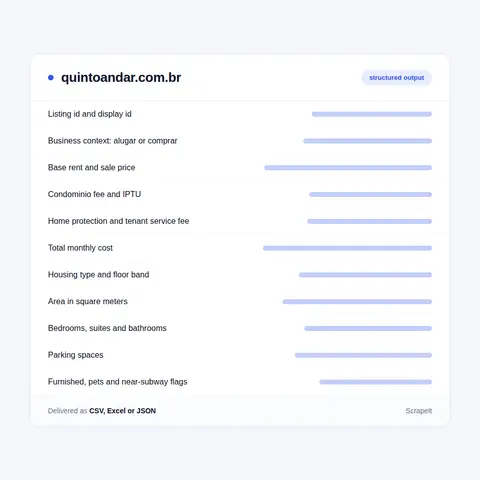
A QuintoAndar scraper reads each home from the page payload, so the fields arrive already typed instead of being parsed back out of prose. Every property carries two identifiers: the nine-digit id that sits in the /imovel/ address and a shorter display id printed on the page and in the breadcrumb. The slug behind the id repeats the housing type, the bedroom count, the neighborhood and the city, and the segment after it - alugar or comprar - says which side of the market the card belongs to.
The money block is where QuintoAndar rent data parts company with a classifieds feed. A rental card carries base rent, the condominio (the monthly building fee), IPTU (the municipal property tax), a home protection charge and the platform tenant service fee, then the total the tenant is actually billed. Two type flags say how the first two behave: the condominio is either charged on top or folded into the rent, and IPTU is either billed or absent entirely. On the sale side those recurring lines fall to zero, the sale price carries the asking figure, and a sale type plus a primary-market flag separate resale stock from new developments.
Physical fields we extract for QuintoAndar listings: floor area in square meters, bedrooms, suites, bathrooms, parking spaces and the housing type - apartamento, casa, casa de condominio or kitnet, the local word for a studio. The storey arrives as a band with a floor and a ceiling rather than an exact number, and houses carry no band at all. Boolean flags cover furniture, pets, subway proximity, newly built or renovated stock, reserved status and an exclusivity marker.
Address, building and media finish the row. Street, neighborhood, city, state name and two-letter acronym, CEP postcode and coordinates come with every home, while the street number rides on the linked condominium record rather than on the listing itself. That condominium brings its own hash id, name, slug, doorman shift and shared installations. Amenities arrive as four keyed blocks - fittings, comfort, practicality and building installations - each entry a code, a label and a yes or no. Photos carry an id, a room caption and a cover flag; nearby places come typed as metro or train station, shopping mall, park, school, university or stadium. Publication history gives a first and a last publication date, a status and a status reason.
There is no listing-level sitemap, and the result grid is virtualised with no page number in the address, so coverage cannot be a page walk. It has to be a slice plan, and the site publishes the cuts to use. The sitemap index carries search partitions at four depths - city, neighborhood, street and building - each crossed with housing type and a filter word, plus pages that pin a rent or area ceiling. Street partitions for rent alone ran to roughly 42,400 addresses, neighborhood partitions to roughly 7,400 for rent and 6,300 for sale.
The facet vocabulary is the crawl grid. Housing types are apartamento, casa, casacondominio and kitnet. Filter words run 1-quartos through 4-quartos plus mobiliado (furnished), piscina, academia, churrasqueira, varanda, quintal, jardim, closet, barato and proximo-ao-metro. The full panel adds suites, parking, pets, immediate or upcoming availability, exclusives, a combined condominio and IPTU ceiling, a publication window from today out to six months, an investor mode for tenanted homes, and a construction status: ready, under construction or pre-construction.
Building pages form a second dataset - roughly 179,600 condominium records in early September 2026, each an apartment complex with from-prices for rent and sale, a price per square meter, the condominio and IPTU floor, unit size and bedroom ranges, an availability count and the street address with number. Roughly 2,850 neighborhood pages sit above them. Owner and agent names and contact details stay out of every delivery.
QuintoAndar is the Brazilian housing platform at quintoandar.com.br, and what makes QuintoAndar data unlike an ordinary portal feed is that the company sits inside the deal rather than beside it. A tenant signs with no fiador (a personal guarantor), no seguro-fianca (rent insurance) and no deposito caucao (a security deposit): the platform underwrites the lease itself, screens the tenant with its own credit analysis and pays the landlord on time. Because it issues the invoice, every rental card prints the whole monthly bill rather than a single asking figure.
Search runs two stacks of inventory at once. Part of the catalogue is handled end to end by the company; the rest is partner classified stock from brokerages, and the split is written into the search payload as separate totals. In Sao Paulo, rent listings ran to roughly 68,700 in early September 2026, about two thirds of them handled in house. The for-sale side held roughly 378,200 homes in the same city, and there the partner classified share was the larger of the two.
Coverage is Brazil only: 99 cities across nine states - Sao Paulo, Minas Gerais, Rio de Janeiro, Rio Grande do Sul, Parana, Goias, Santa Catarina, Bahia and the Federal District. Alongside the listings the site runs building pages under /condominio, a QPreco valuation tool for owners, and a rent index published jointly with Imovelweb. The operator is registered as a broker under CRECI-SP J24.344, which is the tell that it acts as a principal in the transaction.
Get a Quote
Developers

Customers worldwide

Pages extracted

Hours saved for our clients
€199 / one-time
setup fee - included
€169 / mo
setup fee €499
€229 / mo
setup fee €499
€349 / mo
setup fee €499
€549 / mo
setup fee €799
Delivery: CSV, JSON or XLSX files, our API or a JSON feed. MCP server on request.
Full plan details →Sorting by the advertised figure produces a ranking nobody can act on, and the platform knows it: its own price control switches between Aluguel, the base rent, and Valor total, the full monthly bill. The gap between them is not a fixed markup. A furnished studio in Vila Olimpia billed about fourteen percent above its base rent. A two-bedroom flat in the east of Sao Paulo, in an older building with a heavy condominio, billed more than seventy percent above, the building fee alone worth over half the rent. A house on the same market, with the condominio folded into the rent and no IPTU line, billed four percent above. Three homes, three different answers.
So a QuintoAndar price comparison that reads one number is not a comparison. The condominio tracks the building, not the unit; IPTU tracks the municipality and the valuation; the service fee scales with the rent; home protection is its own line. Pull them as separate columns and the total becomes reproducible, a yield calculation honest, and an index built on top of it survives contact with a landlord.
The second reason to scrape QuintoAndar on a schedule is that asking prices move with nobody touching them. Owners can switch on automatic pricing that trims the rent to pull in visits, and automatic relisting that republishes a home when a lease ends. Cards carry a price-drop badge and a new-listing badge, and the first and last publication dates on the same home can sit years apart. Reductions are never written into a history table, so cut size and frequency come out of comparing snapshots.
A daily apartments.com feed for a US apartment locator: about 3,000 buildings from the client's own list, down to each unit's rent and floor plan.
Learn More
A one-time Housing.com collection for a real-estate company in India: project cards plus every photo and floor plan, uploaded straight to its cloud drive.
Learn More
A one-time 30-day history of Sahibinden car and SUV listings for a startup building an AI deal finder, delivered as JSON through our API.
Learn MoreLearn how to use web scraping to solve data problems for your organization

Real estate teams work in a fragmented data landscape. The sites that drive demand in Boston look nothing like the ones that matter in Berlin, São Paulo, Dubai, or Mumbai.

Real estate teams are operating in a data environment that is bigger, faster, and more fragmented than ever. Listings go live and disappear in hours, price cuts happen quietly, and the portals that matter most in each country are rarely the same global “top 5.”

Six jobs that scraped property data does, each backed by a ScrapeIt project: seller leads, listing monitoring, image datasets, weekly market supply, sold records and unit-level rentals. For every use case - the fields it needs and how often to refresh them.
ScrapeIt is a managed scraping agency. You describe the dataset - cities, business context, fields, cadence - and we build the crawlers, repair them when the site ships a new build, and deliver checked rows on a schedule. Nothing to host on your side, no proxy bills, no maintenance backlog.
We work only on pages a signed-out visitor can open, we do not log in, and we do not claim a perfect success rate on any site. Name the markets and we will scope a QuintoAndar dataset and quote it.
Yes. The ScrapeIt QuintoAndar API returns base rent, the condominio, IPTU, the total monthly bill, bedrooms and floor area as JSON from an endpoint we host, refreshed on the schedule you set. The same data also comes as CSV or XLSX files or straight into your database.
Five lines and a total. Base rent; the condominio, the monthly fee the building charges; IPTU, the municipal property tax; a home protection charge; and the platform tenant service fee. The sum is the figure the tenant is billed each month, and it is carried on the card as its own number rather than being left to the reader. Two flags tell you how to treat the first two lines: the condominio may be folded into the rent instead of billed separately, and IPTU may not exist for a given home. We deliver all five as separate columns plus the total, so you can rank on either one.
Brazil only, across 99 cities in nine states, weighted to Sao Paulo, Minas Gerais, Rio de Janeiro and Rio Grande do Sul, with Brasilia and Salvador as single-city entries. Depth is set by slicing rather than by paging, because the result grid does not expose page numbers: we cut a market by neighborhood, then by street, then by housing type, bedroom count, amenity filter and rent or area band, following the partitions the site itself publishes. That reaches inventory a plain city sweep would truncate, and it works the same way for rent and for sale.
Daily is normal for live rent inventory, price-drop tracking and new-listing detection; weekly or monthly suits sale stock and condominium records, which move more slowly. Because reductions are not stored as history rows on the site, price movement is reconstructed from repeat snapshots, which is why cadence matters more here than on a portal that prints a price history. Output is CSV, JSON, XLSX or a hosted endpoint, or a direct push into S3, a database, Google Sheets or a BI tool, with an optional delta file listing only the rows that changed.
Yes. Rent and sale listings, the full charge stack, floor area, bedrooms and condominium records are shown to any visitor on quintoandar.com.br. We collect only publicly available data - everything a visitor can see on QuintoAndar - and we collect it legally. We never sign in or bypass an access control, and we leave owner and agent names and contact details out by default.
Step 1 - Make a Request
You share your needs, expectations, and desired timeframe. We’ll suggest the best solution based on your request and budget.
Step 2 - Configuring Custom Web Crawlers
Our specialists configure the crawlers and extract a sample dataset for your review before proceeding with the full-scale extraction.
Step 3 - Collect and Deliver
Once you approve the sample, we launch the project and start full data collection. We gather, filter, and structure the data for easy use, delivering it on time in your preferred format.
Step 4 - Maintain and Support
Our team manages ongoing processes, monitors website changes, and supports all data extraction cycles. We can also help integrate data into your systems or create dashboards to simplify analysis.
QuintoAndar data from €169/month. Free project assessment, reply within 1 business day.

Scrapeit Sp. z o.o.
10/208 Legionowa str., 15-099, Bialystok, Poland
KRS: 0000996672
NIP: 5423457175
REGON: 523384582