Homegate Data: A Daily Snapshot of Two Cantons with 46K Photos
Every day, a full snapshot of all active Homegate listings in one Swiss region, with photos and PDFs, for a company's own listing-history database.
Learn More
Zonaprop sale listings are commonly priced in US dollars and rentals in pesos. We keep every price with its currency marker and the date we read it.
Plans from €169/month · Free project assessment · Reply within 1 business day
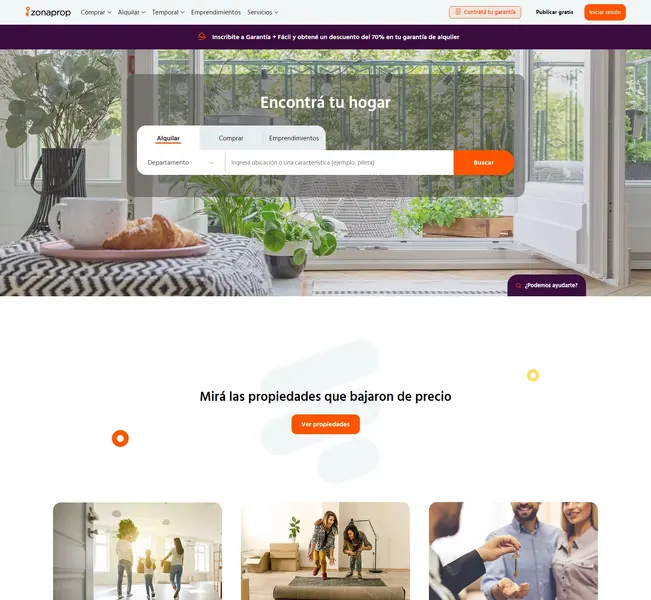
We run the crawl, you receive files. Zonaprop data arrives as CSV, JSON, XLSX or through an API endpoint, on a schedule you set - daily, weekly, or a single one-off pull. Scope is whatever a search on the site can express: operation, property type, barrio or partido, price band, ambientes, or a named inmobiliaria.
Runs can be full or incremental. We can return the whole current set each time, or only the rows that changed since the previous run, which is how price movement and time-on-market tracking is normally built. The schema is agreed with you before the first delivery and then held stable, so a layout change on the site is our problem to absorb rather than a break in your loader.
Each search page and listing page carries a structured object behind the rendered markup. We read that object rather than guessing at rendered text, so fields arrive typed and the native Spanish labels stay attached to them. A standard extract includes:
Fields a listing does not carry come back empty rather than filled with a guess. Argentine stock is inconsistent about antigüedad and about superficie total in particular, and a pipeline that quietly substitutes zero for a missing value will skew every later aggregate you build on it.
Expensas are the monthly building charges an occupant pays on top of rent, covering shared services, staff and upkeep. On Zonaprop they are a field of their own, not a component of the rent. In dense Buenos Aires stock they are large enough that ranking rentals by advertised rent alone reorders the list wrongly. An honest rental comparison adds expensas to rent first, which is only possible when both figures keep their own currency and observation date.
Ambientes is the Argentine room count and it is not a bedroom count. It counts habitable rooms including the main living room, so a property advertised as 4 ambientes has fewer dormitorios. In an archived capture of the Palermo rental search dated 23 July 2026, one listing headlined 2 Dorm. carried a site-generated title of 4 Ambientes. Mapping ambientes onto a bedrooms column corrupts every comparison against a market that counts bedrooms directly, so we deliver both under their native names.
Geography splits in two. Inside the Capital Federal a listing resolves to a barrio such as Palermo, Belgrano or Caballito. Outside it, in the surrounding province, it resolves to a partido such as Vicente López, San Isidro or Tigre, commonly grouped under a wider zone label. Both appear in the search slug and in the location tree, which nests país, ciudad and barrio with a stable identifier at each level. We keep the identifiers, not only the names, because place names repeat across provinces.
Zonaprop is the main property portal in Argentina. It covers venta (sale), alquiler (rent) and alquiler temporario (short stay) across departamentos, casas, PH, terrenos, locales, oficinas and cocheras. Listings are published by inmobiliarias (estate agencies) and by private owners, and the search layer carries a dueño directo filter that isolates owner-published stock.
The portal belongs to the Navent group, which QuintoAndar of Brazil announced it would acquire in December 2021. The same group runs sibling portals elsewhere in Latin America, among them Inmuebles24 in Mexico, Plusvalia in Ecuador, Adondevivir and Urbania in Peru, Imovelweb and Wimoveis in Brazil and Compreoalquile in Panama. That shapes the engineering. The page scaffolding and the embedded listing objects rhyme across the family, so a Zonaprop scraper ports to the siblings with modest work. What does not port is the money. The currency behaviour and the expensas convention described below are Argentine, and treating a Zonaprop record like a Mexican or Peruvian one produces silent errors rather than loud ones.
Search pages are readable slugs, for example /departamentos-alquiler-palermo.html or /inmuebles-venta.html, with filters appended as further slug segments. Individual listings sit under /propiedades/clasificado/ with a slug and a numeric identifier before the.html suffix. Agency profiles live under /inmobiliarias/ with the same slug and identifier pattern.
Get a Quote
Developers

Customers worldwide

Pages extracted

Hours saved for our clients
€199 / one-time
setup fee - included
€169 / mo
setup fee €499
€229 / mo
setup fee €499
€349 / mo
setup fee €499
€549 / mo
setup fee €799
Delivery: CSV, JSON or XLSX files, our API or a JSON feed. MCP server on request.
Full plan details →Zonaprop prices do not sit in one currency. Sale listings are commonly quoted in US dollars while rentals are commonly quoted in pesos, and the site marks each price with the currency it belongs to instead of leaving a reader to infer it. A single rental listing can carry rent in dollars and expensas in pesos at the same moment. In an archived capture of the Palermo sale search dated 23 July 2026, the asking prices were marked USD while the expensas on those same listings were marked in pesos, and as bare digits the two sat in the same numeric range. Any store that collapses both into one column has destroyed the record.
The second half of the problem is time. Argentina has lived with high inflation for years, so a peso figure describes a moment rather than a level. A peso rent captured last quarter and a peso rent captured this week are not comparable quantities, and averaging them yields a number that means nothing. A dollar-quoted asking price ages differently but still moves, because sellers reprice.
So the rule we apply is plain. A price is a triple: amount, currency, observation date. We store all three on every row, separately for the price and for the expensas, and we keep the formatted string the site rendered alongside the parsed number so any conversion you perform later is auditable against the source. We do not convert currencies on your behalf and we publish no rate of our own.

Every day, a full snapshot of all active Homegate listings in one Swiss region, with photos and PDFs, for a company's own listing-history database.
Learn More
A real-estate analytics company got two portals archived listing by listing: the saved page, a JSON file and every photo, 420K+ listings in all.
Learn More
US real-estate investors get agent lists for their markets from MLS portals under their own 2FA logins, plus realtor.com and Zillow directories.
Learn MoreLearn how to use web scraping to solve data problems for your organization

Real estate teams work in a fragmented data landscape. The sites that drive demand in Boston look nothing like the ones that matter in Berlin, São Paulo, Dubai, or Mumbai.

Real estate teams are operating in a data environment that is bigger, faster, and more fragmented than ever. Listings go live and disappear in hours, price cuts happen quietly, and the portals that matter most in each country are rarely the same global “top 5.”

Six jobs that scraped property data does, each backed by a ScrapeIt project: seller leads, listing monitoring, image datasets, weekly market supply, sold records and unit-level rentals. For every use case - the fields it needs and how often to refresh them.
ScrapeIt is a managed web scraping team. We build the crawler, run it on your schedule, monitor it, repair it when the target site changes, and hand over clean data in the format your systems already read. There is no library to install and no infrastructure to run on your side.
Tell us which pages matter and which columns you need. We confirm what is actually available on the page before any work starts, so the schema you agree to is the schema you get.
Yes. The ScrapeIt Zonaprop API returns precio with its currency, operacion, expensas, ambientes and dormitorios, superficie and the barrio or partido as JSON from an endpoint we host, refreshed on the schedule you set. The same data also comes as CSV or XLSX files or straight into your database, and we agree the scope of each project with you in writing.
Yes, and we keep them apart. Each price is delivered with the currency the listing assigned to it, so a sale asking price in US dollars and a rent in pesos never share a column without a label. Expensas travel as their own amount with their own currency, which is why a single rental row can legitimately show dollars in one field and pesos in another. Every row also carries the date and time we read it. We do not apply an exchange rate, because the correct rate for your purpose is your decision and it belongs on your side of the pipeline.
No. Output is limited to listing and commercial data: property attributes, price and expensas, location, listing identifier and URL, and where a listing is agency-published, the business name and its public profile identifier. Personal contact details are excluded by default, and private-owner listings are delivered under the same restriction even though the site distinguishes owner-published stock through its dueño directo filter. Argentina's personal data protection law, Ley 25.326, governs personal information about individuals; we scope projects so they stay clear of it.
Search results paginate through slugs ending -pagina-N.html, but coverage is not built by paging to the end of a large search. We partition instead: split by barrio or partido, then by property type, ambientes and price band, until each partition is small enough to read in full, then merge and de-duplicate on the numeric listing identifier. Counts move constantly. The Palermo rental search reported 3.130 departamentos in an archived capture dated 23 July 2026, which we treat as an observation with a date rather than a constant.
Delisting is the only signal the portal gives. Zonaprop is a listings board rather than a transactions register, so a closing price is not part of what a listing carries, and when an advert stops being returned the site does not say whether it sold, was withdrawn or simply expired. That means the disappearance date has to be recorded by whoever is watching, on the day it happens. We re-read every listing in your scope on each run and stamp each row as seen or not seen, so you accumulate a last-seen date and a price history of your own instead of depending on the site to retain anything.
Step 1 - Make a Request
You share your needs, expectations, and desired timeframe. We’ll suggest the best solution based on your request and budget.
Step 2 - Configuring Custom Web Crawlers
Our specialists configure the crawlers and extract a sample dataset for your review before proceeding with the full-scale extraction.
Step 3 - Collect and Deliver
Once you approve the sample, we launch the project and start full data collection. We gather, filter, and structure the data for easy use, delivering it on time in your preferred format.
Step 4 - Maintain and Support
Our team manages ongoing processes, monitors website changes, and supports all data extraction cycles. We can also help integrate data into your systems or create dashboards to simplify analysis.
Zonaprop data from €169/month. Free project assessment, reply within 1 business day.

Scrapeit Sp. z o.o.
10/208 Legionowa str., 15-099, Bialystok, Poland
NIP: 5423457175
REGON: 523384582