eBay Data: 1.9M Auto Parts Listings from eBay.de, Specs Translated
About 1.9 million auto parts listings from eBay.de with brand, OEM, EAN and fitment, plus titles and specs machine-translated for the client's team.
Learn More
One work, dozens of editions. Hardcover, paperback, Nook and audio all sit behind a single Barnes and Noble page, each with its own EAN, its own price and its own stock line.
Plans from €169/month · Free project assessment · Reply within 1 business day
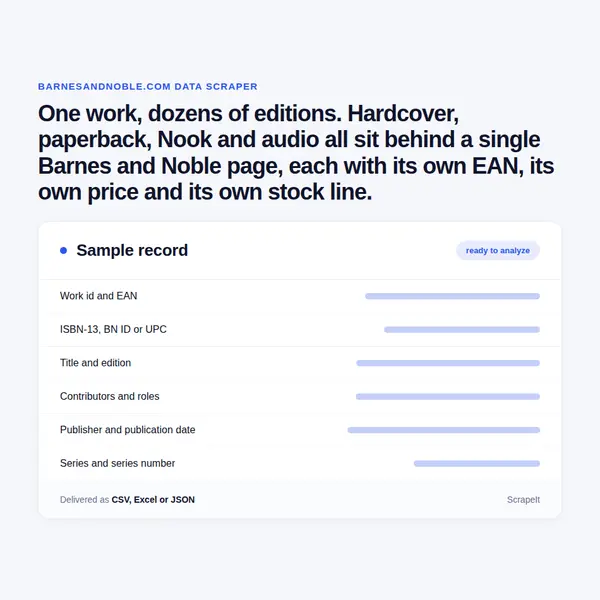
A Barnes and Noble scraper we run is a managed job, not a one-off export. You set the scope - an ISBN list, a publisher, a series, a subject tree or a whole department - and the cadence. We run the crawl, normalise the fields, diff each run against the last and deliver CSV, JSON, XLSX, a Google Sheet, an S3 or SFTP drop, or a REST API your systems poll on their own.
The storefront renders in the browser and opens its detail block only when a reader asks for it, so a crawler has to behave like a browser to see the fields at all. Rendering, anti-bot handling, proxy rotation and CAPTCHA solving are part of the service and stay our problem, not yours.
Change feeds usually beat full snapshots: we can send only the rows where price, availability, release date or promotion moved since the previous run, which keeps a daily file small enough to open in a spreadsheet.
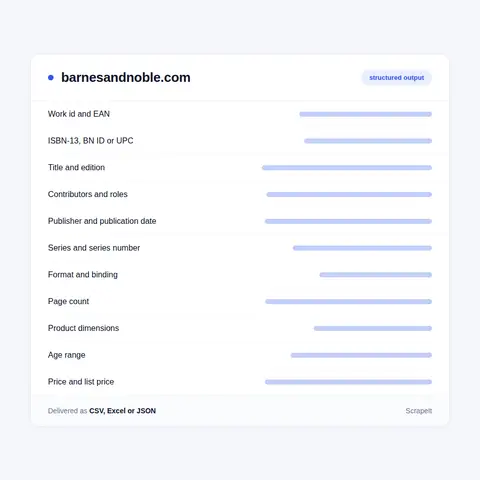
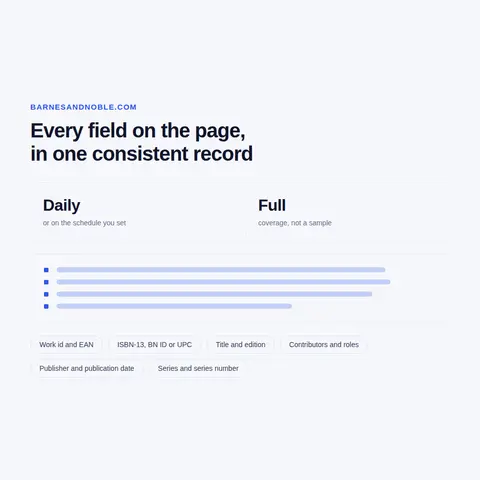
The fields below come off a Barnes and Noble product page by default, and the list is set per project. Labels are quoted as the page prints them, because those strings are what a parser matches.
Public catalogue and pricing pages only. We sign in to nothing, and no customer or reviewer personal data is collected.
Ranked lists are a separate entity from the catalogue and deserve their own schedule. There is a Bestsellers hub, bestseller lists per department, a New York Times list page, a hardcover fiction and nonfiction list drawn from what the shops themselves sell, and merchandising pages under /shop/ that read as editorial lists with prices attached. Rank is never printed on the tile: it is position in a list ordered by the catalogue's own sales rank attribute, so a list has to be captured in order, and captured again and again, before it turns into a time series.
Nook records differ from print in ways that matter downstream. A Nook edition has no page count and no dimensions, its identifier may be a house code rather than a publisher ISBN, and it sits under formats of its own - eBook, NOOK Exclusive, Special eBook Edition - while the audiobook of the same title prices independently inside the same product group.
Two habits of the site shape any Barnes and Noble scraping job. Listings extend with a Load More button instead of numbered pages, so depth comes from slicing by subject, format, price band, language and age, helped by sorts running Bestsellers, Top Matches, Newest to Oldest, Price: Low to High and Title: A to Z. And membership pricing is a footnote rather than a field: the page says Premium members save an extra ten percent, but it prints a single price, so a member price has to be derived. And every offer names Barnes and Noble itself as the seller. No third-party marketplace, no used or rental copies, no seller ratings to collect; the discount channel is the Book Annex shelf of remainders.
Barnes and Noble sells through bookshops across the United States and through barnesandnoble.com, where the whole assortment sits in one catalogue: print books, Nook ebooks, audiobooks, toys and games, stationery, vinyl, movies and magazines. The storefront runs on Shopify, so covers are served from the Shopify CDN and the crawl surface follows Shopify conventions.
Addresses are simple and stable. A work sits at /w/ plus a title-and-author slug plus a numeric work id, and one specific edition is chosen by adding the ean parameter with that edition's code. The work id groups editions; the ean identifies exactly one. Two generations of work id run side by side, an older eight-digit series and the ten-digit ids issued since, and both still resolve. Older contributor addresses under /b/contributor/ redirect to the newer /authors/ form, so archived links keep working.
Four kinds of hub sit around the product pages, and each is its own crawl target. The /collections/ tree holds departments and subjects, from books and the ebooks and Nook aisle down to audiobooks, toys and games, stationery, music, movies, the newsstand, clearance and the Book Annex bargain shelf. The /series/ pages list every title in a book series. The /authors/ pages carry a written biography plus that contributor's backlist. The /shop/ pages are merchandising lists with live prices attached. The sitemap index names all of them separately, which is how the catalogue gets enumerated without touching search.
Get a Quote
Developers

Customers worldwide

Pages extracted

Hours saved for our clients
€199 / one-time
setup fee - included
€169 / mo
setup fee €499
€229 / mo
setup fee €499
€349 / mo
setup fee €499
€549 / mo
setup fee €799
Delivery: CSV, JSON or XLSX files, our API or a JSON feed. MCP server on request.
Full plan details →The reason to scrape Barnes and Noble is the ISBN, and the reason it is harder than it looks is also the ISBN. Those digits identify the same edition at a publisher, a distributor, a library and every competing retailer, so a Barnes and Noble price row joins to your own catalogue with no fuzzy title matching. The catch is that the key describes an edition, not a book. One classic American novel sits behind a single work page with fifty separate editions under it - twenty-one paperbacks, fourteen hardcovers, fourteen audio editions and one ebook - each with its own ean, its own price and its own stock state, spread from under a dollar to forty-five. Compared title to title across two retailers that means nothing; compared ean to ean it means everything.
That is the shape of the request we get most often: put Barnes and Noble prices next to Amazon prices for the same ISBN list. It works edition by edition, and only if the format travels with the row, because a hardcover undercut and an audiobook undercut are different commercial facts.
House editions are the second reason. Barnes and Noble commissions its own printings with different covers, designed endpapers and bonus chapters, gives them their own ISBNs and files them under formats of their own. Those editions exist nowhere else, so they never surface in a rival feed, and any title-level comparison that ignores them is wrong in both directions.
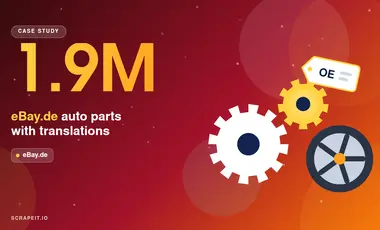
About 1.9 million auto parts listings from eBay.de with brand, OEM, EAN and fitment, plus titles and specs machine-translated for the client's team.
Learn More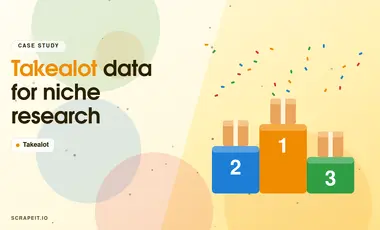
A one-off Takealot product list for an entrepreneur choosing niches: only products rated 4 stars or higher with at least 50 reviews.
Learn More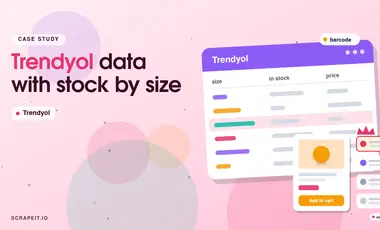
Trendyol product data for an e-commerce startup reselling Turkish fashion: 27 categories in JSON on FTP, with in-stock status for every size.
Learn MoreLearn how to use web scraping to solve data problems for your organization
If you sell online, run a marketplace, or advise e-commerce clients, you already know why eBay matters: it’s one of the few places where big retailers compete side by side with thousands of small merchants and private sellers.

E-commerce teams do not just need “some” competitor data anymore. They need a continuous stream of real prices, discounts, stock levels, reviews, and seller behavior from the platforms that actually shape their markets.
Amazon provides valuable information gathered in one place: products, reviews, ratings, exclusive offers, news, etc. So scraping data from Amazon will help solve the problems of the time-consuming process of extracting data from e-commerce.
ScrapeIt is a managed web scraping agency. We write the crawlers, host them, watch them and repair them when Barnes and Noble changes its markup, so nobody on your side keeps scraping code alive. Data arrives on a schedule, in the format your team already works with.
Scope, field list and delivery are agreed before the first run and can be changed later without a rebuild. Tell us which Barnes and Noble data you need and we will scope it.
Yes. The ScrapeIt Barnes and Noble API returns the ean, ISBN-13, format, selling price, list price and availability as JSON from an endpoint we host, refreshed on the schedule you set. Our crawlers read the public product, collection, series and author pages, and the same data also comes as CSV or XLSX files, a Google Sheet or straight into your database.
Yes, and most projects start that way. You send ISBNs or EANs, we resolve each one to its edition on the site, and we report back the codes with no match so your list stays honest. Editions are kept apart rather than collapsed: hardcover, paperback, large print, ebook and audio each come back as their own row with their own price, format and availability. Nook-only editions are flagged separately, because they can carry a house identifier instead of a publisher ISBN and will never match an ISBN list on their own.
No. A product page shows online availability - in stock and shipping in one to two days, out of stock online, or a dated pre-order line - and then asks the reader to select a store before it will say anything about shelves. That selection sits behind a store picker we do not drive, so what we deliver is online stock state, not per-branch counts. The same honesty applies to member pricing: the page states that Premium members take an extra ten percent off, but it prints a single price, so we deliver the published price and mark where a member discount is advertised.
Cadence is a scoping decision rather than a fixed number. Daily suits price and availability tracking, weekly or monthly suits catalogue and metadata work, and a short watchlist of ISBNs can run more often than a sweep of an entire department. Delivery is CSV, JSON, XLSX, a Google Sheet, an S3 or SFTP drop, or a REST API your systems poll, with an optional change feed that carries only the rows whose price, availability, release date or promotion moved since the run before.
Yes. We collect only publicly available data - catalogue, pricing, availability, editorial copy and aggregate ratings, everything a visitor can see on Barnes and Noble - and we collect it legally. We sign in to no account, we work around no geographic restriction, and we take no personal data - no reviewer identities, no customer details, nothing about staff. Crawling is paced so the site is never disturbed.
Step 1 - Make a Request
You share your needs, expectations, and desired timeframe. We’ll suggest the best solution based on your request and budget.
Step 2 - Configuring Custom Web Crawlers
Our specialists configure the crawlers and extract a sample dataset for your review before proceeding with the full-scale extraction.
Step 3 - Collect and Deliver
Once you approve the sample, we launch the project and start full data collection. We gather, filter, and structure the data for easy use, delivering it on time in your preferred format.
Step 4 - Maintain and Support
Our team manages ongoing processes, monitors website changes, and supports all data extraction cycles. We can also help integrate data into your systems or create dashboards to simplify analysis.
Barnes and Noble data from €169/month. Free project assessment, reply within 1 business day.

Scrapeit Sp. z o.o.
10/208 Legionowa str., 15-099, Bialystok, Poland
KRS: 0000996672
NIP: 5423457175
REGON: 523384582