The Entire Iherb Supplements Catalog, Captured End-to-End in 3 Days
Scraping supplement products from iHerb.com with full details, including descriptions and packaging variations.
Learn More
Listing and closet data from Poshmark, including sold records with sale dates, brand, size, condition and price history. Built, run and maintained by us.
Plans from €169/month · Free project assessment · Reply within 1 business day
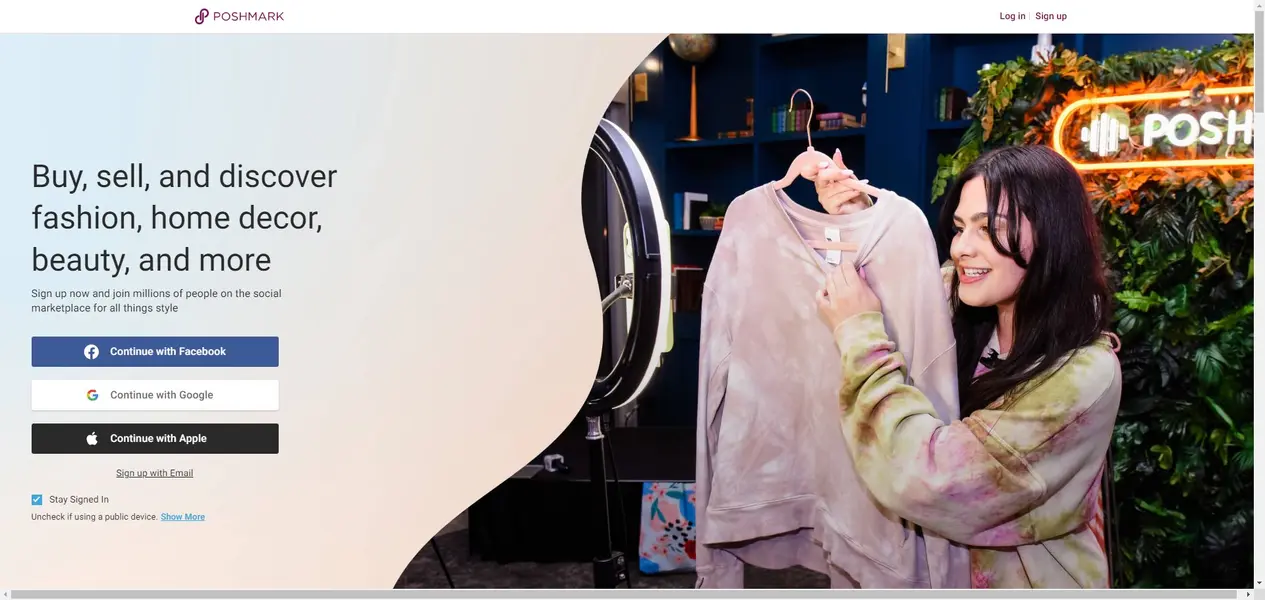
We scope the slice first: which categories, brands, sizes and price bands, and whether you need the available side, the sold side or both. Then we build the crawler, run it on your schedule and hand over CSV, JSON, XLSX or a hosted API endpoint.
Records are keyed on the listing identifier, so repeated runs deduplicate cleanly and every field change becomes a diff you can act on: a price drop, a relist, a status flip to sold. Poshmark sits behind a CDN with bot screening, so we run at a measured request rate, monitor response shape and re-run failed slices instead of pushing harder. Schema changes on their side are our maintenance problem, not yours.
Listing and closet pages are server-rendered by a Vue application, and the HTML carries the full record as a JSON state blob. One fetch of a listing page returns the same fields the app works from.
Closet pages add the seller side: post counts split into resale, retail and wholesale, follower and following counts, shipped order count, average ship time, five-star rating comment counts, last active date and vacation hold windows. They also return a facet block with per-brand, per-colour and per-size counts for that closet.
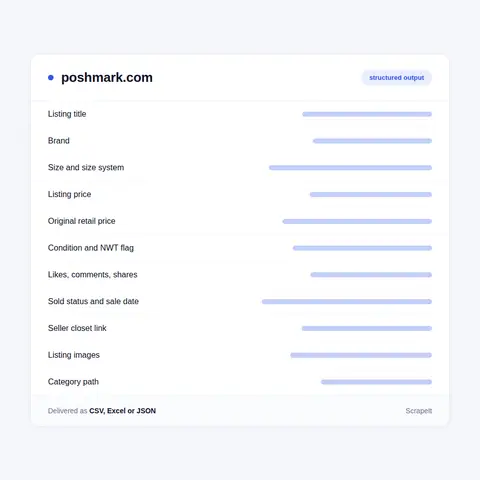
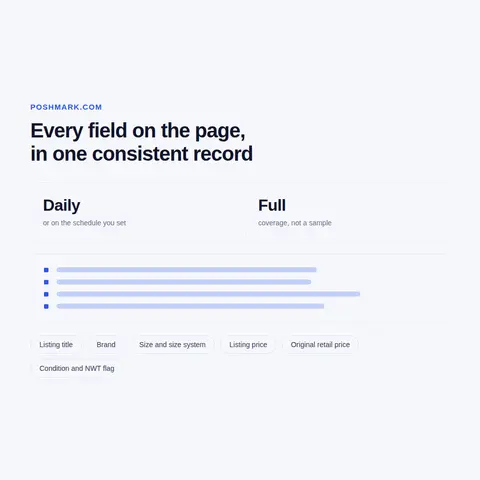
Sold listings stay addressable. The URL keeps working and the record keeps its price, original price, size, condition and engagement counts; the inventory status flips to sold out and a sale timestamp appears. Sold items are reachable through the availability filter on closet and category browse, next to available, dropping soon and not for sale.
Two limits matter. The price on a sold record is the last list price, not the amount paid: offers and bundle discounts are private, and the record shows only offer counts and flags. Items sold in a live Posh Show auction settle at a bid the listing record does not carry.
The default browse index holds available posts only, and a filtered result set reports a total capped at 5,000, paged with an opaque cursor at 48 listings per request. Facet counts still report the true size of the set, so covering a large category means slicing the query across brand, size, colour and price band rather than paging deeper.
On personal data: listings are attached to named individuals, and a closet profile can carry a real name, city, state, a linked social handle and a photo. Output is limited to listing and commercial fields. Seller usernames can be pseudonymised with a stable hash or dropped entirely, and profile text and images excluded at the schema level. US state privacy law, starting with the California Consumer Privacy Act, treats identifiers tied to a natural person as personal information. We collect only publicly available data - everything a visitor can see on Poshmark - and we collect it legally.
Poshmark is a peer-to-peer fashion resale marketplace in the United States and Canada. Every seller has a closet, every listing belongs to exactly one closet, and there is no shared product catalogue: two sellers listing the same jacket create two unrelated records. A closet lives at poshmark.com/closet/{username}, with an about-me page under the same path.
A listing URL ends in a 24-character hexadecimal identifier, as in /listing/Colorful-Floral-Hat-695378941986c22fab87a63b. The words in front are a slug Poshmark regenerates from the title, so the identifier alone is stable. The first four bytes of that identifier are a Unix timestamp: decode them and you have the listing creation time, to the second, before fetching anything.
Browse paths are built from the catalogue tree. Categories sit at /category/Women-Jeans and /category/Electronics-Cameras,_Photo_&_Video-Bags_&_Cases, with spaces written as underscores and facets appended after a double hyphen, as in /category/Electronics--color-Black. Brand pages follow /brand/{Brand} and take the same department, category and sub-category suffixes. Search takes query, department, category and sub_category, repeated brand[], size[] and color[] parameters, price bands such as price[]=50-100, plus condition and sort_by.
Poshmark has been a Naver subsidiary since January 2023 and no longer reports as a public company, so platform-level metrics are not published. The UK, India and Australia marketplaces closed on 2 November 2023. The US site and poshmark.ca, priced in Canadian dollars, remain.
Get a Quote
Developers

Customers worldwide

Pages extracted

Hours saved for our clients
€199 / one-time
setup fee - included
€169 / mo
setup fee €499
€229 / mo
setup fee €499
€349 / mo
setup fee €499
€549 / mo
setup fee €799
Delivery: CSV, JSON or XLSX files, our API or a JSON feed. MCP server on request.
Full plan details →Resale pricing has no list price to anchor to. What a leather tote or a pair of straight-leg jeans is worth this month is whatever closets have actually cleared it for, and that number moves with season, size and condition. The sold side of Poshmark stays publicly addressable, which makes it worth measuring rather than estimating.
Two timestamps on a sold record, first published and the moment the last unit was reserved, give days to sale for that exact item. Run it across a brand and a full size run and you get a sell-through curve instead of an anecdote: which sizes clear in a week, which sit for a year, which condition grade carries a premium and how large that premium is.
The original retail price and the seller's first asking price sit on the same record as the current price, so discount depth off retail and the seller's own markdown path are both computable from a single fetch. For a brand team that is a read on where secondary pricing has settled relative to full price. For a reseller or an aggregator it is sourcing input: what to buy, at what cost, in which size.
Closet aggregates separate a hobby seller from an operation running hundreds of shipments, which matters when you are sizing a category or picking supply partners.

Scraping supplement products from iHerb.com with full details, including descriptions and packaging variations.
Learn More
Daily scraping of lowest prices for 150K products on Allegro.pl to support marketplace pricing and margin optimization.
Learn More
Regular monitoring of Ralph Lauren clothing, footwear, and accessories sold across Amazon subdomains: AE, DE, ES, FR, IT, NL, PL, UK.
Learn MoreLearn how to use web scraping to solve data problems for your organization
If you sell online, run a marketplace, or advise e-commerce clients, you already know why eBay matters: it’s one of the few places where big retailers compete side by side with thousands of small merchants and private sellers.

E-commerce teams do not just need “some” competitor data anymore. They need a continuous stream of real prices, discounts, stock levels, reviews, and seller behavior from the platforms that actually shape their markets.
Amazon provides valuable information gathered in one place: products, reviews, ratings, exclusive offers, news, etc. So scraping data from Amazon will help solve the problems of the time-consuming process of extracting data from e-commerce.
ScrapeIt is a managed scraping team. We write the crawler, host it, watch it and repair it when the site changes, and you receive data on a schedule in a format your systems already read. No infrastructure on your side, no proxy accounts, no maintenance backlog. If a slice turns out to be unreachable, or a field you asked for is not public, we say so during scoping rather than after the build.
Yes. Sold listings keep their URL and their full record, and both closet and category browse expose an availability filter for sold-out items. Each sold record carries the last list price, the original retail price, size, condition, engagement counts and a sale timestamp. One caveat we state up front: that price is the last list price, not necessarily the amount paid, because accepted offers are private between buyer and seller.
By the 24-character hexadecimal identifier at the end of the listing URL. The slug in front of it is regenerated when a seller edits the title, so it is not a stable key and we ignore it. The first four bytes of the identifier decode to a Unix timestamp equal to the listing creation time, which gives an independent check on listing age and on relisted inventory.
Yes. poshmark.ca uses the same page structure and the same identifier format, prices in Canadian dollars, and every listing record names an origin domain and a set of destination domains that separate US supply from Canadian. The UK, India and Australia marketplaces closed on 2 November 2023, so no current data exists there to collect.
Closet pages can carry a real name, a city and state, a linked social handle and a profile photo, so we treat the seller side as personal data by default and ship listing and commercial fields only. Seller usernames can be replaced with a stable pseudonymous hash or removed, and profile text and images excluded from the schema. Tell us the constraint and we build to it.
Yes. The ScrapeIt Poshmark API returns the listing identifier, current asking price, original retail price, size, condition and inventory status as JSON from an endpoint we host, refreshed on the schedule you set. The same data also comes as CSV or XLSX files or straight into your database. A filtered browse query pages to a capped depth, so a broad category is covered by splitting it across brand, size, colour and price band and merging the results on the listing identifier. Facet counts tell us the true size of each slice, so the split can be planned rather than guessed. We size it during scoping and give you the achievable coverage before the build starts.
Step 1 - Make a Request
You share your needs, expectations, and desired timeframe. We’ll suggest the best solution based on your request and budget.
Step 2 - Configuring Custom Web Crawlers
Our specialists configure the crawlers and extract a sample dataset for your review before proceeding with the full-scale extraction.
Step 3 - Collect and Deliver
Once you approve the sample, we launch the project and start full data collection. We gather, filter, and structure the data for easy use, delivering it on time in your preferred format.
Step 4 - Maintain and Support
Our team manages ongoing processes, monitors website changes, and supports all data extraction cycles. We can also help integrate data into your systems or create dashboards to simplify analysis.
Poshmark data from €169/month. Free project assessment, reply within 1 business day.

Scrapeit Sp. z o.o.
10/208 Legionowa str., 15-099, Bialystok, Poland
NIP: 5423457175
REGON: 523384582