Grainger Data: 3 MRO Catalogs with UNSPSC, 250K Products from Cromwell
Full MRO catalogs from Grainger, Fastenal and Cromwell for a product content company: UNSPSC, EAN, every attribute and a taxonomy sheet.
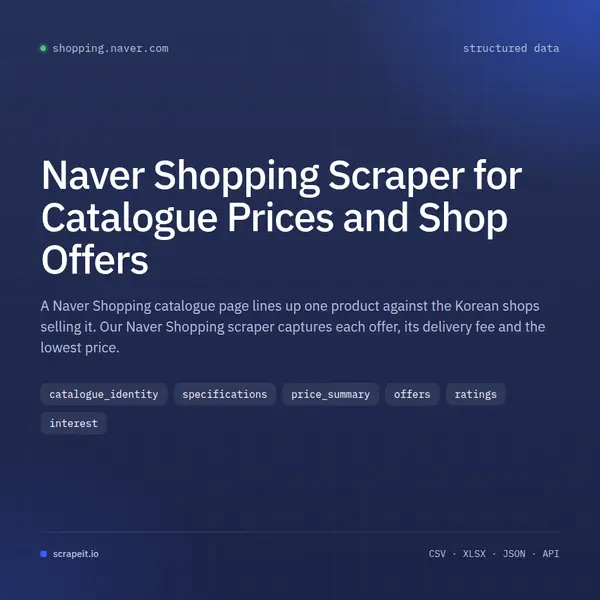
A Naver Shopping catalogue page lines up one product against the Korean shops selling it. Our Naver Shopping scraper captures each offer, its delivery fee and the lowest price.
Plans from €169 a month · Free project assessment · Reply within 1 business day
CSV · Excel · JSON · XML · FTP · SFTP · Amazon S3 · Google Cloud
API, JSON feed or CSV, XLSX and JSON files
ScheduleOne-time, monthly, weekly, daily or 3 times a day
Naver Shopping pages, filters, fields and a schedule
Built, monitored and repaired by our team
API, JSON feed or CSV, XLSX and JSON files
We run Naver Shopping crawling for you; you receive data, not a tool. Tell us the keywords, categories, catalogue ids, brands or Smart Store shops and how often, and we build the crawlers, run them on a daily, weekly or on-demand schedule and fix them when Naver changes its pages. Naver is quick to block automated traffic, so pacing, proxy rotation, rendering and CAPTCHA handling are part of the service.
Each delivery comes with field documentation and lands as CSV, XLSX or JSON, through our API, on SFTP or in Amazon S3. A sample comes first and the project assessment is free; plans start from EUR 169 a month, or EUR 199 for a one-time extract.
Naver Shopping rests on the catalogue page: one product, one numeric catalogue id in the address, and every shop that sells it gathered underneath. We read that page as a product record plus one row per offer, so the lowest price and the shops behind it stay linked.
The offer list can be ordered by lowest price or by popularity, with or without delivery fees and card discounts; we record the price both ways. Search result pages return a lighter version of the record - title, price, delivery fee, category path, review count, registration date, shop name, store grade and points rate - which is how a crawl finds catalogues before opening them. Korean text stays exactly as Naver prints it, in UTF-8, with English column names in the documentation.
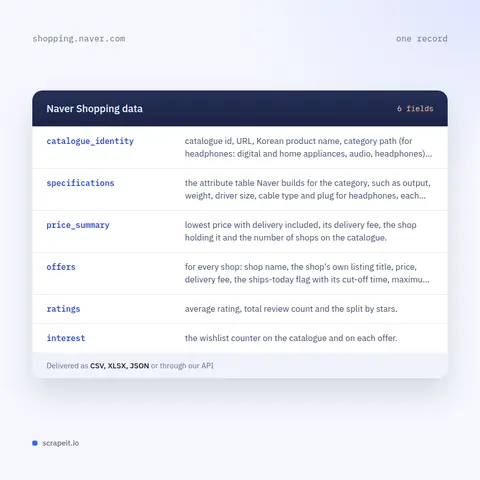
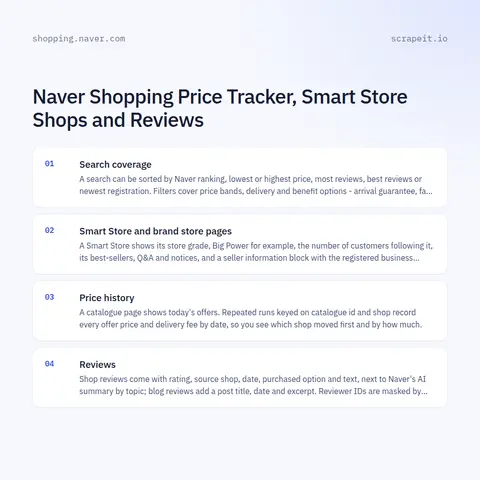
The catalogue page is where the price sits. Around it, Naver Shopping has four more layers worth collecting.
Naver Shopping is the commerce side of Naver, the Korean search portal, and it is really two services under one name. Naver price comparison, at search.shopping.naver.com, gathers products from shops across the Korean web and groups identical items into catalogue pages. The Naver Plus Store, at shopping.naver.com, is where Naver's own sellers trade: Smart Store shops at smartstore.naver.com and brand stores, paid with Naver Pay.
The two meet in search. One query returns catalogue cards that bundle many shops, single offers from Smart Stores, and listings from open markets, department stores and home shopping, duty-free, overseas and SOHO malls, with filters that pull them apart. Around that core sit Fashion Town, Naver Shopping Live for live commerce, arrival-guaranteed delivery, and the Naver Plus membership subscription, whose badge sits next to many shops in the offer list.
Everything is in Korean: product names, categories, badges and reviews. Prices are in won and shown next to a delivery fee, so we keep the delivered price as a column of its own rather than adding it up afterwards.
Delivery: CSV, JSON or XLSX files, our API or a JSON feed. MCP server on request.
Full plan detailsA catalogue page puts the same product from dozens of shops on one list, ordered by price with delivery included. For anyone selling in Korea, that list is the comparison the customer actually makes.
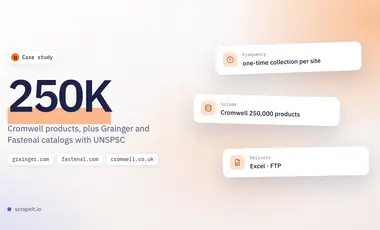
Full MRO catalogs from Grainger, Fastenal and Cromwell for a product content company: UNSPSC, EAN, every attribute and a taxonomy sheet.
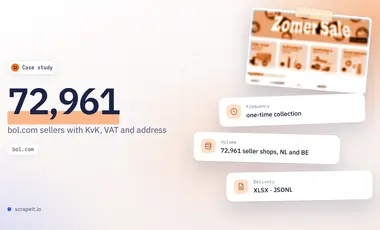
Every seller shop on bol.com with its trade name, business address, KvK and VAT number, collected once: 72,961 shops in 18 days.
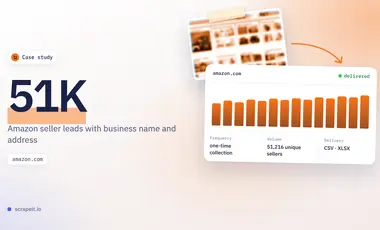
A one-time B2B lead file from Amazon seller profiles: 51,216 sellers with business name and address, 13,366 of them in the US and Canada.
Learn how to use web scraping to solve data problems for your organization
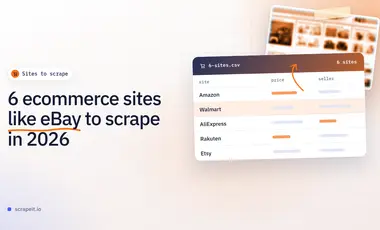
If you sell online, run a marketplace, or advise e-commerce clients, you already know why eBay matters: it’s one of the few places where big retailers compete side by side with thousands of small merchants and private sellers.
E-commerce teams do not just need “some” competitor data anymore. They need a continuous stream of real prices, discounts, stock levels, reviews, and seller behavior from the platforms that actually shape their markets.
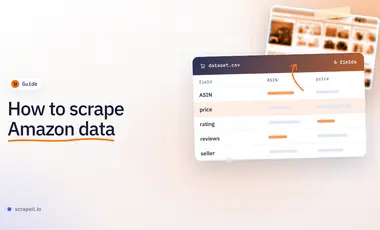
Amazon provides valuable information gathered in one place: products, reviews, ratings, exclusive offers, news, etc. So scraping data from Amazon will help solve the problems of the time-consuming process of extracting data from e-commerce.

ScrapeIt is a managed web scraping service: we build, run and maintain the crawlers and deliver the dataset. Price comparison sites like Naver Shopping suit that model, because the value sits in the joins - catalogue to offer, offer to shop, shop to grade - and in collecting them again on schedule. Shops on Naver are businesses and come with their names and ratings; reviewer IDs stay out by default, and GDPR governs any personal data we touch.
Still unsure? Write to info@scrapeit.io
Yes. The ScrapeIt Naver Shopping API returns catalogue id, product name, lowest price with delivery, shop name, offer price and review count as JSON from an endpoint we host, refreshed at the frequency you choose. Excel or CSV files, a JSON feed and a load into your database are available too.
Yes. Catalogue pages, offers, delivery fees, ratings and Smart Store shop pages are open to any visitor without signing in. We collect only publicly available data - everything a visitor can see on Naver Shopping - and we collect it legally. Masked reviewer IDs are left out by default.
Yes. A project can start from catalogue ids, from keywords or from a list of Smart Store and brand store addresses. For a shop we collect its store grade, follower count and products with price, discounted price, sale status and review count, and link a product to its catalogue where it appears there as an offer.
We keep the Korean text exactly as Naver shows it - product names, category paths, badges and review text - in UTF-8, and document every column in English. Prices stay numbers in won, with the delivery fee in a separate column.
Offers change whenever a shop edits its price, coupon or delivery fee, and the catalogue's lowest price follows the cheapest of them. Daily runs suit most price monitoring; campaign periods and fast-moving categories can be collected several times a day.
You share your needs, expectations, and desired timeframe. We'll suggest the best solution based on your request and budget.
Our specialists configure the crawlers and extract a sample dataset for your review before proceeding with the full-scale extraction.
Once you approve the sample, we launch the project and start full data collection. We gather, filter, and structure the data for easy use, delivering it on time in your preferred format.
Our team manages ongoing processes, monitors website changes, and supports all data extraction cycles. We can also help integrate data into your systems or create dashboards to simplify analysis.
Tell us which sites, which fields and how often. A couple of lines is enough to start.
Naver Shopping data from €169/month. Free project assessment, reply within 1 business day.