Grainger Data: 3 MRO Catalogs with UNSPSC, 250K Products from Cromwell
Full MRO catalogs from Grainger, Fastenal and Cromwell for a product content company: UNSPSC, EAN, every attribute and a taxonomy sheet.
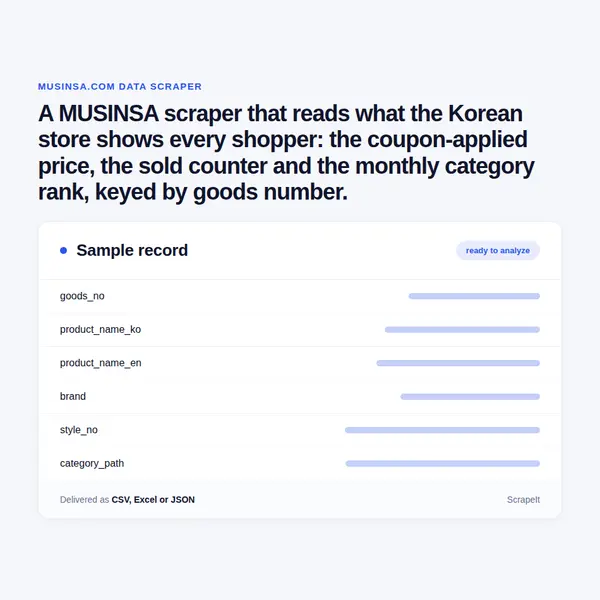
A MUSINSA scraper that reads what the Korean store shows every shopper: the coupon-applied price, the sold counter and the monthly category rank, keyed by goods number.
Plans from €169 a month · Free project assessment · Reply within 1 business day
CSV · Excel · JSON · XML · FTP · SFTP · Amazon S3 · Google Cloud
API, JSON feed or CSV, XLSX and JSON files
ScheduleOne-time, monthly, weekly, daily or 3 times a day
MUSINSA pages, filters, fields and a schedule
Built, monitored and repaired by our team
API, JSON feed or CSV, XLSX and JSON files
You tell us what to cover - whole categories by their numeric codes, a list of brands, the ranking boards, the KICKS or BOUTIQUE store, or a fixed set of goods numbers - and how often. We build the crawlers, run them and repair them when MUSINSA reworks a page. The site is Korean-language and heavily scripted, and the price a shopper pays only appears once coupons are applied, so rendering, pacing, proxy rotation and CAPTCHA handling are part of the service.
Every row carries the goods number, the store it came from and the time it was read. Korean labels arrive with an English gloss next to the original, and field documentation comes with the first delivery.
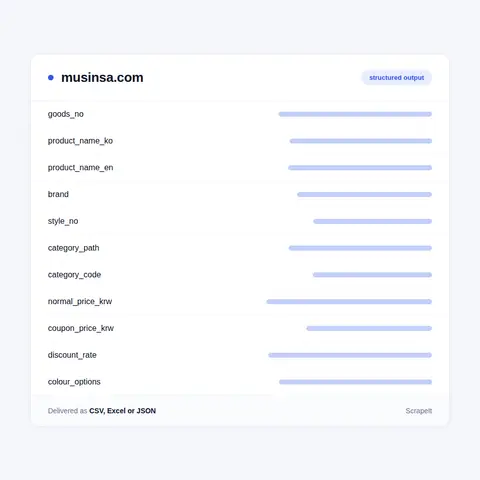
The key is the goods number: a MUSINSA product lives at musinsa.com/products/ followed by digits, and that number stays with the item through price changes, sell-outs and restocks. Around it the product page shows the Korean product name with an English alternate name, the brand in Hangul and Latin script, and the style number the brand assigns (제품번호, product number).
Category and brand listings show brand, name, discount, price, rating and review count on every card, so a feed can start from a category code, a brand page or a search term and then go deep on the goods that matter.
The 랭킹 (ranking) board is where MUSINSA shows demand. It has three tabs - products, brands and search keywords - and can be cut by gender, age group and period, from real time upward. A daily archive and a monthly ranking archive keep past boards by date and category, so brand ranking and search keyword ranking can be read as a series rather than a snapshot.
Category listings return sixty goods a page under the MUSINSA recommended sort, with quick filters for exclusives, a rating of 4.5 and above, coupons, time sales and lowest price, plus colour, material, fit, size and price filters. Separate tabs list the brands and the snaps for the same category.
Reviews come with the star rating and text, and MUSINSA adds an AI summary of them on the product page. Reviewer nicknames and any personal details stay out by default.
Repeated runs on the same goods numbers turn the price columns into price history: every coupon, sale and quiet price increase gets a date.
MUSINSA began as an online sneaker community in Korea and is now a fashion store built around Korean labels, imported brands and its own lines, led by MUSINSA STANDARD. Prices are in KRW and the interface is Korean, and that is where prices after coupons, stock by option and rank badges are read.
musinsa.com is not one storefront but several under one header: the main MUSINSA store, BOUTIQUE for imported designer labels, KIDS, OUTLET, SPORTS, BEAUTY, KICKS for sneakers, and USED, a second-hand market where individual and business sellers are marked apart. Most stores share the same set of tabs - 추천 (recommended), 랭킹 (ranking), 세일 (sale) and 발매 (release) - so the same crawl logic covers each one with its own scope.
Outside Korea, MUSINSA GLOBAL runs regional storefronts for markets in Asia, North America and Oceania, among them Japan, Singapore, Thailand, the United States, Canada and Australia; the US store prices in USD. Comparing MUSINSA Korea prices with a global storefront means matching the same goods on both sides.
Delivery: CSV, JSON or XLSX files, our API or a JSON feed. MCP server on request.
Full plan detailsOn MUSINSA, placement shows up in the fields themselves. The monthly rank badge and the ranking board tell a brand manager whether a drop held its place against rivals in the same category code; the sold counter and review count show whether it actually sold.
Pricing teams watch the gap between the normal price and the coupon-applied price, because that gap is where MUSINSA promotions happen. Tracking MUSINSA STANDARD in the same table gives a benchmark for basics, so a label's price can be read against the store's own line.
Category filters let an analyst read the MUSINSA price range of a segment - lightweight padding, wide denim, running shoes - and see which brands sit at each level. The search keyword ranking shows what shoppers type before it shows up in sales.
Cross-border resellers compare MUSINSA Korea prices with what the global storefronts and other markets charge for the same goods, and use the restock and sold-out flags to time their buying.
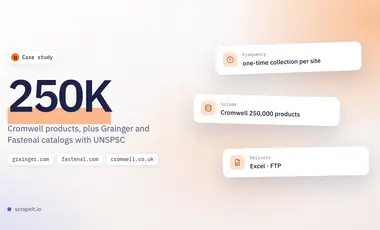
Full MRO catalogs from Grainger, Fastenal and Cromwell for a product content company: UNSPSC, EAN, every attribute and a taxonomy sheet.
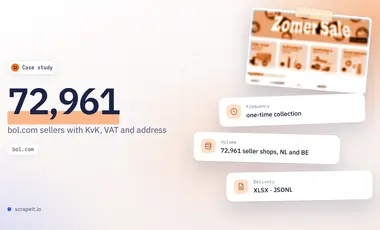
Every seller shop on bol.com with its trade name, business address, KvK and VAT number, collected once: 72,961 shops in 18 days.
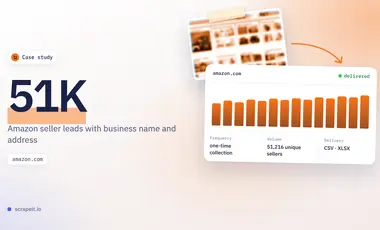
A one-time B2B lead file from Amazon seller profiles: 51,216 sellers with business name and address, 13,366 of them in the US and Canada.
Learn how to use web scraping to solve data problems for your organization
If you sell online, run a marketplace, or advise e-commerce clients, you already know why eBay matters: it’s one of the few places where big retailers compete side by side with thousands of small merchants and private sellers.
E-commerce teams do not just need “some” competitor data anymore. They need a continuous stream of real prices, discounts, stock levels, reviews, and seller behavior from the platforms that actually shape their markets.
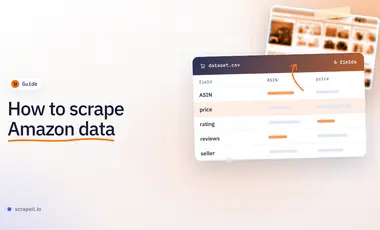
Amazon provides valuable information gathered in one place: products, reviews, ratings, exclusive offers, news, etc. So scraping data from Amazon will help solve the problems of the time-consuming process of extracting data from e-commerce.

ScrapeIt is a managed web scraping service: we build, run and maintain the crawlers and deliver the data as files or through our API. Korean fashion stores are a good fit for that model - Korean labels, coupon-driven prices and ranking boards that change through the day. You choose the stores, categories and fields; we start with a free project assessment and a sample from your own scope.
Still unsure? Write to info@scrapeit.io
Yes. The ScrapeIt MUSINSA API returns the goods number, brand, coupon-applied price, discount rate, review count and category rank as JSON from an endpoint we host, refreshed on the schedule you choose. The same rows come as CSV or XLSX files, a JSON feed or a load into your database.
Yes. Product pages, prices, ranking boards and review scores on MUSINSA are open to any visitor without an account. We collect only publicly available data - everything a visitor can see on MUSINSA - and we collect it legally. Reviewer nicknames are left out by default and personal data is handled under GDPR.
Yes. We read the normal price, sale price and coupon-applied price for each goods number on every run and keep the dated values, so a MUSINSA price tracker shows each increase, markdown and coupon window. MUSINSA STANDARD can be tracked as a whole brand or as a list of core items.
The ranking board can be viewed in real time and is archived daily and monthly, and coupon and time-sale prices move within a day. Most clients run price and ranking crawls daily; review counts and assortment are usually enough weekly.
Yes. Each store on musinsa.com is scoped separately, and USED listings are marked as coming from an individual or a business seller. Regional MUSINSA GLOBAL storefronts are crawled in their own currency and matched to Korean goods where the same item appears on both.
You share your needs, expectations, and desired timeframe. We'll suggest the best solution based on your request and budget.
Our specialists configure the crawlers and extract a sample dataset for your review before proceeding with the full-scale extraction.
Once you approve the sample, we launch the project and start full data collection. We gather, filter, and structure the data for easy use, delivering it on time in your preferred format.
Our team manages ongoing processes, monitors website changes, and supports all data extraction cycles. We can also help integrate data into your systems or create dashboards to simplify analysis.
Tell us which sites, which fields and how often. A couple of lines is enough to start.
MUSINSA data from €169/month. Free project assessment, reply within 1 business day.