Grainger Data: 3 MRO Catalogs with UNSPSC, 250K Products from Cromwell
Full MRO catalogs from Grainger, Fastenal and Cromwell for a product content company: UNSPSC, EAN, every attribute and a taxonomy sheet.
Rakuma keeps sold-out items on view with the price they went for. Our Rakuma scraper collects live listings from fril.jp with condition and shipping, and sold ones with their final price.
Plans from €169 a month · Free project assessment · Reply within 1 business day
CSV · Excel · JSON · XML · FTP · SFTP · Amazon S3 · Google Cloud
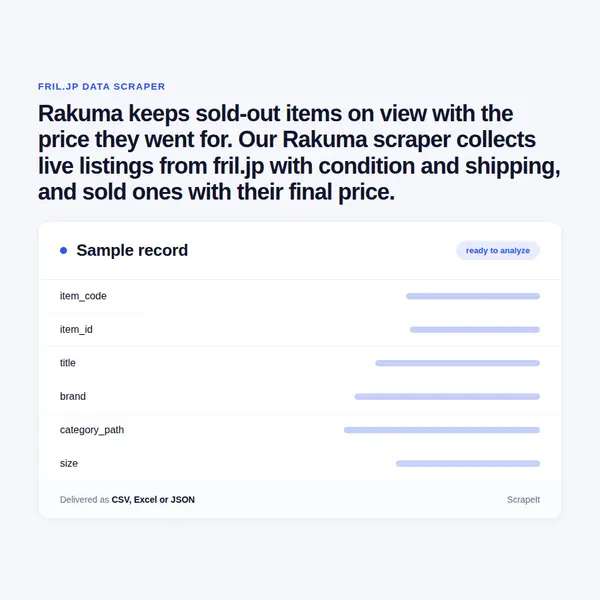
API, JSON feed or CSV, XLSX and JSON files
ScheduleOne-time, monthly, weekly, daily or 3 times a day
Rakuma pages, filters, fields and a schedule
Built, monitored and repaired by our team
API, JSON feed or CSV, XLSX and JSON files
You tell us what to follow on Rakuma - brands, categories, keywords or price bands - and we write the crawlers, operate them and repair them when fril.jp changes its pages. Nothing to install and no Japanese needed on your side: anti-bot handling, pacing, proxy rotation and rendering are part of the service.
Labels arrive in two forms. Every fixed value keeps the platform's Japanese wording, such as 送料込 or 新品、未使用, with an English code beside it, so a filter works without a translator. Prices become integers in JPY, relative posting times such as 11分前 (11 minutes ago) become timestamps at collection, and each row keeps the item code from its address. Collection can be a single extract or a daily, weekly or on-demand schedule, and a free assessment and a sample open every project.
A Rakuma item page is short and fully labelled, which suits a fixed schema. It lives at item.fril.jp followed by a 32-character code, and the same page carries a numeric item id; we keep both. Fields below are given in Rakuma's Japanese with an English gloss.
Search and category cards repeat title, brand and price, so a wide crawl starts from them and opens item pages only where the full field set is wanted. A sold page keeps title, brand, category, price and the seller rating but drops condition and shipping, so those fields are captured while the item is live.
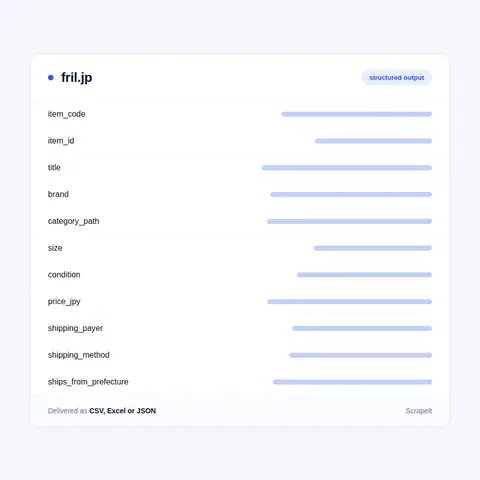
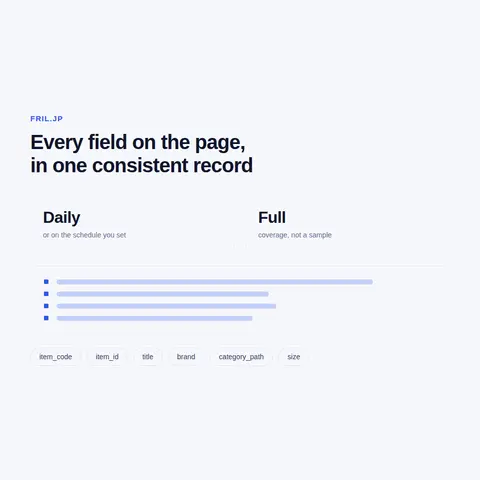
Rakuma does not hide what has already sold. An item that finds a buyer keeps its page, its price and a SOLD OUT stamp, and search results mix live and sold items unless the 販売中のみ (for sale only) box is ticked. Sold prices are therefore read directly, not estimated.
The platform also publishes 相場価格情報 (market price information): a page per brand and per category with a recent selling price range and a list of recently sold items. We collect it as a second layer beside the listings.
Sellers are often private persons, so their nicknames, profile texts and photos stay out of the dataset by default; ラクマ公式ショップ (official shops) are businesses and keep their shop names.
Rakuma is the flea market app of Rakuten Group in Japan. It grew out of two services - Fril, run by Fablic, and Rakuten's own first Rakuma - which merged in February 2018 under the Rakuma name, with the merged app running on Fril's system. That history explains the addresses: the web version still runs on fril.jp, items sit on item.fril.jp, and the app is listed as ラクマ (旧フリル), Rakuma, formerly Fril.
The site is in Japanese and every price is in yen. Members list new and used goods, which category pages split into 新品 (new) and 中古 (used): fashion for women, men and children, smartphones and home appliances, cameras, games, talent goods and toys, cosmetics, and even vegetables, fruit and tea under food and drink. Each category and brand has a numeric id in its address, as in /category/10001 or /brand/149, and brand names appear in Latin letters with their katakana reading, as in ZARA (ザラ).
Items, prices, seller ratings and sold pieces can be browsed on the web by anyone; buying, liking and commenting need a Rakuten ID, and item pages show the Rakuten points a purchase would earn.
Delivery: CSV, JSON or XLSX files, our API or a JSON feed. MCP server on request.
Full plan detailsJapan's second-hand trade sets prices in public, item by item, and Rakuma shows the outcome next to the asking price. What clients use Rakuma datasets for:
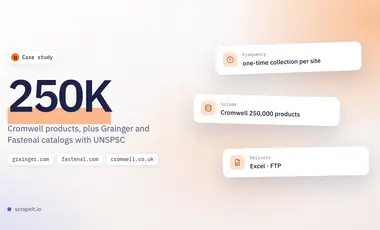
Full MRO catalogs from Grainger, Fastenal and Cromwell for a product content company: UNSPSC, EAN, every attribute and a taxonomy sheet.
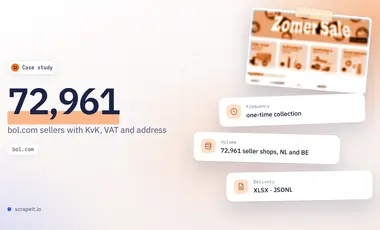
Every seller shop on bol.com with its trade name, business address, KvK and VAT number, collected once: 72,961 shops in 18 days.
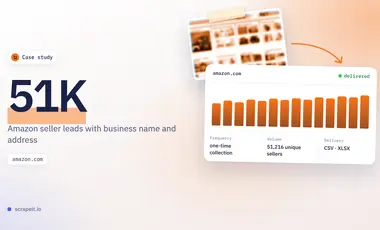
A one-time B2B lead file from Amazon seller profiles: 51,216 sellers with business name and address, 13,366 of them in the US and Canada.
Learn how to use web scraping to solve data problems for your organization
If you sell online, run a marketplace, or advise e-commerce clients, you already know why eBay matters: it’s one of the few places where big retailers compete side by side with thousands of small merchants and private sellers.
E-commerce teams do not just need “some” competitor data anymore. They need a continuous stream of real prices, discounts, stock levels, reviews, and seller behavior from the platforms that actually shape their markets.
Amazon provides valuable information gathered in one place: products, reviews, ratings, exclusive offers, news, etc. So scraping data from Amazon will help solve the problems of the time-consuming process of extracting data from e-commerce.

We are ScrapeIt, a managed web scraping service: we build, run and maintain the crawlers, and you receive the data. For a Japanese marketplace like Rakuma that means we deal with the language, the yen formats and the relative timestamps, and you get tables your analysts can read. Plans start from EUR 169 a month, or EUR 199 for a one-time extract. Field documentation comes with every dataset, seller nicknames stay out by default, and we process personal data under GDPR.
Still unsure? Write to info@scrapeit.io
Yes. The ScrapeIt Rakuma API returns item id, title, brand, price in JPY, condition grade, shipping terms and the SOLD OUT status as JSON from an endpoint we host, refreshed on the schedule you set. The same rows also come as CSV or Excel files, a JSON feed or a load into your database.
Yes. Item pages, sold-out items, seller rating counts and the market price pages are open to any visitor of fril.jp without a Rakuten ID. We collect only publicly available data - everything a visitor can see on Rakuma - and we collect it legally. Seller nicknames and profile texts are personal data and are left out by default.
Yes, as far as the site shows them. Each item page carries the seller's good, neutral and bad counts, and each shop has a public review page with the latest rating comments, split into ratings received as seller and as buyer. We deliver the counts, the rating label, the comment and its date; reviewer names stay out by default.
Daily for most projects. Each listing sells once and then switches to SOLD OUT, and the sold page keeps price, brand and category but no longer shows condition or shipping, so a daily run records those while the item is live and dates the sale. Fast categories such as trading cards and talent goods can run several times a day.
Yes. Fixed values - condition grade, who pays shipping, shipping method, prefecture - arrive in Japanese with an English code next to them, and categories and brands keep their numeric ids. Titles and descriptions stay exactly as the seller wrote them, so nothing is lost in translation.
You share your needs, expectations, and desired timeframe. We'll suggest the best solution based on your request and budget.
Our specialists configure the crawlers and extract a sample dataset for your review before proceeding with the full-scale extraction.
Once you approve the sample, we launch the project and start full data collection. We gather, filter, and structure the data for easy use, delivering it on time in your preferred format.
Our team manages ongoing processes, monitors website changes, and supports all data extraction cycles. We can also help integrate data into your systems or create dashboards to simplify analysis.
Tell us which sites, which fields and how often. A couple of lines is enough to start.
Rakuma data from €169/month. Free project assessment, reply within 1 business day.