The Entire Iherb Supplements Catalog, Captured End-to-End in 3 Days
Scraping supplement products from iHerb.com with full details, including descriptions and packaging variations.
Learn More
Plans from €169/month · Free project assessment · Reply within 1 business day
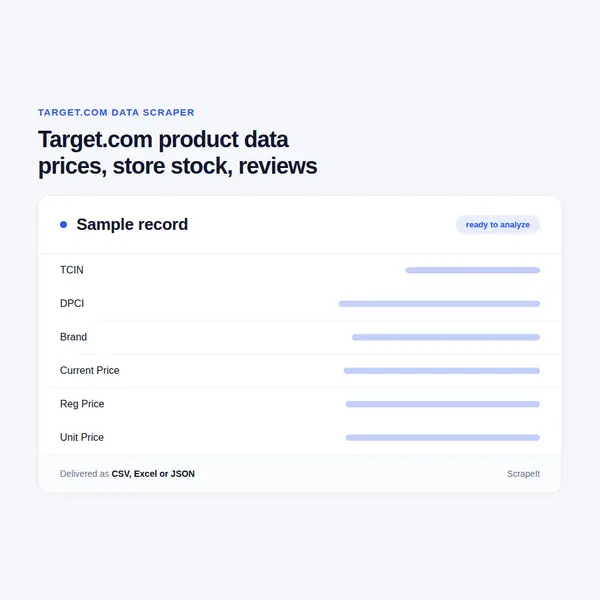
You send a category, a store list or a set of TCINs and the fields you want. We build the crawlers, run them on your schedule, and repair them when Target restructures a category page or changes the markup behind it. You get CSV, JSON, XLSX, an API feed or a direct write into your database. Target is hard to collect at scale - dynamic rendering, store-scoped requests and firm rate limits - and that stays our problem, not yours.
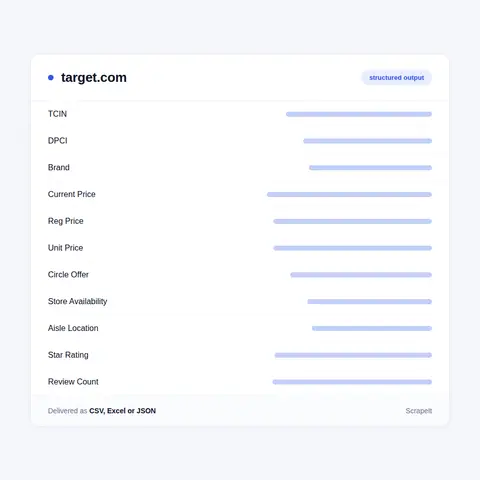
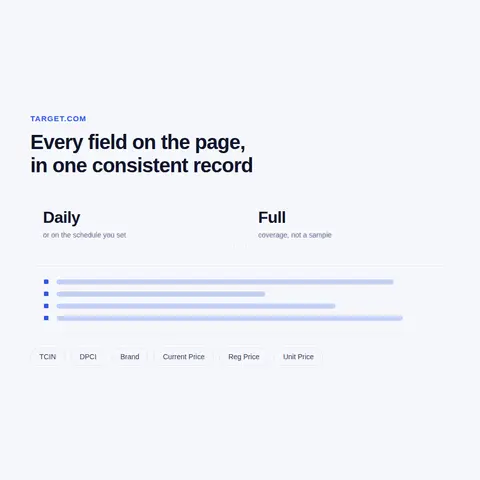
Some of the most useful Target fields are the ones the page does not put in front of you. DPCI carries the department and class prefix, so a feed can be rolled up by department without any category mapping of your own. Parent and child TCIN relationships let you rebuild a full size and color grid rather than a list of loose SKUs. Unit price makes grocery and household essentials comparable across pack sizes, and the aisle string ties an online record back to a physical shelf.
The derived signals are what most Target feeds are bought for. We can timestamp every price change so you get a markdown history rather than a snapshot, track clearance depth as an item is stepped down, flag the moment a listing switches between Target owned and Target Plus fulfillment, record how long a TCIN stays out of stock in a given store, and separate syndicated manufacturer reviews from reviews written on target.com. Where the Circle offer text on the page disagrees with the price actually shown, both are logged side by side.
Target is a general merchandise retailer that trades in a single market: the United States. Target.com is its one storefront, listings are in English and every price is in USD, so there is no country or language matrix to reconcile. The assortment runs from grocery and household essentials to apparel, beauty, home, electronics, toys, baby gear and seasonal ranges, and it mixes national brands with Target owned labels such as Good & Gather, Up&Up, Cat & Jack, Threshold, Room Essentials, Opalhouse, All in Motion, Universal Thread and Goodfellow & Co.
Two things complicate a catalog that sounds simple. Target Plus, the marketplace, adds partner listings that sit beside owned inventory and are labeled as sold and shipped by a third-party seller. And nearly every target.com page is store aware: choose a store and the price, the stock state, the aisle and the fulfillment options can all shift, so a single TCIN has many correct answers at once.
Get a Quote
Developers

Customers worldwide

Pages extracted

Hours saved for our clients
€199 / one-time
setup fee - included
€169 / mo
setup fee €499
€229 / mo
setup fee €499
€349 / mo
setup fee €499
€549 / mo
setup fee €799
Delivery: CSV, JSON or XLSX files, our API or a JSON feed. MCP server on request.
Full plan details →Brands that sell through Target use the data to police the shelf: whether every TCIN in the assortment is live, whether the reg price and the promoted price match the plan, whether a Target Plus seller has listed the same item cheaper, and whether copy, images and specifications survived the last catalog update.
Retail competitors track it because Target sets a visible USD benchmark across grocery, beauty and home, and because Circle offers and weekly ad deals move faster than shelf prices do. Store-level collection turns that into a map: which stores hold stock, where Drive Up and Order Pickup are offered, where an item has quietly gone out of stock.
Category and merchandising teams read the review layer rather than the star average alone. The would-recommend share and the secondary ratings on fit, quality or value say more about a Cat & Jack or All in Motion item than one number does, and separating syndicated manufacturer reviews from reviews written on target.com keeps an owned-brand launch from looking better than it is.

Scraping supplement products from iHerb.com with full details, including descriptions and packaging variations.
Learn More
Daily scraping of lowest prices for 150K products on Allegro.pl to support marketplace pricing and margin optimization.
Learn More
Regular monitoring of Ralph Lauren clothing, footwear, and accessories sold across Amazon subdomains: AE, DE, ES, FR, IT, NL, PL, UK.
Learn MoreLearn how to use web scraping to solve data problems for your organization
If you sell online, run a marketplace, or advise e-commerce clients, you already know why eBay matters: it’s one of the few places where big retailers compete side by side with thousands of small merchants and private sellers.
E-commerce teams do not just need “some” competitor data anymore. They need a continuous stream of real prices, discounts, stock levels, reviews, and seller behavior from the platforms that actually shape their markets.
Amazon provides valuable information gathered in one place: products, reviews, ratings, exclusive offers, news, etc. So scraping data from Amazon will help solve the problems of the time-consuming process of extracting data from e-commerce.
ScrapeIt is a fully managed web scraping service. You name the sites and the fields; we build the crawlers, run them, maintain them when a target site changes, and deliver structured data on a schedule. No infrastructure to run, no code to write. Plans start from EUR 169 a month, or EUR 199 for a one-time extract. We collect public data only, do not touch logins or paywalls, work to a GDPR and CCPA posture, and will sign a confidentiality agreement before the first crawl.
Yes. Crawlers run store by store, so stock, aisle location and pickup options come back per store ID instead of one national answer.
Yes. Partner listings are captured with the seller name and flagged, so you can separate them from items Target sells and ships itself.
TCIN, DPCI, UPC and the parent-to-child variant link, so records join cleanly to your own catalog and to in-store item numbers.
No. We collect public listing pages only. No accounts, no logins. Circle offers are captured only where publicly shown.
CSV, JSON, XLSX, an API feed or a direct database write, on the schedule you choose. Plans start from EUR 169 a month, or EUR 199 for a one-time extract.
Step 1 - Make a Request
You share your needs, expectations, and desired timeframe. We’ll suggest the best solution based on your request and budget.
Step 2 - Configuring Custom Web Crawlers
Our specialists configure the crawlers and extract a sample dataset for your review before proceeding with the full-scale extraction.
Step 3 - Collect and Deliver
Once you approve the sample, we launch the project and start full data collection. We gather, filter, and structure the data for easy use, delivering it on time in your preferred format.
Step 4 - Maintain and Support
Our team manages ongoing processes, monitors website changes, and supports all data extraction cycles. We can also help integrate data into your systems or create dashboards to simplify analysis.
Target data from €169/month. Free project assessment, reply within 1 business day.

Scrapeit Sp. z o.o.
10/208 Legionowa str., 15-099, Bialystok, Poland
NIP: 5423457175
REGON: 523384582