eBay Data: 1.9M Auto Parts Listings from eBay.de, Specs Translated
About 1.9 million auto parts listings from eBay.de with brand, OEM, EAN and fitment, plus titles and specs machine-translated for the client's team.
Learn More
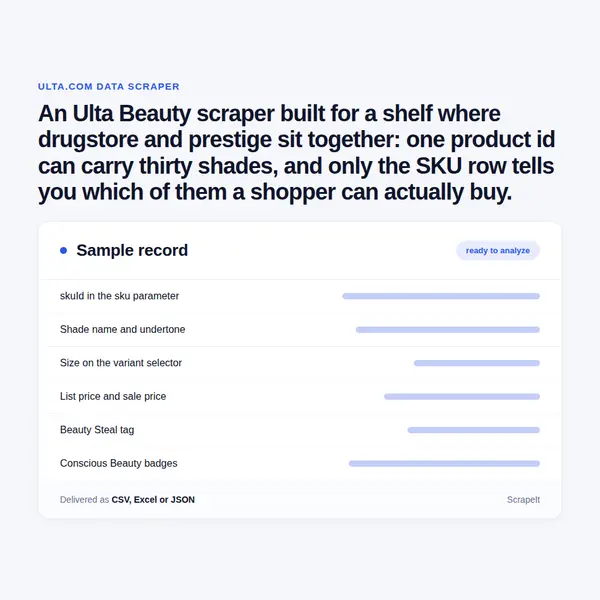
An Ulta Beauty scraper built for a shelf where drugstore and prestige sit together: one product id can carry thirty shades, and only the SKU row tells you which of them a shopper can actually buy.
Plans from €169/month · Free project assessment · Reply within 1 business day
Ulta puts its busiest entry points behind a queue, so a crawler that hammers site search learns nothing while one that walks the category tree and the sku sitemap gets the whole shelf. Anti-bot handling, proxy rotation and CAPTCHA solving are part of what we run, and the crawl is paced to read like traffic rather than a flood.
Delivery is CSV, JSON, XLSX or an API endpoint on the schedule you set: daily for price and stock, weekly for assortment, more than once a day around an event. The usual shape is linked tables - one row per product keyed on the product id, one row per variant keyed on the skuId, with reviews and store stock as tables of their own. Every run ships a short report: rows delivered, fields that came back empty, and SKUs that were present last time and are not present now.
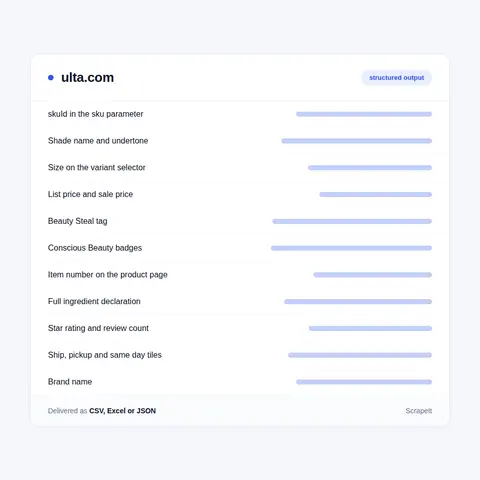
An Ulta Beauty record has two levels we keep apart: the product level holds what is true of the whole item, the SKU level everything that changes shade by shade and size by size.
Facet vocabularies are not global, and that is where a generic crawler goes wrong. Foundation exposes Form, Finish, Coverage, Skin Type and SPF; shampoo exposes Type and Concern; lipstick exposes a Color facet whose values carry hex swatch codes; face serums expose Skin Type and a Concern list from Acne and Blemishes to Uneven Skin Tone. A field list right for makeup is wrong for hair care, so we map facets per category first. If Ulta stops publishing a field, the column arrives empty and the run report says so.
Two things about Ulta are easy to underestimate. The first is that stock is a store fact, not a site fact. Pickup and same day delivery are fulfilled from a named location, and the In Store filter on a listing does nothing at all until a store has been chosen. Every branch carries its number in its own address and publishes street address, phone, coordinates and weekday opening hours. We record the store a stock reading was taken under, because a stock value without its store cannot be reproduced.
The second is loyalty pricing. Ulta Beauty Rewards, still called Ultamate Rewards in the app and on the credit card, shapes what a shopper pays: points multipliers run on named brands for a fixed window, Diamond and Platinum members get shipping that other members do not, and some event offers are gated on membership. The offer copy is public and we collect it. The member benefit chart is published as an image rather than as text, and account pricing sits behind a login. We do not sign in, so we never report a member price as though it were a shelf price.
On personal data the default is narrow. Ulta prints a reviewer nickname and a city and state beside each review. Our standard output carries review text, rating and date, with reviewer identifiers excluded and location reported in aggregate rather than person by person. Anything wider than that is agreed in writing before the first run. We collect only publicly available data - everything a visitor can see on Ulta Beauty - and we collect it legally.
Ulta Beauty is a United States beauty retailer that puts drugstore and prestige on the same shelf. Its foundation aisle runs from e.l.f. Cosmetics and Maybelline through to CHANEL, Dior and PAT McGRATH LABS, with the house label Ulta Beauty Collection in the same list. That choice shapes every extraction plan: one category spans an order of magnitude in price, and a competitor set drawn from a single brand tier misses half the shelf.
Addressing is simple once the pattern is clear. A product sits at /p/{slug}-{productId} and the buyable variant is carried in a query parameter, ?sku={skuId}. Product ids come in three families that live side by side: bare numeric ids such as 2486, PIM ids such as pimprod2053446, and legacy import ids such as xlsImpprod15511061. The slug is descriptive and can be rewritten, so the product id paired with the skuId is the join key we carry between runs.
Browse pages sit under /shop/ as a three-level tree such as /shop/makeup/face/foundation, and the same path appears inside the page as a colon-delimited string, makeup:face:foundation. Brand pages live at /brand/{slug} and can be crossed with a category in one address, /brand/{slug}?category=makeup,face,foundation. Stores sit at /stores/{city}-{state}-{storeId}, and that trailing number keys pickup and same day delivery.
The catalogue is enumerated at variant level rather than product level. In September 2026 the product sitemap resolved to 54,601 addresses across 28 files, one entry per purchasable sku, alongside 1,098 brand pages and 1,549 store pages. Ulta also runs its own marketplace, so third-party items sit among the core assortment, marked as sold and shipped by the brand.
Get a Quote
Developers

Customers worldwide

Pages extracted

Hours saved for our clients
€199 / one-time
setup fee - included
€169 / mo
setup fee €499
€229 / mo
setup fee €499
€349 / mo
setup fee €499
€549 / mo
setup fee €799
Delivery: CSV, JSON or XLSX files, our API or a JSON feed. MCP server on request.
Full plan details →The reason to extract Ulta Beauty data carefully rather than quickly is that a listing row does not carry a usable number. Ulta prints the tile price as a range across sizes, so a shampoo shows $12.00 - $58.00 and a hair oil shows something similar. There is no single Ulta price at product level. There is a price per skuId, and that is the only row a buyer or a merchant can act on.
Shades multiply the same problem. A complexion product can offer thirty options behind one product id, each with its own skuId, its own shade name and its own undertone line. Availability is set per variant as well: the selector marks individual shades unavailable while the product page stays live and buyable. A crawler writing one row per product URL records an item that is in stock and never notices that the fair end of the range has sold out. That gap is exactly the signal a brand team is paying for.
Then there is the calendar. Prices here move on events rather than drift. The 21+ Days of Beauty run sells Daily and Weekly Beauty Steals at half price and rotates them day by day, with the upcoming days published in advance. The Gorgeous Hair Event runs twice a year, in May and October, for three weeks. Buy More Save More, Gift With Purchase and brand coupon exclusions layer on top of both. Ulta price tracking that samples weekly will see the shelf price and never see the deal.

About 1.9 million auto parts listings from eBay.de with brand, OEM, EAN and fitment, plus titles and specs machine-translated for the client's team.
Learn More
A one-off Takealot product list for an entrepreneur choosing niches: only products rated 4 stars or higher with at least 50 reviews.
Learn More
Trendyol product data for an e-commerce startup reselling Turkish fashion: 27 categories in JSON on FTP, with in-stock status for every size.
Learn MoreLearn how to use web scraping to solve data problems for your organization
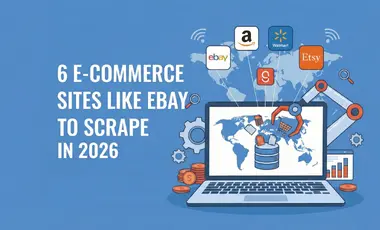
If you sell online, run a marketplace, or advise e-commerce clients, you already know why eBay matters: it’s one of the few places where big retailers compete side by side with thousands of small merchants and private sellers.

E-commerce teams do not just need “some” competitor data anymore. They need a continuous stream of real prices, discounts, stock levels, reviews, and seller behavior from the platforms that actually shape their markets.
Amazon provides valuable information gathered in one place: products, reviews, ratings, exclusive offers, news, etc. So scraping data from Amazon will help solve the problems of the time-consuming process of extracting data from e-commerce.
ScrapeIt is a managed web scraping agency. We build the crawler, run it on your schedule, watch it and hand over clean files. There is nothing to install and no library to learn. When Ulta changes its markup, repairing the parser is our work and not a ticket for your team, because this is billed as a service rather than a tool. Tell us the categories, the brands, the stores and the refresh rate you need, and we come back with a field list and a sample before anything is committed.
Yes. The ScrapeIt Ulta Beauty API returns skuId, shade name, size, list price, sale price and the ship, pickup and same day states as JSON from an endpoint we host, refreshed on the schedule you set. The same data also comes as CSV or XLSX files or straight into your database. We have no partnership or affiliation with Ulta Beauty. We collect what is publicly visible and return it in a structured form.
One row per shade or size by default. Every variant gets its own row keyed on skuId, carrying the shade name, the undertone description, the size, its own list price and sale price and its own availability state, with the product id as the foreign key back to the parent. A collapsed product-level table can ship alongside it when your reporting needs one, but the SKU table is the source of truth, because a product-level price on Ulta is a range and not a number.
It depends on what you are watching. Assortment and new-brand launches survive a weekly run. Price and stock want daily, because shades sell through without warning and promo copy changes without a version number. Around an event we run more than once a day: the 21+ Days of Beauty Daily Beauty Steals rotate on a fixed calendar, and a weekly crawler will record the regular shelf price for a product that spent that day at half off.
Yes, store by store. Each Ulta location has its own numbered page carrying the address, phone, coordinates and opening hours, and that store number is what scopes an availability check. Give us the branches you care about, by number or by city and state, and each stock row arrives with the store recorded on it. Ulta runs a single United States storefront priced in dollars, so there is no country dimension to configure, only a store one.
The two catalogues answer different questions. Ulta carries mass and prestige side by side plus a third-party marketplace, so a category sweep returns a full price ladder rather than a prestige slice, and the seller has to be kept as a field. The identifiers differ too: Ulta mixes three product id families and hangs the variant on a sku parameter. Reviews come from a different provider, so the review attributes on one site have no counterpart on the other. Runs on the two sites are configured separately and delivered as separate tables.
Step 1 - Make a Request
You share your needs, expectations, and desired timeframe. We’ll suggest the best solution based on your request and budget.
Step 2 - Configuring Custom Web Crawlers
Our specialists configure the crawlers and extract a sample dataset for your review before proceeding with the full-scale extraction.
Step 3 - Collect and Deliver
Once you approve the sample, we launch the project and start full data collection. We gather, filter, and structure the data for easy use, delivering it on time in your preferred format.
Step 4 - Maintain and Support
Our team manages ongoing processes, monitors website changes, and supports all data extraction cycles. We can also help integrate data into your systems or create dashboards to simplify analysis.
Ulta Beauty data from €169/month. Free project assessment, reply within 1 business day.

Scrapeit Sp. z o.o.
10/208 Legionowa str., 15-099, Bialystok, Poland
KRS: 0000996672
NIP: 5423457175
REGON: 523384582