Sky Sports Scraper for Fixtures, Results and Coverage

A broadcaster publishes two things at once: what happened, and what it is about to show you. Mixed into one dataset they cancel each other out.

Sky Sports Scraper
Solutions

Managed Sky Sports collection, run end to end by us

ScrapeIt runs the collector as a managed service. You name the sports, competitions and clubs; we build the pipeline, run it on your cadence and hand back CSV, JSON, Excel or a push into your warehouse, with editorial and broadcast data in separate tables and item types typed.

Cadence is per section and per matchday. Fronts and live coverage justify frequent passes around fixtures; archive work runs slower. Sport is scoped at the start, because football volume otherwise dominates everything.

We collect what the site renders publicly, honour the crawl rules it publishes and pace requests. The journalism and video are copyrighted and the terms restrict reuse, so the dataset is metadata and publicly rendered text for analysis rather than material for republication, and we do not download video. If your use case touches betting, take it to your own counsel first.

Sky Sports fields in every export

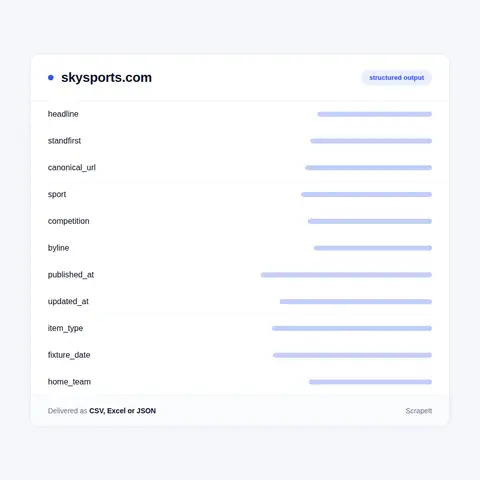
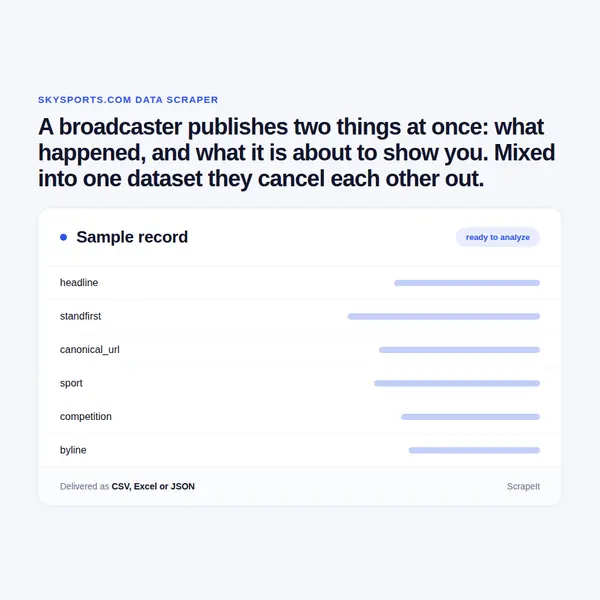
Editorial records cover canonical URL, headline, standfirst, sport, competition where tagged, byline, publication timestamp, last updated timestamp, item type and the article identifier.

Item type separates match report, preview, news, analysis and video, because on a broadcaster a large share of output is video with little body text. Word count without that separation ranks the most watched output lowest, which is the same trap as on any broadcaster site.

Fixture and result records are kept as their own rows: sport, competition, date, kickoff time in local and UTC, teams, venue and final score where played. They are joined to editorial coverage on competition and date rather than merged into it.

Broadcast fields are recorded where published: which channel, which window, and whether the fixture is listed as live. Those sit in their own columns so a client can ask what was shown without that data contaminating a coverage count.

Then the usual context: front position from repeated observation, topic and team tags where published, word count for text items, video duration where relevant, and the collection timestamp on every row.

Sky Sports fields in every export
Fixtures, rights bias and comparison with other outlets

Fixtures, rights bias and comparison with other outlets

Fixture and result collection here is a convenience rather than an authority. For a competition's own numbers the official site is better and we say so; what this source adds is the broadcast layer attached to those fixtures, which the official site does not carry.

Rights bias is handled by design rather than by disclaimer. Where a client needs a fair share of voice number, we collect this alongside outlets without the same rights and report the gap between them, which is itself informative: the size of the difference measures how much of the coverage is commercial rather than editorial.

Team and competition tagging supports the questions most clients have: coverage of one club over a season, of one competition against another, of a sponsor's properties against their rivals. Those tags are published rather than inferred, which makes the selection reproducible.

Historical backfill is practical because URLs are stable and section pagination reaches back. It runs as a one time job separate from the ongoing feed, bounded by sport and date so the football archive does not swallow the budget.

A broadcaster site: reporting plus a schedule

Sky Sports is a broadcaster that publishes heavily on the web, and its site carries two different kinds of content side by side. There is conventional sports journalism - match reports, previews, transfer coverage, analysis - and there is broadcast information: what is on which channel, when, and which fixtures are being shown live.

Those are not the same data and should not land in the same table. Coverage volume tells you what the newsroom wrote about; broadcast listings tell you what the business paid to show. A client tracking sponsorship value cares about the second; a client tracking share of voice cares about the first.

Structurally the site is organised by sport, with fixtures and results sections that respond directly, plus competition and team pages. Volume is substantial: the front alone renders over twelve thousand words, and football dominates.

Discovery is straightforward through section fronts and the fixtures and results surfaces, and article pages carry structured markup with headline, publisher and timestamps. Crawl rules are published and permit ordinary collection.

Get a Quote
dev_w
25

Developers

customers
500+

Customers worldwide

pages
1 500 000 000+

Pages extracted

stime
15000+

Hours saved for our clients

Plans

Airplane

€199 / one-time

setup fee - included

Data limits100,000
Frequencyone-time
Run timeup to 5 days
Data storing7 days

Helicopter

€169 / mo

setup fee €499

Data limits250,000
Frequencymonthly
Run timeup to 5 days
Data storing14 days

Glasses

€229 / mo

setup fee €499

Data limits1,000,000
Frequencyweekly
Run timeup to 5 days
Data storing30 days

DNA

€549 / mo

setup fee €799

Data limits3,000,000
Frequency3 times daily
Run timesame day
Data storing90 days

Why a broadcaster needs coverage and schedule kept apart

Merge the two and every number gets worse. Broadcast listings are generated in bulk and repeat across pages, so a naive collection inflates apparent coverage of whichever competition the broadcaster holds rights to. A sponsorship analysis built on that concludes the sponsor is getting enormous editorial attention when what it is actually seeing is a television schedule.

Kept apart, both become useful. Editorial coverage answers what the newsroom chose to write about and how prominently. Broadcast data answers which fixtures were shown, on which channel and in which window, which is the question rights holders and sponsors actually ask.

The second issue is rights bias, and it is worth naming rather than hiding. A broadcaster covers the competitions it broadcasts more heavily than the ones it does not. That is not a flaw in the data, it is a property of the source, and any share of voice measure built on a single broadcaster has to state it. We do, and we recommend collecting at least one non-rights-holding outlet alongside.

The third is video. As on any broadcaster, a large share of items are video packages with a caption rather than a body, and typing them is what keeps a length based measure honest.

The fourth is football dominance. Football volume will swamp any chart drawn across the whole site, so sport is a filter we set at the start rather than a surprise later.

Our Blog

Reads Our Latest News & Blog

Learn how to use web scraping to solve data problems for your organization

How Artificial Intelligence Is Used In Web Scraping

How Artificial Intelligence Is Used In Web Scraping

Leveraging advances in technology, the AI-powered web scraper has skyrocketed in demand and is helping to expand capabilities by automating tedious daily tasks and speeding up data collection from thousands of websites several times over.

What is Web Scraping and What is it Used For?

What is Web Scraping and What is it Used For?

Web scraping is a method of obtaining web data by extracting it from pages of web resources with the help of a program, that is, in automatic mode. It is used to syntactically convert web pages into more usable forms.

Web Scraping for Machine Learning

Web Scraping for Machine Learning

If you specialize in machine learning, you need to feed large amounts of data to the algorithms. Web scraping is the easiest and the most efficient method of collecting the data from all over the Internet.

scrapeit logo

Who builds and keeps your Sky Sports feed

ScrapeIt is a managed extraction company, not a tool you have to learn. Our team builds the pipeline, watches it through the season as fronts and templates change, and repairs it before matchday.

You see a sample first, in your format, over the sports and competitions you actually track, with editorial and broadcast rows already separated so you can see the difference on real data.

FAQ

Why keep broadcast listings out of the coverage count?

Because listings are generated in bulk and repeat across pages, so merging them inflates apparent coverage of whichever competition the broadcaster holds rights to. A sponsorship analysis built on that reports enormous editorial attention when it is looking at a television schedule. We keep them in separate tables joined on competition and date.

Is a broadcaster a fair source for share of voice?

On its own, no, and we say so rather than bury it. A broadcaster covers the competitions it broadcasts more heavily than the ones it does not. That is a property of the source, not a bug. Where a fair number is needed we collect at least one outlet without the same rights alongside, and the gap between them is itself informative.

Should I use this for fixtures and results?

Only as a convenience. For a competition's own fixtures, tables and statistics the official site is more authoritative and we will point you there. What this source adds is the broadcast layer attached to those fixtures, which official sites do not carry.

How do you handle video items?

By typing them and capturing duration instead of a word count. A large share of a broadcaster's output is video with a caption rather than a body, and any measure based on text length ranks the most watched material lowest. We do not download video files.

Football swamps everything. Can that be controlled?

Yes, and it should be decided at the start. Sport is a filter on the collection, so football can be analysed on its own or excluded. Left untreated it dominates any chart drawn across the whole site and makes every other sport look like noise.

How does it Work?

Step 1 - Make a Request

You share your needs, expectations, and desired timeframe. We’ll suggest the best solution based on your request and budget.

Step 2 - Configuring Custom Web Crawlers

Our specialists configure the crawlers and extract a sample dataset for your review before proceeding with the full-scale extraction.

Step 3 - Collect and Deliver

Once you approve the sample, we launch the project and start full data collection. We gather, filter, and structure the data for easy use, delivering it on time in your preferred format.

Step 4 - Maintain and Support

Our team manages ongoing processes, monitors website changes, and supports all data extraction cycles. We can also help integrate data into your systems or create dashboards to simplify analysis.

Request a Quote

Tell us more about you and your project information.
Which sites, which fields, how often. A couple of lines is enough.

We reply within 1 business day. No obligation.

scrapiet

Scrapeit Sp. z o.o.
10/208 Legionowa str., 15-099, Bialystok, Poland
NIP: 5423457175
REGON: 523384582