WhoScored Scraper for Player Ratings, Match Events and Team Statistics

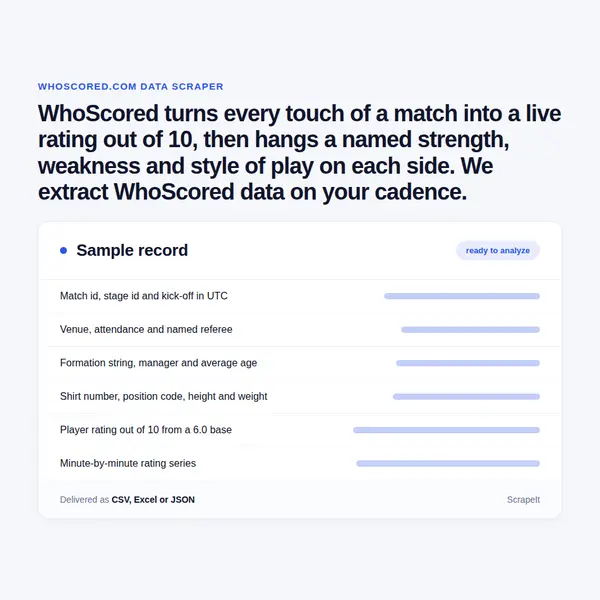
WhoScored turns every touch of a match into a live rating out of 10, then hangs a named strength, weakness and style of play on each side. We extract WhoScored data on your cadence.

WhoScored Scraper
Solutions

Running a WhoScored Scraping Project on Your Own Schedule

You name the competitions, the seasons and the surfaces, and we build the collectors around them. ScrapeIt writes the parsing logic against WhoScored markup, runs it on the cadence you set - live through a matchday, once after the settling window closes, or a full historical backfill - and hands back a sample before the full pass. Anti-bot handling, proxy rotation and CAPTCHA solving are part of the service, because the site sits behind a challenge that turns away plain automated clients and the collectors have to behave like real browsers.

We collect what the game itself produces: appearances, events, ratings and results for professional footballers. Contact details and private life stay out of scope. Nothing behind a login is touched either, so the WhoScored Plus value-bets tool and anything else gated by an account is ruled out before the quote rather than promised and quietly dropped.

WhoScored Match Centre, Squad and Season Statistics Fields

We extract WhoScored data surface by surface and keep the platform's own column names, so every row traces back to its page.

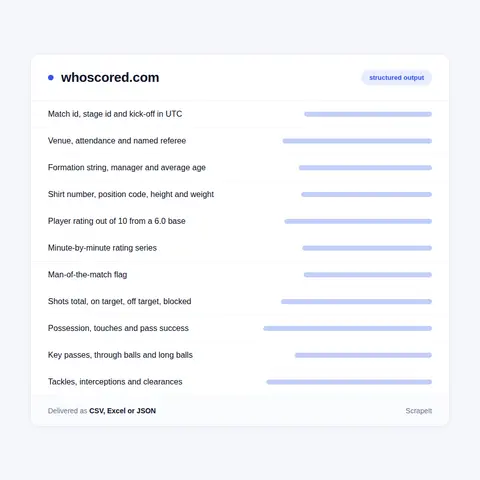
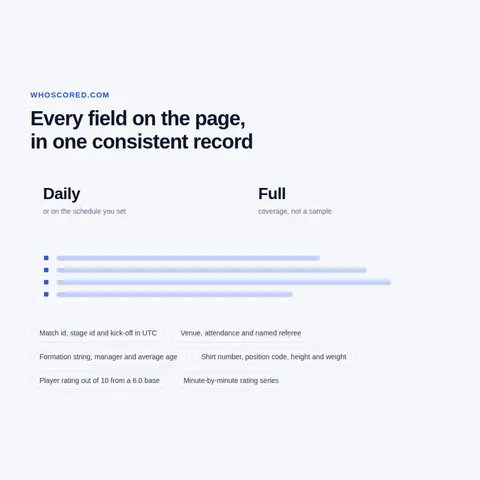
  • Match header. Match id, stage id, kick-off in local time and UTC, status and elapsed minute, half-time, full-time, extra-time and penalty scores, venue, attendance, weather code and referee, plus each side's formation string, manager and average age.
  • Lineups. Shirt number, player id, name, position code from GK through AMR to FW, height, weight, age, a first-eleven flag, the substitution pair with its minute, and a man-of-the-match flag.
  • Team match totals. Shots total, on target, off target, blocked and on the woodwork; possession and touches; passes total, accurate and key with pass success; aerials, corners, throw-ins and tackles each with their success rate; fouls, dribbles won and lost, dispossessed, errors and offsides. Goalkeeping splits into saves, collected, parried safe, parried danger and goals conceded.
  • Player match rows. The same vocabulary per player, plus the rating series: a value against each minute, opening at 6.0 and moving as events land.
  • Events. Roughly 1,500 rows for a single top-flight fixture, each carrying minute, second, team id, player id, x and y on a hundred-by-hundred pitch grid, an event type such as Pass, TakeOn, Aerial, Tackle, Interception, SavedShot, Goal, Card or Foul, an outcome of Successful or Unsuccessful, and a qualifier list holding PassEndX, PassEndY, Length, Angle and Zone alongside flags such as BigChance, Throughball, Cross and KeyPass. A satisfied-event list maps each row onto the platform's dictionary of 219 named counters.
  • Season aggregates. Per tournament and per season: apps written as starts with substitute appearances in brackets, minutes, goals, assists, cards, shots per game, pass success, aerials won, man-of-the-match count and rating, split Overall, Home and Away, with Summary, Defensive, Offensive, Passing, xG and Detailed views.
  • Tables. Played, won, drawn, lost, goals for and against, goal difference, points and a form string, with Form, Streaks, Progress and custom-date variants.

Delivery is CSV, JSON, XLSX or a load into your warehouse, with the capture moment on every row.

WhoScored Match Centre, Squad and Season Statistics Fields
How the WhoScored Rating, Characters and Formations Work

How the WhoScored Rating, Characters and Formations Work

The rating is the house currency, and it pays to know how it is built before storing it. It runs out of 10 from a 6.0 baseline, is computed from over 200 raw statistics weighted by where on the pitch an event happened and how it ended, and refreshes every 30 seconds in play. Five minutes after the whistle the provider revises the underlying statistics and the rating moves with them. At full time the figure also picks up adjustments for goals scored, goals conceded and a clean sheet, scaled by position and minutes played. Keep the live series and the settled figure in separate columns or they will never reconcile.

Characteristics are labels, not numbers. Every player and team carries Strengths and Weaknesses graded Very Strong, Strong, Weak or Very Weak - passing, key passes, dribbling, finishing, through balls and crossing for a player; attacking down the wings, counter attacks, protecting the lead and defending set pieces for a team - beside a Style of Play list in the platform's own phrasing, from likes to cut inside to possession football and consistent first eleven. They are worked out against league averages over the latest two seasons, and several fold raw measures together.

Around that sit surfaces nobody else arranges the same way: formation records with the id, the name from 442 to 343d, the captain, the minute range and the slot each shirt filled; referee tables giving fouls per game, penalties, yellows and reds both for and against a club; previews with a predicted eleven, a missing-players table whose reason travels in an icon title, and a written verdict.

What WhoScored Publishes and Where the Opta Depth Stops

WhoScored is a football analytics site run from London, and every figure on it rests on licensed Opta data. That shapes both what a WhoScored scraper can reach and the paperwork around it: the event feed is bought in, the ratings and characteristics on top are the platform's own, and the terms treat the whole lot as licensed material.

Coverage and depth are two separate questions here. The tournament menu currently carries 433 competitions across 114 regions, from the Premier League down to regional and continental minor cups, and scores, fixtures, lineups and tables run across all of them. Event detail does not. The competitions that carry it are named in the player comparison filter, 46 of them: the top five European leagues, the senior English tiers below them, Eredivisie, Liga Portugal, Super Lig, MLS, Copa Libertadores, the European club competitions and the major national-team tournaments. Anywhere else a player row shows apps and goals with N/A in the minutes, shots, pass success and rating columns. The scores payload marks the split itself with an isOpta flag on the stage and a matchIsOpta flag on the fixture, so a crawl can tell in advance which games repay a deep pass.

Addresses are numeric and predictable. A match lives at /matches/{id}/{tab}/ with tabs for live, livestatistics, matchreport, preview and betting; a team at /teams/{id}/{tab}/ with fixtures, statistics, refereestatistics and archive; a player at /players/{id}/{tab}/ with matchstatistics, fixtures and history; a season at /regions/{region}/tournaments/{tournament}/seasons/{season}/stages/{stage}/{tab}/. The trailing slug is decoration: it is translated on the language subdomains while the numeric id stays put, so ids are the join key and the slug never is.

Get a Quote
dev_w
25

Developers

customers
500+

Customers worldwide

pages
1 500 000 000+

Pages extracted

stime
15000+

Hours saved for our clients

Plans

Airplane

€199 / one-time

setup fee - included

Data limits100,000
Frequencyone-time
Run timeup to 5 days
Data storing7 days

Helicopter

€169 / mo

setup fee €499

Data limits250,000
Frequencymonthly
Run timeup to 5 days
Data storing14 days

Glasses

€229 / mo

setup fee €499

Data limits1,000,000
Frequencyweekly
Run timeup to 5 days
Data storing30 days

DNA

€549 / mo

setup fee €799

Data limits3,000,000
Frequency3 times daily
Run timesame day
Data storing90 days

Is There a WhoScored API, and What the Licence Allows

There is no open WhoScored API, and that answer matters before anyone budgets around one. No developer portal, no key, no self-serve endpoint. What exists is the WhoScored Ratings Feed, a sales enquiry form, not documentation: you choose Live ratings refreshed every 30 seconds in play, Post-Match ratings, Historical ratings, or the weekly, monthly and seasonal Best XI, tick the leagues from a list of nineteen and state your company size. The page says outright that the figures are supplied for a negotiable fee and never free of charge, so WhoScored ratings pricing is a conversation with sales. That feed carries ratings alone - not the event stream, the characteristics or the team tables.

The terms are just as plain. Copying, reproduction, republication, framing and broadcasting of statistics, tables and graphics require an official licence, as does use of the ratings by media, betting or fantasy platforms; an individual publication may quote a rating if it names WhoScored as the source and links back. Because the underlying feed belongs to Opta, redistribution has two licences to satisfy, not one.

The site is built for reading, not for bulk. Player tables page ten rows at a time and team tables twenty, the headline statistics screens cover only the top five leagues, there is no export button, and deeper views are drawn by script after load. So a WhoScored scraping plan is sliced by competition, season and stage id, not by scrolling, and it honours the published crawl rules, which put account, user and prediction paths out of bounds.

Our Blog

Reads Our Latest News & Blog

Learn how to use web scraping to solve data problems for your organization

How Artificial Intelligence Is Used In Web Scraping

How Artificial Intelligence Is Used In Web Scraping

Leveraging advances in technology, the AI-powered web scraper has skyrocketed in demand and is helping to expand capabilities by automating tedious daily tasks and speeding up data collection from thousands of websites several times over.

What is Web Scraping and What is it Used For?

What is Web Scraping and What is it Used For?

Web scraping is a method of obtaining web data by extracting it from pages of web resources with the help of a program, that is, in automatic mode. It is used to syntactically convert web pages into more usable forms.

Web Scraping for Machine Learning

Web Scraping for Machine Learning

If you specialize in machine learning, you need to feed large amounts of data to the algorithms. Web scraping is the easiest and the most efficient method of collecting the data from all over the Internet.

scrapeit logo

Who Builds and Keeps Your WhoScored Feed Running

ScrapeIt runs the WhoScored scraper as a managed service. Our team builds the collectors, watches them as the site changes and repairs them when it does. You receive files or an endpoint - CSV, JSON, XLSX or a database drop - with nothing to install and no infrastructure to keep alive. Where a licensed feed is the cheaper and cleaner answer to the question you actually asked, we say so before the project starts rather than after the invoice. Clients come for scouting models, opposition analysis, fantasy football tooling and media research, and each takes a different slice of the same site.

FAQ

Does WhoScored have a public API for ratings and match data?

No. There is no developer portal, no API key and no self-serve endpoint on whoscored.com. The one official route is the WhoScored Ratings Feed, which is a sales enquiry form: you pick Live, Post-Match, Historical or Best XI ratings, tick leagues from a list of nineteen and give your company size, and the page states that the data is supplied for a negotiable fee and never free of charge. It also carries ratings only - the event stream, the player and team characters and the season tables are not part of it. That is the gap a WhoScored scraper fills.

Which WhoScored fields can you deliver for a single match?

The header first: venue, attendance, referee, kick-off in local time and UTC, half-time and full-time scores, formation, manager and squad average age. Then lineups with shirt number, position code, height, weight, age, substitution minute and the man-of-the-match flag. Then team and player totals - shots by outcome, possession, touches, passes and key passes, tackles, interceptions, clearances, aerials, dribbles, dispossessions, errors, fouls, offsides and keeper saves. Underneath sit the event rows with pitch coordinates and qualifiers, and the minute-by-minute rating series for each player.

How far back does WhoScored historical data go?

Two different depths, and mixing them up is the usual mistake. Detailed statistics, ratings and player comparison currently cover eighteen seasons, starting from 2009/10. Results, fixtures and league tables reach further: the Premier League season picker currently runs back to 1999/2000, and other competitions vary. Season and stage ids sit in the address, so a backfill is a finite list of pages rather than an open crawl. Tell us the competitions and the years and we will say which of the two depths you actually get for each one before any work starts.

How often can you refresh a WhoScored feed during a matchday?

As often as the source moves, and it moves fast: live ratings recalculate every 30 seconds, and scores, lineups and in-play totals shift with them. The catch is settlement. The data provider revises statistics about five minutes after the final whistle, the man-of-the-match star lands ten minutes after full time, and further corrections can follow later. So we usually run a live pass for the in-play series and a second settled pass after the revision window, then deliver both with a capture timestamp on every row so you can see which figure is which.

Is scraping WhoScored lawful, and what will you not collect?

We work only on pages a signed-out visitor can open, we do not log in, and we stay inside the crawl rules the site publishes. Redistribution is where the care is needed: the terms require an official licence for republishing statistics, tables and graphics, use of the ratings by media, betting and fantasy platforms needs a licence too, and the underlying feed is Opta's, so two sets of terms apply. We take the playing record of professional footballers, not their contact details or private life. We are not lawyers, so put any resale or publishing plan in front of your own counsel first.

How does it Work?

Step 1 - Make a Request

You share your needs, expectations, and desired timeframe. We’ll suggest the best solution based on your request and budget.

Step 2 - Configuring Custom Web Crawlers

Our specialists configure the crawlers and extract a sample dataset for your review before proceeding with the full-scale extraction.

Step 3 - Collect and Deliver

Once you approve the sample, we launch the project and start full data collection. We gather, filter, and structure the data for easy use, delivering it on time in your preferred format.

Step 4 - Maintain and Support

Our team manages ongoing processes, monitors website changes, and supports all data extraction cycles. We can also help integrate data into your systems or create dashboards to simplify analysis.

Request a Quote

Tell us more about you and your project information.
Which sites, which fields, how often. A couple of lines is enough.

We reply within 1 business day. No obligation.

scrapiet

Scrapeit Sp. z o.o.
10/208 Legionowa str., 15-099, Bialystok, Poland
NIP: 5423457175
REGON: 523384582