LiveScore Scraper for Live Match State Across Sports

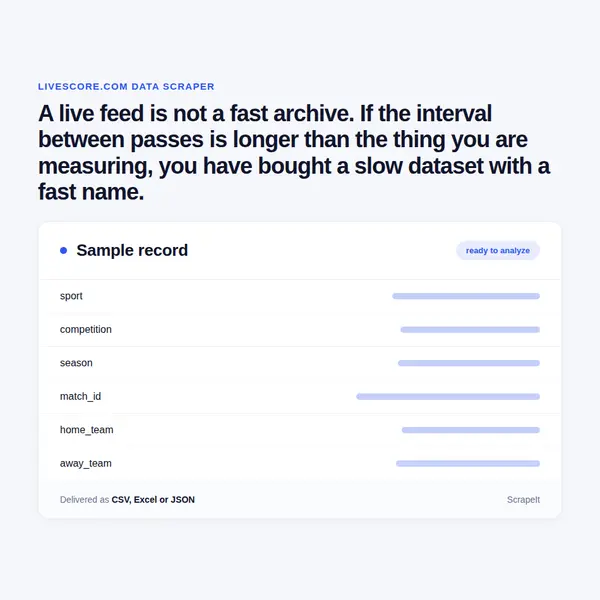
A live feed is not a fast archive. If the interval between passes is longer than the thing you are measuring, you have bought a slow dataset with a fast name.

LiveScore Scraper
Solutions

Managed live results collection, run end to end by us

ScrapeIt runs the collection as a managed service. You name the competitions and the tiering; we build the pipeline, run the archive backfill once and the live collection on a per match schedule, and hand back CSV, JSON, Excel or a push into your warehouse, with events as a timestamped stream and time zones explicit.

We are direct about what a cadence costs and what it buys. Minute level collection across a defined watch list is affordable and sustainable; minute level collection across everything is neither, and we would rather quote the first than promise the second.

We collect what the site renders publicly, honour the crawl rules it publishes and pace requests. Compiled sports data carries rights held by operators and competitions, so the dataset is for analysis and product use rather than republication of their pages. If your use case touches betting, take it to your own counsel first.

LiveScore fields in every export

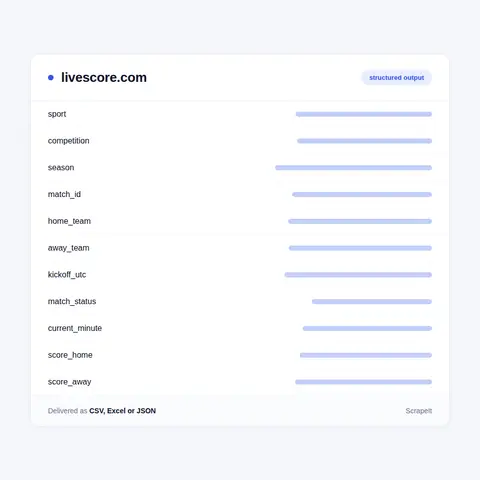
Fixture records cover sport, competition and stage, season, match identifier, home and away team, scheduled kickoff in local time and UTC, venue where published, and match status.

Live state is delivered as timestamped observations rather than as a value that gets overwritten: current score, half time score, elapsed minute, and the event stream of goals with scorer where published, cards, substitutions and penalties. Keeping the stream is what lets a client reconstruct the state of a match at any point rather than only how it finished.

Observation timing is recorded on every live row. A score without the moment it was read is not a fact about a match, it is a rumour with a number attached.

Match statistics are captured as published per competition, which varies considerably down the tiers: possession, shots, corners and cards where the competition supplies them, and recorded as absent where it does not rather than filled in.

Every row carries the competition and the collection timestamp, and kickoff times are stored with their time zone, because a fixture list that is an hour wrong twice a year is a fixture list nobody trusts.

LiveScore fields in every export
Tiering, entity matching and the archive

Tiering, entity matching and the archive

Tiering is set with the client before anything is built: which competitions are live watched, which are polled slowly, and what happens on a matchday when several watched fixtures overlap. That conversation decides both the cost and whether the feed is usable, and having it late is how projects on this kind of source go wrong.

Entity matching is the hidden cost as soon as a second source joins. Team names differ between services, clubs share names across countries and player names vary with accents and transliteration. We match teams on competition context and aliases, players on birth date and squad, and keep every surface form so a join can be audited.

The archive is collected once. Past results never change, so a historical backfill is a one time job and normally the cheaper half of the project, while the live half carries the ongoing cost.

Where a client also needs authoritative standings, we take them from the competition's own site rather than from a results service, and join on the normalised competition identifier. The official source is both more accurate and, on several services, the only permitted route.

A results service built around the live minute

LiveScore is a results service covering football in depth and a range of other sports alongside it. Its whole design is the live match: scores, minutes and events updating continuously while games are in progress, with fixtures before and results after.

That design decides how it should be collected. The archive half - yesterday's results, last season's fixtures - is static and cheap. The live half changes every few seconds and is the reason anybody is here. Running both on one schedule either overpays for the archive or misses the live state entirely, and it is the single most common mistake on this kind of source.

The site is addressed by sport and competition with a match page per fixture, and section fronts respond directly. Coverage extends past the major competitions into second tier and regional football, which is where a results service earns its place: major leagues are available everywhere, the long tail is not.

The front renders comparatively little text because the content is a live grid rather than an article, which is normal for this kind of service and says nothing about the data underneath.

Get a Quote
dev_w
25

Developers

customers
500+

Customers worldwide

pages
1 500 000 000+

Pages extracted

stime
15000+

Hours saved for our clients

Plans

Airplane

€199 / one-time

setup fee - included

Data limits100,000
Frequencyone-time
Run timeup to 5 days
Data storing7 days

Helicopter

€169 / mo

setup fee €499

Data limits250,000
Frequencymonthly
Run timeup to 5 days
Data storing14 days

Glasses

€229 / mo

setup fee €499

Data limits1,000,000
Frequencyweekly
Run timeup to 5 days
Data storing30 days

DNA

€549 / mo

setup fee €799

Data limits3,000,000
Frequency3 times daily
Run timesame day
Data storing90 days

Why the cadence is the product

On this source the collection schedule is not a setting, it is the thing being bought. A feed that arrives every ten minutes cannot tell you the score at minute sixty three, and anything built on it that claims to be live will be wrong at exactly the moment people are watching.

Equally, collecting every fixture in every competition at minute level is wasteful and impolite. Most matches on any given day do not matter to any given client, and hammering a results service to collect them is how access gets withdrawn for everyone.

So the design is tiered and agreed up front. A defined watch list is collected at minute level through the match window; everything else runs at a slow interval or only after the final whistle. Fixtures are collected in advance on a light schedule, and once a match is over it moves into the archive and stops being polled at all.

The second reason to be here is the long tail. Second tier and regional competitions are frequently absent from official sources and from the bigger providers, and for a product that needs coverage rather than headline fixtures that tail is the whole point.

The third is that statistics thin out down the tiers. We record what a competition actually publishes and mark the rest as absent, rather than producing a column that is silently empty for half the rows.

Our Blog

Reads Our Latest News & Blog

Learn how to use web scraping to solve data problems for your organization

How Artificial Intelligence Is Used In Web Scraping

How Artificial Intelligence Is Used In Web Scraping

Leveraging advances in technology, the AI-powered web scraper has skyrocketed in demand and is helping to expand capabilities by automating tedious daily tasks and speeding up data collection from thousands of websites several times over.

What is Web Scraping and What is it Used For?

What is Web Scraping and What is it Used For?

Web scraping is a method of obtaining web data by extracting it from pages of web resources with the help of a program, that is, in automatic mode. It is used to syntactically convert web pages into more usable forms.

Web Scraping for Machine Learning

Web Scraping for Machine Learning

If you specialize in machine learning, you need to feed large amounts of data to the algorithms. Web scraping is the easiest and the most efficient method of collecting the data from all over the Internet.

scrapeit logo

Who builds and keeps your live results feed

ScrapeIt is a managed extraction company, not a tool you have to learn. Our team builds the pipeline, watches it through the season as competitions and pages change, and repairs it before matchday rather than after.

You see a sample first, in your format, over the competitions you actually cover, including a live window on a real fixture so you can judge the latency rather than take it on trust.

FAQ

How fast can the live feed actually be?

Minute level on a defined watch list, and faster on a narrow set. What we will not do is promise minute level across every competition at once, because that is not a rate anyone can sustain politely. The design that works is a named list collected fast and everything else collected slowly.

Why not just collect everything frequently?

Because most matches on any given day do not matter to any given client, and hammering a results service to collect them is how access gets withdrawn for everyone. Tiering keeps the feed affordable and keeps it working, which is worth more than a number in a proposal.

Can you cover lower divisions?

That is the main reason to use a results service. Major leagues are available everywhere; second tier and regional competitions are frequently absent from official sources and bigger providers. Statistics thin out down the tiers, and we record what each competition actually publishes rather than filling gaps.

Do you collect league tables here?

Where you need authoritative standings we take them from the competition's own site and join on a normalised competition identifier. The official source is more accurate, and on several results services the standings paths are not open to collection anyway.

How do you combine this with other sports sources?

With entity matching, which is the real work. Team names differ between services, clubs share names across countries and player names vary with accents. We match teams on competition context and aliases and players on birth date and squad, keeping every surface form so any join can be audited.

How does it Work?

Step 1 - Make a Request

You share your needs, expectations, and desired timeframe. We’ll suggest the best solution based on your request and budget.

Step 2 - Configuring Custom Web Crawlers

Our specialists configure the crawlers and extract a sample dataset for your review before proceeding with the full-scale extraction.

Step 3 - Collect and Deliver

Once you approve the sample, we launch the project and start full data collection. We gather, filter, and structure the data for easy use, delivering it on time in your preferred format.

Step 4 - Maintain and Support

Our team manages ongoing processes, monitors website changes, and supports all data extraction cycles. We can also help integrate data into your systems or create dashboards to simplify analysis.

Request a Quote

Tell us more about you and your project information.
Which sites, which fields, how often. A couple of lines is enough.

We reply within 1 business day. No obligation.

scrapiet

Scrapeit Sp. z o.o.
10/208 Legionowa str., 15-099, Bialystok, Poland
NIP: 5423457175
REGON: 523384582