FootballTransfers Scraper for Deals, Rumours and Values

A rumour, a confirmed fee and a model estimate are three kinds of number. Put them in one column and the dataset starts lying politely.

Plans from €169 a month · Free project assessment · Reply within 1 business day

CSV · Excel · JSON · XML · FTP · SFTP · Amazon S3 · Google Cloud

footballtransfers.com
FootballTransfers Scraper for Deals, Rumours and Values
footballtransfers.comwhat you get
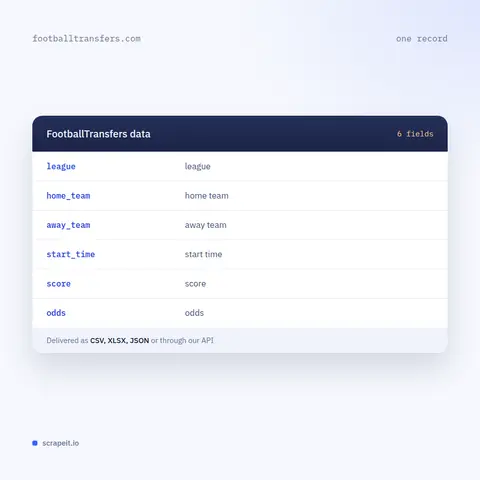
Typical fields for sports sites
leaguehome_teamaway_teamstart_timescoreodds
Delivery

API, JSON feed or CSV, XLSX and JSON files

Schedule

One-time, monthly, weekly, daily or 3 times a day

Managed transfer market data, run end to end by us

  1. You send

    FootballTransfers pages, filters, fields and a schedule

  2. We run the scrapers

    Built, monitored and repaired by our team

  3. You receive the data

    API, JSON feed or CSV, XLSX and JSON files

ScrapeIt runs the collection as a managed service. You name the leagues, clubs or windows; we build the pipeline with record type on every row, attribution kept on reported claims, valuations labelled as estimates with dates, and hand back CSV, JSON, Excel or a push into your warehouse.

Windows are seasonal, so cadence is set against them - dense during a window, sparse outside it - rather than a flat daily schedule that mostly records nothing.

Requests are paced. We collect only publicly available data - everything a visitor can see on FootballTransfers - and we collect it legally.

FootballTransfers fields in every export

Record type is the first field: completed transfer, reported interest, or estimated valuation. Everything else is interpreted through it, and a dataset without it cannot be used safely by anyone who did not build it.

Transfer records carry the player, the clubs on both sides, the window and season, the fee as published with its currency, the deal type such as permanent or loan, and whether the fee was disclosed or reported.

Reported interest records carry the player, the interested club, the date reported and the publication cited where the site names one. Attribution is the field that lets a user weigh the claim; without it a rumour becomes an anonymous assertion in a spreadsheet.

Valuation records carry the estimate, the currency and the date, and are labelled as estimates on the row rather than in documentation nobody downstream will read.

Every row carries the collection timestamp, which matters here because a valuation is only meaningful with a date attached.


FootballTransfers fields in every export
Rumour patterns, window timing and limits

Rumour patterns, window timing and limits

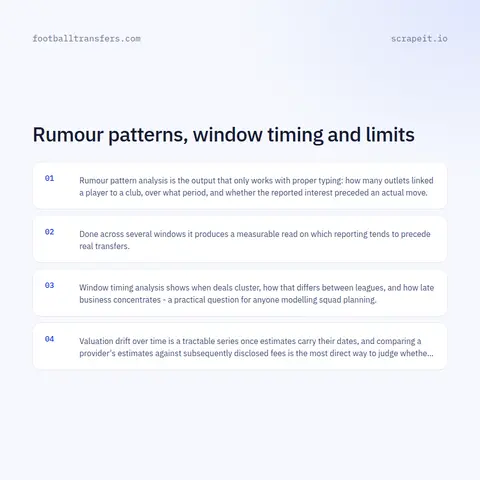
Rumour pattern analysis is the output that only works with proper typing: how many outlets linked a player to a club, over what period, and whether the reported interest preceded an actual move. Done across several windows it produces a measurable read on which reporting tends to precede real transfers.

Window timing analysis shows when deals cluster, how that differs between leagues, and how late business concentrates - a practical question for anyone modelling squad planning.

Valuation drift over time is a tractable series once estimates carry their dates, and comparing a provider's estimates against subsequently disclosed fees is the most direct way to judge whether a valuation model is worth anything.

The limits are plain. Undisclosed fees stay undisclosed and we never impute them. And no provider has complete transfer coverage, so a serious market dataset draws on more than one and reconciles the disagreements rather than picking a favourite.

Three different kinds of number on one page

Source
footballtransfers.com
Category
sports sites
Delivery
API, JSON feed, CSV, XLSX
Plans
From €169 a month
Get a quote

FootballTransfers covers the transfer market: completed deals, reported interest, and its own estimated player valuations. Those three things sit close together on the site and they are not the same kind of fact.

A completed transfer is a record of something that happened, with a fee that may or may not have been disclosed. Reported interest is journalism about something that might happen, sourced from varying places with varying reliability. An estimated value is a model output - a calculation about what a player might be worth, which is useful and is not a price anyone paid.

A dataset that merges them into a value column produces something that looks like market data and behaves like rumour. The single most important design decision on this source is to type each record for what it is and to keep the source of any reported claim attached.

Transfer and player sections respond directly, and the site publishes language editions next to the English catalogue, so collection can cover the English pages and any edition a project needs.

25Developers
500+Customers
1.5BPages extracted
15,000+Hours saved for our clients

FootballTransfers scraping plans and pricing

Airplane

€199one-time

Setup fee included

100,000
One-time
Up to 5 days
7 days

Helicopter

€169/ mo

Setup fee €499

250,000
Monthly
Up to 5 days
14 days

Glasses

€229/ mo

Setup fee €499

1,000,000
Weekly
Up to 5 days
30 days

Microscope popular

€349/ mo

Setup fee €499

2,000,000
Daily
Same day
60 days

DNA

€549/ mo

Setup fee €799

3,000,000
3 times daily
Same day
90 days

Delivery: CSV, JSON or XLSX files, our API or a JSON feed. MCP server on request.

Full plan details

Why typing the record is the whole job

Transfer data is among the easiest sports data to deliver badly, because the badly delivered version is more convenient and looks more complete.

Flatten everything into player, club and value and you get a tidy table where a completed twelve million transfer, a newspaper claim and an algorithmic estimate are indistinguishable. Anyone analysing it will treat all three as observations of the same thing, and the conclusions will be confidently wrong in whichever direction the rumours lean.

The second reason is that rumours are genuinely interesting once typed correctly. The pattern of reported interest - which clubs are linked with which profiles, how often, how far ahead of a window - is a real signal about intent, and it is a signal about reporting as much as about football. It just is not a record of a transaction.

The third is that fees are frequently undisclosed and the reported figure is an estimate by a journalist. Recording whether a fee was disclosed or reported is the difference between a market dataset and a collection of educated guesses presented as accounting.

The fourth is that valuations are model outputs. They are useful for comparison and ranking and they are not prices. A row that says so protects every analysis built on it.

Who builds and keeps your transfer feed

ScrapeIt is a managed extraction company, not a tool you have to learn. Our team builds the pipeline, maintains player and club resolution across spellings, and repairs the collector before a transfer window goes half recorded.

You see a sample first, in your format, over the leagues you actually follow, with record types separated so you can see on real deals how much of the table is fact and how much is reporting.

FAQ

Still unsure? Write to info@scrapeit.io

Why separate rumours from completed deals?

Because merged they are indistinguishable, and anyone analysing the table will treat a newspaper claim as an observation of the same kind as a completed twelve million transfer. The conclusions then lean whichever way the rumours did, confidently and invisibly.

Are the valuations real prices?

No, they are model estimates, and the row says so rather than a note in documentation nobody downstream reads. They are useful for ranking and comparison. Treating them as prices is the mistake the labelling exists to prevent.

What happens with undisclosed fees?

They stay undisclosed, flagged as such. We never impute a figure. A reported fee is marked as reported rather than disclosed, because the difference between those two is the difference between market data and educated guessing.

Do you keep the source of a rumour?

Where the site names one, yes. Attribution is what lets a user weigh a claim, and without it a rumour becomes an anonymous assertion sitting in a spreadsheet looking like a fact.

Is one transfer source enough?

No, and we say so rather than selling completeness we cannot deliver. No provider covers the whole market, so a serious dataset draws on several and reconciles the disagreements - which are themselves informative about reporting quality.

How it works

  1. 1

    Make a request

    You share your needs, expectations, and desired timeframe. We'll suggest the best solution based on your request and budget.

  2. 2

    We configure the crawlers

    Our specialists configure the crawlers and extract a sample dataset for your review before proceeding with the full-scale extraction.

  3. 3

    Collect and deliver

    Once you approve the sample, we launch the project and start full data collection. We gather, filter, and structure the data for easy use, delivering it on time in your preferred format.

  4. 4

    Maintain and support

    Our team manages ongoing processes, monitors website changes, and supports all data extraction cycles. We can also help integrate data into your systems or create dashboards to simplify analysis.

Request a quote

Tell us which sites, which fields and how often. A couple of lines is enough to start.

  • We reply within 1 business day
  • A sample dataset before the full run
  • We sign an NDA on request
  • Delivery by API, JSON feed or files
Which sites, which fields, how often. A couple of lines is enough.

This form is protected by Google reCAPTCHA, which loads when you start filling it in. If you prefer not to use it, email us at info@scrapeit.io. Privacy & Cookie Policy

We reply within 1 business day. No obligation.

FootballTransfers data from €169/month. Free project assessment, reply within 1 business day.