Transfermarkt Scraper for Market Values and Transfer History

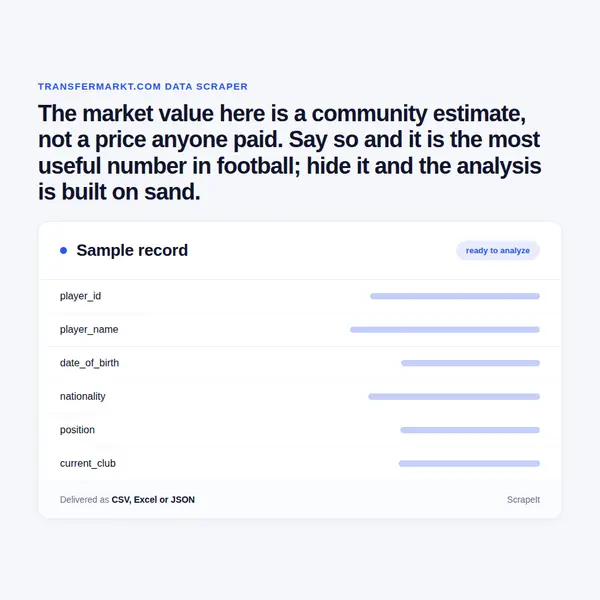
The market value here is a community estimate, not a price anyone paid. Say so and it is the most useful number in football; hide it and the analysis is built on sand.

Transfermarkt Scraper
Solutions

Managed transfer and valuation data, run end to end by us

ScrapeIt runs the collector as a managed service. You name the leagues, clubs or player set; we build the pipeline, run the historical backfill once and the updates on your cadence, and hand back CSV, JSON, Excel or a push into your warehouse, with valuation history as rows, transfers typed and undisclosed fees marked as undisclosed.

Cadence is modest by design. Valuations update on a cycle rather than continuously and squads change in windows, so most clients run weekly or monthly with change records, plus tighter collection during a transfer window when it actually matters.

We collect what the site renders publicly and pace requests within the crawl rules it publishes. Player data here is professional information about public figures, and we collect no personal contact details. The database is a compilation with rights attached, so the dataset is built for analysis rather than for republication of their pages. Bring the use case to your own counsel before the project starts.

Transfermarkt fields in every export

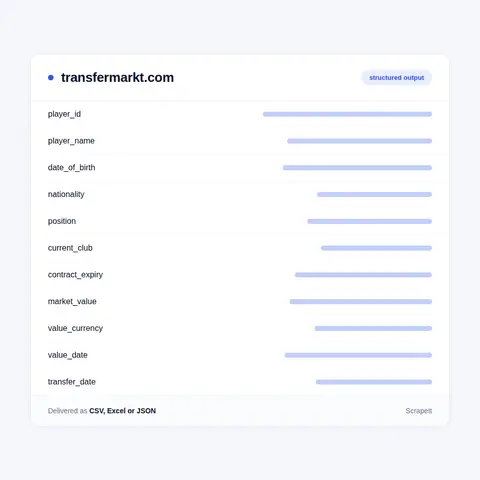
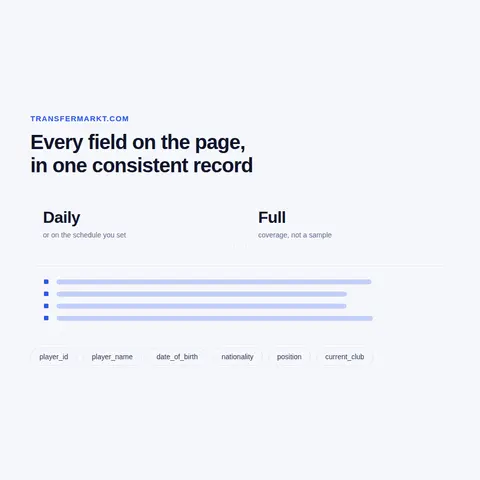
The player record covers player identifier, name, date of birth, nationality and second nationality, position and secondary positions, height, preferred foot, current club, shirt number, joined date, contract expiry date and agent where published.

Market value is delivered as a history rather than a single current figure. Each valuation carries its amount, currency, the date it took effect and the club the player was at, so a valuation curve can be drawn across a career. The current value alone answers almost nothing; the trajectory answers most of what people ask.

Transfer records come as their own rows: date, season, club from, club to, transfer type covering permanent moves, loans, returns and free transfers, and the fee where it is disclosed. Undisclosed fees are recorded as undisclosed rather than as zero, which is a distinction that ruins aggregate analysis when it is lost.

Squad and performance data covers season, competition, appearances, minutes, goals, assists where published, yellow and red cards, and the squad the player belonged to.

Club records carry club identifier, league, squad size, average age, foreigner share, total squad market value and stadium where published, with the collection timestamp on every row.

Transfermarkt fields in every export
Squad building, loan networks and historical depth

Squad building, loan networks and historical depth

Squad composition analysis follows naturally once players, values and contracts are collected together. Age profile against value, foreigner share, positional depth, and how these change season over season describe a club's strategy more honestly than any statement about it does.

Loan networks are a specific and often overlooked structure. Clubs that systematically loan players out, and the clubs that receive them, form a network that is visible only if loans are typed separately from permanent transfers rather than flattened into one movement column. For anyone analysing club groups or feeder relationships, that typing is the whole analysis.

Historical depth is one of this source's real strengths. Squad lists, transfers and valuation histories reach back many seasons, so a longitudinal panel is buildable as a one time job. Since past seasons never change, that backfill is collected once and never revisited, and the ongoing feed is comparatively small.

Cross referencing with match data is the standard extension. Valuations and contracts on one side, appearances and minutes on the other, joined on a normalised player identity, answers whether a valuation is tracking performance or reputation. That join needs careful player matching, which is the same entity work described on our live scores page.

What Transfermarkt holds and where its numbers come from

Transfermarkt is the reference database for football squads, transfers, contracts and player valuations. It covers leagues down to a surprising depth, and its transfer records and contract expiry dates are used across the industry, in media and in scouting.

The market value is the number everyone comes for and the number most often misunderstood. It is not a transfer fee and not an audited valuation; it is an estimate produced through a community and editorial process. That does not make it useless, quite the opposite, because it is consistent, comparable across the whole database and updated on a regular cycle. But it has to be labelled for what it is, and any model that treats it as an observed price will produce confident nonsense.

Alongside valuations the site carries actual transfer records with fees where disclosed, loan arrangements, contract expiry dates, squad lists per season, appearances, minutes, goals and disciplinary records, plus agent and club affiliation data.

Structurally it is addressed by competition, club, season and player, with stable identifiers throughout, which makes systematic collection practical. Its robots file allows general crawling while disallowing specific clients, so ordinary polite collection is within the published rules; we pace requests accordingly.

Get a Quote
dev_w
25

Developers

customers
500+

Customers worldwide

pages
1 500 000 000+

Pages extracted

stime
15000+

Hours saved for our clients

Plans

Airplane

€199 / one-time

setup fee - included

Data limits100,000
Frequencyone-time
Run timeup to 5 days
Data storing7 days

Helicopter

€169 / mo

setup fee €499

Data limits250,000
Frequencymonthly
Run timeup to 5 days
Data storing14 days

Glasses

€229 / mo

setup fee €499

Data limits1,000,000
Frequencyweekly
Run timeup to 5 days
Data storing30 days

DNA

€549 / mo

setup fee €799

Data limits3,000,000
Frequency3 times daily
Run timesame day
Data storing90 days

Why the valuation curve beats the valuation

The single most common request on this source is the current market value of a squad, and it is the least useful thing the data can produce. A number without history has no direction, no context and no way to judge whether it is a rise, a fall or a plateau.

The curve is where the analysis lives. A player whose value has doubled over eighteen months and one whose value has halved may sit at the same figure today and represent opposite decisions. A squad whose aggregate value is drifting down while its average age rises is describing a problem that a single snapshot conceals entirely.

The contract expiry date is the second field that carries disproportionate weight. A high value player with a year left is a very different asset from the same player with four years left, and the entire economics of a transfer window turn on that gap. Collected across a league, expiry dates predict where the market will be active months in advance.

The third is the fee versus valuation comparison. Because both exist here, the difference between what a player was valued at and what a club actually paid, where the fee was disclosed, is a measurable premium. Tracked by selling league, by position and by age, it is a genuinely commercial insight and it needs both fields on the same row.

The fourth is the caveat that must travel with all of it: valuations are estimates from a community process. We label them as such on every row rather than in a footnote, because a model that treats them as observed prices will be confidently and invisibly wrong.

Our Blog

Reads Our Latest News & Blog

Learn how to use web scraping to solve data problems for your organization

How Artificial Intelligence Is Used In Web Scraping

How Artificial Intelligence Is Used In Web Scraping

Leveraging advances in technology, the AI-powered web scraper has skyrocketed in demand and is helping to expand capabilities by automating tedious daily tasks and speeding up data collection from thousands of websites several times over.

What is Web Scraping and What is it Used For?

What is Web Scraping and What is it Used For?

Web scraping is a method of obtaining web data by extracting it from pages of web resources with the help of a program, that is, in automatic mode. It is used to syntactically convert web pages into more usable forms.

Web Scraping for Machine Learning

Web Scraping for Machine Learning

If you specialize in machine learning, you need to feed large amounts of data to the algorithms. Web scraping is the easiest and the most efficient method of collecting the data from all over the Internet.

scrapeit logo

Who builds and keeps your transfer data feed

ScrapeIt is a managed extraction company, not a tool you have to learn. Our team builds the pipeline, watches it through transfer windows and season changes, and repairs it before your valuation series develops a gap.

You see a sample first, in your format, over the leagues or clubs you actually track, with the valuation history already populated so you can judge the curve rather than a single number.

FAQ

Is the market value a real transfer fee?

No, and this matters more than anything else on the page. It is an estimate produced through a community and editorial process, not an audited valuation and not a price anyone paid. It is consistent and comparable across the database, which makes it genuinely useful, but a model that treats it as an observed price will be confidently wrong. We label it as an estimate on every row rather than in a footnote.

Can I get the history of a player's valuation?

Yes, as rows: amount, currency, effective date and the club at the time. The curve is the analysis; the current figure on its own answers almost nothing. Two players at the same value today, one doubling over eighteen months and one halving, represent opposite decisions.

How do you handle undisclosed transfer fees?

As undisclosed, never as zero. Recording an undisclosed fee as zero drags every average downwards and the error is invisible in the output. Transfer type is also kept separate, so permanent moves, loans, loan returns and free transfers do not get flattened into one movement column.

Why are contract expiry dates useful?

Because they predict market activity. A valuable player with a year remaining is a different asset from the same player with four, and the economics of a transfer window turn on that gap. Collected across a league, expiry dates show where the market will be active months before it happens.

How far back does the historical data go?

Many seasons, for squads, transfers and valuation histories. Because past seasons never change, the backfill is a one time job collected once and never revisited, which makes it the cheaper half of most projects here. The ongoing feed is comparatively small.

How does it Work?

Step 1 - Make a Request

You share your needs, expectations, and desired timeframe. We’ll suggest the best solution based on your request and budget.

Step 2 - Configuring Custom Web Crawlers

Our specialists configure the crawlers and extract a sample dataset for your review before proceeding with the full-scale extraction.

Step 3 - Collect and Deliver

Once you approve the sample, we launch the project and start full data collection. We gather, filter, and structure the data for easy use, delivering it on time in your preferred format.

Step 4 - Maintain and Support

Our team manages ongoing processes, monitors website changes, and supports all data extraction cycles. We can also help integrate data into your systems or create dashboards to simplify analysis.

Request a Quote

Tell us more about you and your project information.
Which sites, which fields, how often. A couple of lines is enough.

We reply within 1 business day. No obligation.

scrapiet

Scrapeit Sp. z o.o.
10/208 Legionowa str., 15-099, Bialystok, Poland
NIP: 5423457175
REGON: 523384582