Soccerway Scraper for Squads, Fixtures and Career Records

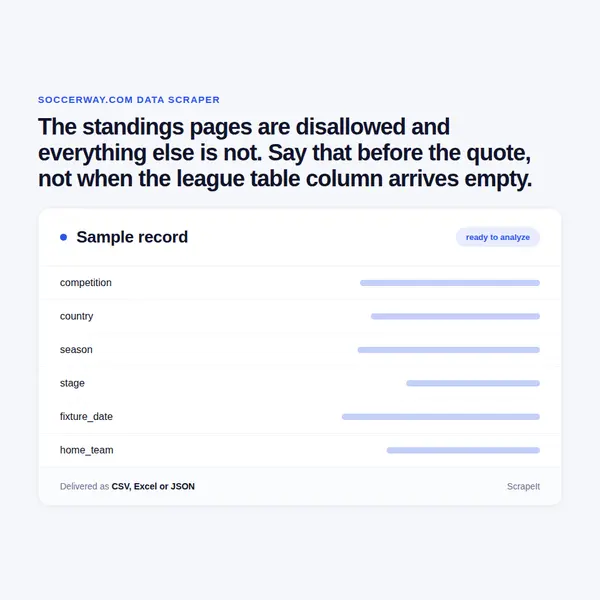
The standings pages are disallowed and everything else is not. Say that before the quote, not when the league table column arrives empty.

Soccerway Scraper
Solutions

Managed football records, run end to end by us

ScrapeIt runs the collection as a managed service. You name the competitions and seasons; we build the pipeline with competitions, teams, squads and career records as linked entities, keep season on every row, and hand back CSV, JSON, Excel or a push into your warehouse.

Standings are disallowed by the site's crawl rules, so we either compute tables from collected fixtures where the format allows or tell you to source them elsewhere. We say which before quoting.

We collect published records only, honour the crawl rules and pace requests. Competitions are scoped explicitly so youth and amateur data is not swept up by accident. Terms restrict commercial reuse of the content, so the dataset is for analysis rather than republication, and your counsel should see the use case before the project starts.

Soccerway fields in every export

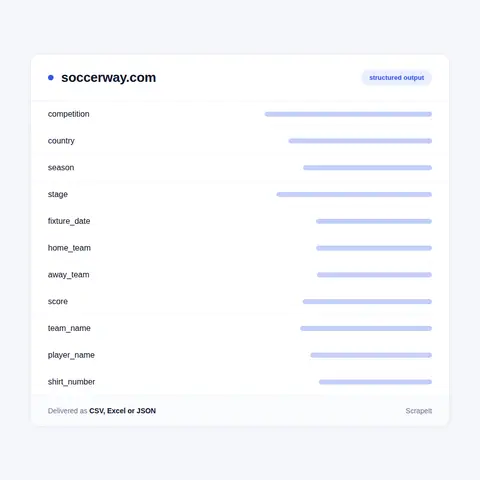
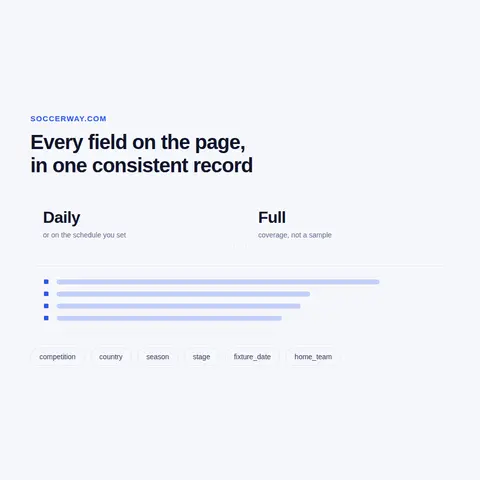
Competition records carry the competition name, country, season, stage and the fixtures within it. Fixture records carry date, kick-off time, home and away teams, score, and the competition and stage they belong to.

Squad records list the players registered to a team in a season with shirt number, position and nationality as published. Career records connect a player to clubs and seasons with appearances, minutes and goals where the source states them.

Season is mandatory on every row that has one. A squad without its season is a squad for no particular year, and career analysis is entirely a question of which season a row belongs to.

Standings are not collected, and the dataset says so rather than leaving an unexplained gap. Where a client needs league tables we compute them from collected fixtures where the competition rules allow, or source them elsewhere, and we say which.

Every row carries the collection timestamp and the source address.

Soccerway fields in every export
Player movement, coverage depth and the standings gap

Player movement, coverage depth and the standings gap

Player movement reconstruction is the analysis this source supports best. A career record across clubs and seasons is a movement history, and aggregated across a division it shows recruitment patterns - which clubs feed which, where players come from and where they go.

Coverage depth mapping answers how far down the pyramid consistent data actually exists per country, which is a practical question before any project that depends on lower divisions. It is worth running first rather than discovering the limits in delivery.

Fixture and result series support schedule and congestion analysis, and where the competition format permits, tables can be computed from results rather than collected - which is how we handle the standings restriction honestly rather than ignoring it.

What stays out of scope is anything not a professional record: no contact information, no personal details beyond what a squad listing publishes, and no youth or amateur competitions unless a client has a specific, defensible reason and has cleared it themselves.

Football records across a very large number of leagues

Soccerway is a football results and statistics database covering an unusually wide range of competitions - not only the major European leagues but lower divisions, national cups and smaller federations that most databases skip entirely.

That breadth is the reason to use it. Coverage of the top five leagues is available in many places; consistent structured records for a second division in a smaller federation are not, and for scouting, betting research and academic work that long tail is frequently the whole point.

The data is organised around three linked things: competitions with their seasons and fixtures, teams with their squads, and players with their appearance records across clubs and seasons. Team pages respond directly with substantial content.

The crawl rules need reading before scoping rather than after. Standings pages are disallowed, as are bracket and newsfeed paths and the sections covering other sports. Football match, team and player records remain open, which is what these projects are for.

Get a Quote
dev_w
25

Developers

customers
500+

Customers worldwide

pages
1 500 000 000+

Pages extracted

stime
15000+

Hours saved for our clients

Plans

Airplane

€199 / one-time

setup fee - included

Data limits100,000
Frequencyone-time
Run timeup to 5 days
Data storing7 days

Helicopter

€169 / mo

setup fee €499

Data limits250,000
Frequencymonthly
Run timeup to 5 days
Data storing14 days

Glasses

€229 / mo

setup fee €499

Data limits1,000,000
Frequencyweekly
Run timeup to 5 days
Data storing30 days

DNA

€549 / mo

setup fee €799

Data limits3,000,000
Frequency3 times daily
Run timesame day
Data storing90 days

Why professional records are not private data

Player data draws a reasonable question about privacy, and it deserves a direct answer rather than a disclaimer.

What this source publishes about a player is a professional record: which clubs they were registered with, in which seasons, how many appearances they made and how many goals they scored. That is the same category of information as a footballer's entry in a match programme, and it is published because it is the public record of a professional activity. It is not contact details, not health information, not anything about private life, and we collect none of those.

Where care is genuinely needed is youth and amateur competitions, because the same database structure that holds a professional's career can hold a sixteen year old's. We scope competitions explicitly rather than crawling everything available, and a brief that would sweep up minors gets flagged at scoping rather than delivered quietly.

The second reason to use this source is the long tail. A dataset limited to major leagues answers major league questions; the value of a broad source is in the divisions and federations nobody else structures consistently.

The third is that career records connect across clubs and countries, which makes player movement analysable without a transfer database - the appearances themselves show where somebody went.

Our Blog

Reads Our Latest News & Blog

Learn how to use web scraping to solve data problems for your organization

How Artificial Intelligence Is Used In Web Scraping

How Artificial Intelligence Is Used In Web Scraping

Leveraging advances in technology, the AI-powered web scraper has skyrocketed in demand and is helping to expand capabilities by automating tedious daily tasks and speeding up data collection from thousands of websites several times over.

What is Web Scraping and What is it Used For?

What is Web Scraping and What is it Used For?

Web scraping is a method of obtaining web data by extracting it from pages of web resources with the help of a program, that is, in automatic mode. It is used to syntactically convert web pages into more usable forms.

Web Scraping for Machine Learning

Web Scraping for Machine Learning

If you specialize in machine learning, you need to feed large amounts of data to the algorithms. Web scraping is the easiest and the most efficient method of collecting the data from all over the Internet.

scrapeit logo

Who builds and keeps your football data feed

ScrapeIt is a managed extraction company, not a tool you have to learn. Our team builds the pipeline, maintains team and player resolution as names are written differently across competitions, and repairs the collector before a season goes unrecorded.

You see a sample first, in your format, over the competitions you actually follow, with squads and career records linked so you can judge the model on a real club rather than on a description.

FAQ

Can you collect league tables?

Not from this source - the standings pages are disallowed by its crawl rules. Where the competition format allows, we compute tables from the fixtures we do collect; otherwise we tell you to source them elsewhere. Either way you hear it before the quote, not when a column arrives empty.

Is player data personal data?

What we collect is a professional record: clubs, seasons, appearances, goals. That is the public record of a professional activity, the same category as a match programme entry. No contact details, no personal life, nothing outside the playing record.

What about youth competitions?

We scope competitions explicitly rather than crawling everything available, because the same structure that holds a professional's career can hold a sixteen year old's. A brief that would sweep up minors gets raised at scoping rather than delivered quietly.

Why is this better than a major-league database?

Only for the long tail, which is usually why people come. Top-five-league coverage exists in many places; consistent structured records for lower divisions and smaller federations do not, and that is where this source earns its place.

Can I track player movement without transfer data?

Largely yes. A career record across clubs and seasons is itself a movement history, and aggregated across a division it shows which clubs feed which. Transfer fees need a transfer source, but movement itself is in the appearances.

How does it Work?

Step 1 - Make a Request

You share your needs, expectations, and desired timeframe. We’ll suggest the best solution based on your request and budget.

Step 2 - Configuring Custom Web Crawlers

Our specialists configure the crawlers and extract a sample dataset for your review before proceeding with the full-scale extraction.

Step 3 - Collect and Deliver

Once you approve the sample, we launch the project and start full data collection. We gather, filter, and structure the data for easy use, delivering it on time in your preferred format.

Step 4 - Maintain and Support

Our team manages ongoing processes, monitors website changes, and supports all data extraction cycles. We can also help integrate data into your systems or create dashboards to simplify analysis.

Request a Quote

Tell us more about you and your project information.
Which sites, which fields, how often. A couple of lines is enough.

We reply within 1 business day. No obligation.

scrapiet

Scrapeit Sp. z o.o.
10/208 Legionowa str., 15-099, Bialystok, Poland
NIP: 5423457175
REGON: 523384582