UEFA Scraper for Competitions, Coefficients and Squad Lists

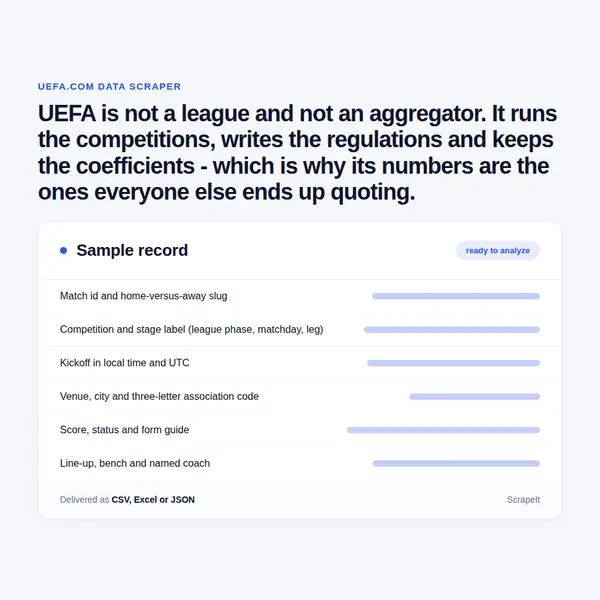
UEFA is not a league and not an aggregator. It runs the competitions, writes the regulations and keeps the coefficients - which is why its numbers are the ones everyone else ends up quoting.

UEFA Scraper
Solutions

Managed UEFA data collection, paced and watched through the season

ScrapeIt runs UEFA scraping as a managed service. You name the competitions, the seasons and the depth; we build the pipeline against the structured layer, pace what we send, and deliver CSV, JSON, Excel or a load straight into your warehouse. The platform answers automated clients unevenly, so the plumbing is part of the job: anti-bot handling, proxy rotation and CAPTCHA solving are included, and we hold one exit region and one timezone so kickoff times and broadcast rows keep their meaning between runs. Nothing behind a sign-in is touched. The player figures we collect are professional sporting statistics about public figures; contact details and private life are not. UEFA's own terms speak directly to automated collection, database building and model training, so scope is agreed with you and your counsel before the first request, and what we hand back is built for internal analysis rather than republication.

Fields a UEFA data export carries, from squad lists to match stats

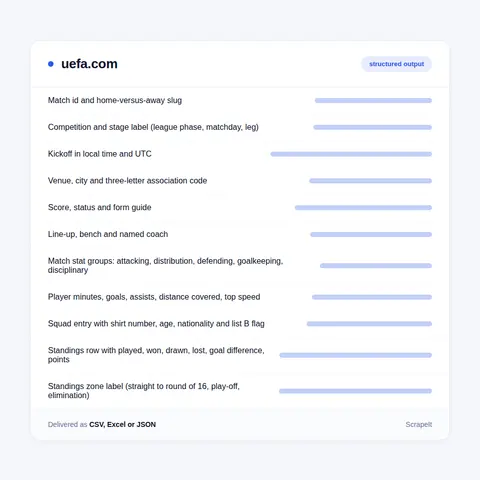
Identity comes first. Every club, national team and match carries a numeric id, and the slug beside it is decoration: one Spanish club is real-madrid-c-f in the English edition and real-madrid everywhere else, while the id never moves. Match addresses follow the same grammar, an id plus a home-versus-away slug, so fixtures join to results without matching strings.

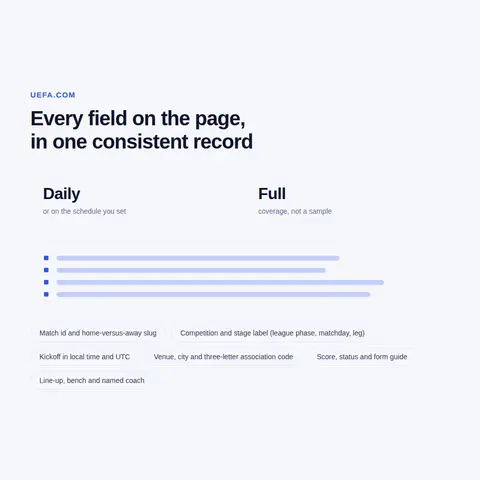
Fixture and result rows carry competition, season, the stage label as UEFA writes it - league phase with a matchday number, second qualifying round with a leg number, knockout phase play-off - plus kickoff, venue with city and a three-letter association code, status, score and the recent form sequence for both sides. Kickoff is rendered in the visitor's own zone, so one zone is pinned and UTC is stored beside local time.

Match detail is split into tabs and we take all of them. The updates feed gives typed incidents on a clock: goals, attempts, corners, direct free-kicks, substitutions naming both players and their positions, second yellows and dismissals. Line-ups give the starting eleven, the coach and the bench with goalkeepers marked. Statistics arrive in the platform's own groups - key stats, attacking, distribution, defending, goalkeeping and disciplinary - and the same grouping repeats in the club and player season tables, which add goals and attempts.

Player season rows are where this source passes the aggregators: minutes played, matches played, goals, assists and then distance covered in kilometres and top speed in km/h, taken from the competition's own tracking, not from a reporter's notebook.

Squad pages group by goalkeepers, defenders, midfielders and forwards and carry shirt number, full and display name, nationality code, age, appearances and goals, or goals conceded for keepers, plus the coach. An asterisk marks a list B player, so registration status comes out with the squad instead of having to be inferred.

Standings arrive as a table plus the zone labels applied to it - straight to the round of 16, seeded and unseeded knockout play-off places, elimination - with played, won, drawn, lost, for, against, goal difference, points and form, and a separate tiebreakers view. Group competitions split into leagues A to D and numbered groups, and every table is flagged provisional until UEFA validates it.

Fields a UEFA data export carries, from squad lists to match stats
Draw pots, disciplinary case law and the regulations library

Draw pots, disciplinary case law and the regulations library

Draw pages are records rather than trailers. Each carries results, a running update feed, the pots as drawn and the written procedure, with host city and date. For the league phase the output is every club against eight opponents, two from each of pots one to four, home and away. Scraping UEFA draws builds the seeding history no results feed keeps.

Published documents are a second dataset. The regulations portal is faceted: competition regulations, technical regulations and guidelines, filed by competition, edition and entry-into-force date, with parallel language versions of the same text. It held about 1,200 documents in September 2026. Handbooks sit behind a sign-in and stay there.

Disciplinary case documents are published as PDFs carrying a case number, the deciding body - the control, ethics and disciplinary body or the appeals body - the club or association concerned, the competition and a last-updated stamp, filterable across more than twenty competitions with an archive behind them. Booking lists, stadium bans and arbitration decisions sit in the same section.

Two more things change what a row means. The match calendar carries a broadcaster country filter covering most of the world, so listings differ by the country you ask from. Language editions sit on their own subdomains in French, German, Spanish, Italian, Portuguese and Russian, with Arabic added on competition sites. Headings, abbreviations, position groups, stage names, form letters and club names are localised; the numeric ids and three-letter association codes are not, which is what keeps the editions reconcilable.

The governing body's own record, not another results site

UEFA is the confederation for European football: 55 member associations, a congress and an executive committee based in Nyon, and the organiser of every competition that carries its name. That is why a UEFA scraper returns material a single league site cannot hold. A league publishes one competition; UEFA publishes a portfolio. On the club side the Champions League, Europa League, Conference League, Super Cup, Youth League and the Under-20 Intercontinental Cup. For national teams the European Qualifiers, Nations League, EURO, Under-21 and the Finalissima. A full women's programme runs beside it, from the Women's Champions League and Women's Europa Cup to the Women's EURO and Women's Nations League. Then Under-19 and Under-17 for boys and girls, the amateur Regions' Cup, and a futsal branch with its own Champions League, EURO and Under-19 title.

Every section is assembled from the same parts, which is what makes UEFA data extraction predictable rather than artisanal: a competition root, then standings, fixtures and results, draws, a competition format page, statistics for players and for clubs, a history branch holding seasons, winners, head to head and all-time rankings, and one page per participating team carrying squad, matches, statistics, qualifying statistics and that team's domestic table. Clubs and national teams are addressed by a numeric id with a readable slug bolted on after it.

The site is a thin shell over a set of named services for matches, standings, statistics, draws and brackets, so the layer worth reading is structured rather than prose. The sitemaps are split the same way: a main index, one file per competition for matches, a second set for published documents, and separate feeds for news and video.

Get a Quote
dev_w
25

Developers

customers
500+

Customers worldwide

pages
1 500 000 000+

Pages extracted

stime
15000+

Hours saved for our clients

Plans

Airplane

€199 / one-time

setup fee - included

Data limits100,000
Frequencyone-time
Run timeup to 5 days
Data storing7 days

Helicopter

€169 / mo

setup fee €499

Data limits250,000
Frequencymonthly
Run timeup to 5 days
Data storing14 days

Glasses

€229 / mo

setup fee €499

Data limits1,000,000
Frequencyweekly
Run timeup to 5 days
Data storing30 days

DNA

€549 / mo

setup fee €799

Data limits3,000,000
Frequency3 times daily
Run timesame day
Data storing90 days

Club and association coefficients: the set that exists nowhere else

Coefficients are why most buyers extract UEFA data at all. No other site can compute them: they are defined in Annex D of the competition regulations and built from results this body has ratified. A club's season coefficient is the points it took in the Champions League, Europa League or Conference League. Its sporting coefficient sums the five most recent seasons, or takes 20% of its association's five-season total, whichever is higher. A separate revenue coefficient runs over ten seasons, for distribution only. An association's figure divides the points won by all its clubs by the number of clubs that entered. Bonus points attach to league phase position and to each knockout round reached, shoot-outs are excluded, and values run to the thousandth without rounding up.

The tables expose all of that: position, club or association, one column per season in the reference window, the total, the association share, and for countries the entered-against-surviving club count. Season selectors reach back around two decades and forward to future editions, a country filter narrows the list, and men's, women's and futsal rankings are separate.

Downstream sits the access list, where coefficients turn into fixtures: how many places each association gets, whether a club enters at league phase, play-offs, third, second or first qualifying round, and by which path. Entries are tagged titleholder, domestic champion, domestic cup winner, European performance slot or rebalancing, and the list stays provisional while licensing and disciplinary matters are open.

Our Blog

Reads Our Latest News & Blog

Learn how to use web scraping to solve data problems for your organization

How Artificial Intelligence Is Used In Web Scraping

How Artificial Intelligence Is Used In Web Scraping

Leveraging advances in technology, the AI-powered web scraper has skyrocketed in demand and is helping to expand capabilities by automating tedious daily tasks and speeding up data collection from thousands of websites several times over.

What is Web Scraping and What is it Used For?

What is Web Scraping and What is it Used For?

Web scraping is a method of obtaining web data by extracting it from pages of web resources with the help of a program, that is, in automatic mode. It is used to syntactically convert web pages into more usable forms.

Web Scraping for Machine Learning

Web Scraping for Machine Learning

If you specialize in machine learning, you need to feed large amounts of data to the algorithms. Web scraping is the easiest and the most efficient method of collecting the data from all over the Internet.

scrapeit logo

Who builds and keeps your European football feed

ScrapeIt is a managed extraction team, not a tool you have to learn. We build the UEFA scraper, watch it through qualifying, the league phase and the knockout rounds, and repair it before the next draw rather than after it. You see a sample first, in your format, with the competitions, coefficients and squad lists you actually asked for, so you can judge it on real rows. A UEFA scraper price follows the plan you choose and the competitions in scope, not the number of pages we happen to load.

FAQ

Does UEFA have a public API we could use instead?

There is no published developer programme, no keys and no documented UEFA API offered to third parties. The site is served by internal services for matches, standings, statistics, draws and brackets, and those exist to render uefa.com rather than to be consumed by anyone else. So we work from what is published: the competition pages, the sitemaps split by competition, matches and documents, and the structured responses behind the rendered views. That is stable enough to run on and gentler on the platform than driving a browser across every page.

Which competitions can you cover, and do the women's and futsal ones count?

All of them, because they share one page skeleton. Club competitions, national team competitions, the women's programme end to end, Under-21, Under-19 and Under-17 for both sexes, the amateur Regions' Cup and the futsal branch all expose the same standings, fixtures, draws, team and statistics pages. Qualifying rounds are included, which matters: a large share of matches in a season is played before the league phase starts, and those rounds carry the coefficient points that decide seeding later.

How far back do the coefficients and historical seasons go?

The coefficient season selectors reach back around two decades and forward to future editions, and both the five-season sporting coefficient and the ten-season revenue coefficient are published side by side. Competition history branches add seasons, winners and finals, head to head, all-time rankings and a club list far longer than the current entry list, since it holds every club that ever played. Past seasons do not change, so the backfill is collected once and never revisited.

What exactly is in a squad list export?

Per team and per competition: shirt number, full name and display name, nationality code, age, position group, appearances and goals, goals conceded for goalkeepers, and the coach with his nationality. List B players are flagged separately from the main registration, and squad changes are published as their own article during the season, so a client tracking eligibility gets both the current state and the amendments. We do not collect contact details, addresses or anything about players' private lives.

Can we republish the tables, coefficients and statistics?

Treat that as a legal question rather than a technical one. Competition data is a protected compilation, and the platform's own terms address systematic collection, database building, redistribution and training models on the content directly and restrictively. We therefore agree scope with you before the project starts and build the dataset for internal analysis and product work. If your plan is to publish tables or coefficients, or to feed anything touching betting, get your own counsel's view first.

How does it Work?

Step 1 - Make a Request

You share your needs, expectations, and desired timeframe. We’ll suggest the best solution based on your request and budget.

Step 2 - Configuring Custom Web Crawlers

Our specialists configure the crawlers and extract a sample dataset for your review before proceeding with the full-scale extraction.

Step 3 - Collect and Deliver

Once you approve the sample, we launch the project and start full data collection. We gather, filter, and structure the data for easy use, delivering it on time in your preferred format.

Step 4 - Maintain and Support

Our team manages ongoing processes, monitors website changes, and supports all data extraction cycles. We can also help integrate data into your systems or create dashboards to simplify analysis.

Request a Quote

Tell us more about you and your project information.
Which sites, which fields, how often. A couple of lines is enough.

We reply within 1 business day. No obligation.

scrapiet

Scrapeit Sp. z o.o.
10/208 Legionowa str., 15-099, Bialystok, Poland
NIP: 5423457175
REGON: 523384582