Charter Flight Data from 12 Danish Tour Operators: a Pilot in 2 Weeks
A paid pilot for a regional airport in Scandinavia: direct charter departures from 12 Danish tour operator sites, sampled in two weeks.
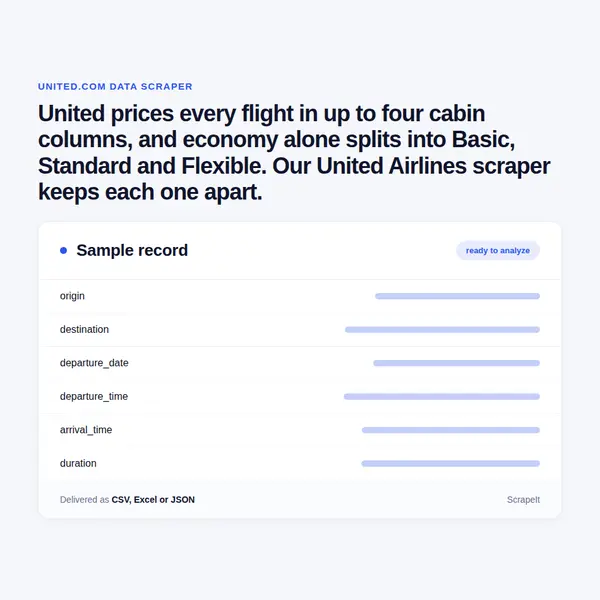
United prices every flight in up to four cabin columns, and economy alone splits into Basic, Standard and Flexible. Our United Airlines scraper keeps each one apart.
Plans from €169 a month · Free project assessment · Reply within 1 business day
CSV · Excel · JSON · XML · FTP · SFTP · Amazon S3 · Google Cloud
API, JSON feed or CSV, XLSX and JSON files
ScheduleOne-time, monthly, weekly, daily or 3 times a day
United Airlines pages, filters, fields and a schedule
Built, monitored and repaired by our team
API, JSON feed or CSV, XLSX and JSON files
You tell us which United routes, travel dates and cabins matter, and how far ahead to look - next week only, or every departure date for the coming months. We build the crawler around the united.com search, which takes origin, destination, date, trip type and passenger count, run it on your schedule and fix it when United changes the page. Anti-bot handling - pacing, proxy rotation, CAPTCHA handling and page rendering - comes with the service.
Nothing is booked and no traveller details are entered: every fare comes from a plain search, the same one a visitor runs before choosing a seat. Each row carries the search date and the time of collection, so a fare seen on Monday and the same fare on Friday stay two separate observations. Field documentation comes with the first file, and a sample can be ordered before any schedule is agreed.
A united.com result is a grid: one line per flight or connection, and across it a column per cabin with a From price or the words Not available. Open a cabin and its fare options appear, each with its own price and rules. We keep that structure, so a row is one itinerary, one cabin and one fare option on one search date.
United notes above the grid that fares are for the entire one-way trip, per person, so we store them exactly that way and keep the bag charge as a flag rather than a price, as the page itself does.
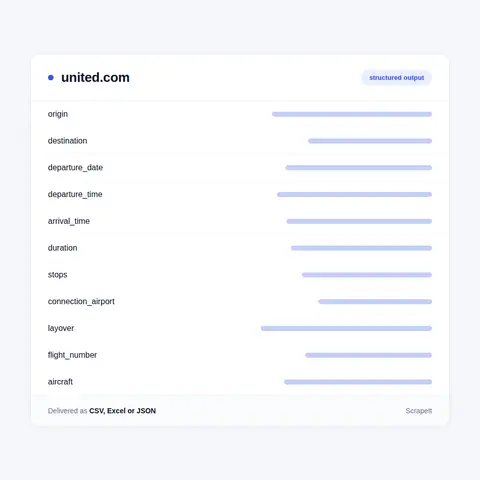
One search is one snapshot. A United Airlines price history comes from running the same searches again - the same origin, destination and departure dates every day or every few hours - and stacking the results by flight number, cabin and fare option. That shows when Basic Economy disappears from a flight while Standard is still offered, how the gap between Economy Plus and United Premium Plus moves as departure nears, and which dates on a route stay cheap. Laid out by departure date, the table becomes a price calendar for the route; read across collection dates, it is the ticket price history of each departure.
Flight status pages add the operational layer: status such as On time, scheduled and estimated times, terminal, gate, baggage claim carousel, aircraft type with its fleet number and seat capacity per cabin, all under a Last refreshed stamp. Collected for yesterday's flights, they show which schedules held. Standby and upgrade lists on the same pages name passengers, so we leave them out.
United Airlines is one of the large US network carriers, and united.com is where it sells its own flights alongside the partner flights it can book. The site is organised by language and country - the US edition sits under /en/us/ and prices in dollars, with Español as the second language - and the search form asks for origin, destination, dates, travellers and whether prices should show in money or miles.
What makes the data distinctive is how United layers a fare. The first layer is the cabin: United Economy, Economy Plus, United Premium Plus, and United Polaris business - or United First, which takes its place on many domestic flights. The second is the fare option inside the cabin - Basic Economy, Standard, Flexible - which changes refunds, changes, seat choice, carry-on and miles earned without changing the seat itself. Two passengers in the same row can hold fares that differ in price and rules, and the page shows both side by side.
Regional flying under the United Express name is operated by partners such as SkyWest and is marked on the result. Award prices in miles sit behind the MileagePlus sign-in, so the public layer is the cash fare grid, the fare rules, the miles each fare earns and flight status.
Delivery: CSV, JSON or XLSX files, our API or a JSON feed. MCP server on request.
Full plan detailsAirlines and their pricing teams compare United's fares by cabin and fare option against their own on shared routes: if United's Standard fare on a hub route drops below a rival's lowest fare, it shows up in the rows the morning it happens. Whether United Airlines prices are going up on a route ahead of a holiday shows in the same daily data.
Corporate travel managers and travel management companies use the fare rules more than the prices. The difference between Basic Economy and Standard - no carry-on bag, no changes, seat choice only for a fee - decides what a travel policy should allow, and the premium of Flexible over Standard puts a price on refundability for each route.
Other uses follow the fields: fare tracker products and alert services for travellers, loyalty analysts measuring MileagePlus miles and PQP earned per dollar by fare, sustainability teams pulling the carbon emissions estimate per flight and aircraft type, and airport or tourism bodies watching which nonstop routes United flies and with which aircraft.
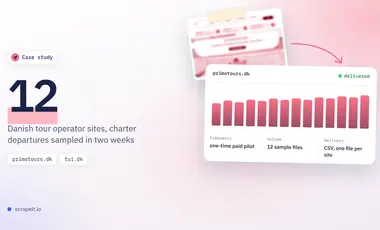
A paid pilot for a regional airport in Scandinavia: direct charter departures from 12 Danish tour operator sites, sampled in two weeks.
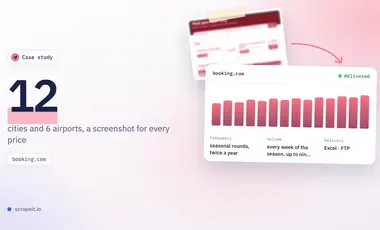
For several years, weekly car rental and, more recently, hotel prices from Booking.com for a tourism organization comparing its destination with rivals.
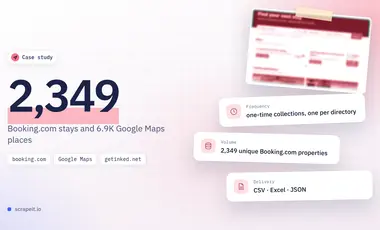
Four datasets for a studio that builds directory websites: Hawaii stays from Booking.com, UK schools and tattoo studios from Google Maps, GetInked profiles.
Learn how to use web scraping to solve data problems for your organization
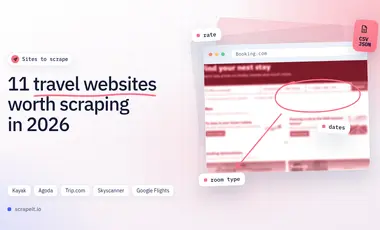
If you work in travel tech, an OTA, a hotel chain, or at an airport, you are in a price-and-availability arms race. Fares change by the hour, room inventory disappears in minutes, and competitors test new bundles and ancillaries constantly.
Data scraping is the wide term that includes documents, scans and old screens; web scraping is the part that works on websites. We compare sources, daily work, output and cost drivers, give a briefing checklist and walk through two of our projects.

Leveraging advances in technology, the AI-powered web scraper has skyrocketed in demand and is helping to expand capabilities by automating tedious daily tasks and speeding up data collection from thousands of websites several times over.

ScrapeIt is a managed web scraping service: we build, run and maintain the crawlers, and you receive the data. Airline sites are some of the most demanding work we do, because a single route and date opens into cabins, fare options and rules that move between one search and the next. For United we deliver the fare grid as rows you can load without reshaping - CSV, Excel, JSON or our API - with personal data handled under GDPR and passenger names left out. Plans start from EUR 169 a month, or EUR 199 for a one-time extract.
Still unsure? Write to info@scrapeit.io
Yes. The ScrapeIt United Airlines API returns flight number, aircraft, cabin, fare option, price and MileagePlus miles earned as JSON from an endpoint we host, refreshed on the schedule you set. The same rows also arrive as CSV or XLSX files, a JSON feed or a direct load into your database.
Yes. Fares, fare rules, schedules and flight status are shown on united.com to any visitor who runs a search. We collect only publicly available data - everything a visitor can see on United Airlines - and we collect it legally.
Yes. We repeat your route and date searches daily or several times a day and key each row on flight number, cabin and fare option, so every change in a fare lands as a new dated record. You choose the routes and how many departure dates ahead to watch.
Yes, through the flight status pages: status, scheduled and estimated departure and arrival, terminal, gate and baggage claim carousel, plus aircraft type and fleet number. Collected on a schedule, they build an on-time record per flight number.
Yes. Every cabin opens into its own fare options, and we store Basic Economy, Standard and Flexible as separate rows with their prices, change and refund rules, carry-on allowance and the miles and PQP each one earns. That lets you price the restrictions, not just the seat.
You share your needs, expectations, and desired timeframe. We'll suggest the best solution based on your request and budget.
Our specialists configure the crawlers and extract a sample dataset for your review before proceeding with the full-scale extraction.
Once you approve the sample, we launch the project and start full data collection. We gather, filter, and structure the data for easy use, delivering it on time in your preferred format.
Our team manages ongoing processes, monitors website changes, and supports all data extraction cycles. We can also help integrate data into your systems or create dashboards to simplify analysis.
Tell us which sites, which fields and how often. A couple of lines is enough to start.
United Airlines data from €169/month. Free project assessment, reply within 1 business day.